How Excavator Bucket Choice Affects Output
Choosing the right excavator bucket can directly affect digging speed, fuel efficiency, material handling, and overall jobsite productivity. For buyers comparing an excavator for sale, planning excavator rental, or sourcing excavator parts, understanding bucket selection is essential for better output and lower operating costs. This guide explains how the right excavator bucket supports excavator for construction projects and helps procurement teams make smarter equipment decisions.
In the road transport equipment and heavy machinery supply chain, bucket choice is not a minor attachment issue. It directly influences machine utilization, truck loading cycles, undercarriage stress, and total cost per cubic meter moved. For procurement teams, distributors, and commercial evaluators, the bucket is a productivity variable that should be reviewed alongside machine weight, hydraulic flow, arm length, and spare parts availability.
On international B2B sourcing platforms, buyers often compare complete excavators, rental-ready units, and excavator parts at the same time. A well-matched bucket can shorten cycle times by 10% to 25% in suitable ground conditions, while a poor match can increase fuel burn, wear rates, and downtime. That is why bucket selection deserves a structured evaluation rather than a last-minute accessory decision.
Why Bucket Selection Has a Direct Impact on Output
Excavator output is usually measured by hourly production, loading efficiency, and operating cost over a shift of 8 to 12 hours. The bucket sits at the center of all three. If the bucket is too large for the machine and material density, breakout force drops, cycle time rises, and the operator spends more time correcting bucket fill. If the bucket is too small, the excavator performs more cycles to move the same volume, increasing fuel consumption and reducing site throughput.
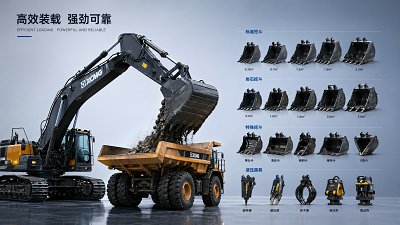
Bucket geometry matters as much as bucket volume. A narrow rock bucket with reinforced side cutters performs differently from a general-purpose digging bucket, even if the nominal capacity is similar. In clay, wet soil, aggregate, demolition waste, and trenching applications, fill factor can vary from around 70% to 110%, depending on material flow and operator technique. That means two buckets with the same listed capacity may deliver very different real-world output.
For buyers involved in construction logistics, the effect extends beyond the excavator itself. A bucket that matches the truck body volume and haul schedule can improve truck loading consistency. For example, reducing one loading pass per truck across 30 to 40 truck movements per day creates measurable savings in labor time, queue delays, and idle engine hours.
Another important factor is fuel efficiency. When a machine operates with repeated overload, the hydraulic system works harder, engine load remains higher for longer periods, and the operator often compensates with more throttle. Even a 5% to 12% increase in average fuel use across a fleet becomes significant over a quarter, especially on infrastructure or mining-adjacent projects with long operating cycles.
Core Output Variables Influenced by the Bucket
- Cycle time per load, often measured in seconds or minutes depending on digging depth and swing angle.
- Bucket fill factor, which can differ by 20% or more across loose soil, compacted ground, and blasted rock.
- Fuel use per cubic meter moved, especially important in multi-shift or rental operations.
- Wear life of teeth, side cutters, pins, bushings, and bucket shell plates.
The table below outlines how common bucket mismatches affect output and operating stability in typical construction and material handling work.
The key takeaway is simple: output losses are often caused by mismatch rather than machine power alone. Procurement teams that evaluate bucket fit early can avoid avoidable costs during the first 3 to 6 months of operation.
How to Match Bucket Type to Material and Application
The first step in bucket selection is defining the dominant application. A contractor doing road foundation excavation, pipe trenching, quarry loading, or municipal utility work does not need the same bucket configuration. Material density, moisture level, abrasiveness, and fragmentation all influence the correct bucket shape, reinforcement level, and edge package.
General-purpose buckets are commonly used for mixed soil, sand, and light aggregate. Heavy-duty buckets add thicker wear plates and stronger lips for compacted ground and more abrasive conditions. Rock buckets use heavier structure, reinforced corners, and specialized teeth for blasted stone or quarry applications. Trenching buckets are narrower, often selected for clean profile work where width control matters more than bulk volume.
For dealers and distributors, this classification matters during quotation. Buyers often ask for the largest available bucket because it appears to promise more capacity. In reality, a 20-ton excavator working in dense clay may perform better with a moderate-capacity heavy-duty bucket than with a larger general-purpose unit that never achieves full fill. Correct matching supports consistent cycle times and reduces operator correction movements.
Attachment interchangeability should also be checked. Pin size, pin center, dipper width, linkage geometry, and coupler compatibility can affect installation. A sourcing team that confirms 4 to 6 fitment points before ordering reduces the risk of rework, field modification, or delivery delay.
Typical Bucket Choices by Job Type
The following comparison can help buyers align bucket type with actual field demand rather than catalog assumptions.
For B2B buyers managing multiple project types, a two-bucket strategy is often more efficient than overloading one bucket with every task. One high-volume bucket for loose material and one reinforced bucket for difficult ground can improve utilization over a 12-month operating period.
Practical Selection Checklist
- Confirm machine operating weight and hydraulic capability.
- Define the main material: loose soil, compacted clay, aggregate, rock, or mixed waste.
- Estimate average haul unit size, such as truck body volume or batch loading target.
- Review wear part supply lead time, especially for teeth, adapters, and side cutters.
- Check coupler and pin fitment before final purchase order approval.
Key Parameters Procurement Teams Should Compare
When evaluating an excavator for sale, rental fleet additions, or replacement excavator parts, buyers should compare more than bucket capacity alone. Capacity is only one line in the specification sheet. Weight, width, material grade, side wall thickness, tooth system, and compatibility with the target excavator are all critical to output and maintenance planning.
A common benchmark is matching bucket capacity to machine class. For example, mini excavators may use buckets well below 0.5 cubic meters, while mid-size construction excavators can operate in a range around 0.8 to 1.5 cubic meters depending on the application. These are typical ranges rather than fixed rules, because dense material and tough ground often require a lower-capacity but stronger bucket to keep actual productivity stable.
Wear package design should not be overlooked. In abrasive environments, replacing a thin bucket after short service life can cost more than buying a reinforced option initially. Commercial evaluators should calculate not only purchase price but also expected wear life, service intervals, and the availability of local or regional spare parts over 6 to 18 months.
For distributors and agents, specification clarity also reduces return disputes. A quotation should define bucket type, volume, installed weight, edge protection, compatible machine tonnage, and tooth configuration. This level of detail supports better cross-border transactions and clearer supplier comparison on international B2B platforms.
Important Comparison Factors
The table below highlights practical parameters that influence performance, fitment, and cost control during procurement.
A disciplined parameter review helps procurement teams compare suppliers fairly. It also improves total lifecycle planning, especially when fleet utilization exceeds 1,500 to 2,000 working hours per year.
Common Buying Mistakes
- Selecting by quoted volume only and ignoring bucket weight.
- Using a rock bucket for every job, which may reduce efficiency in loose material.
- Skipping fitment confirmation because the machine tonnage looks similar on paper.
- Not checking wear part lead time for remote or export destinations.
Bucket Choice, Maintenance Planning, and Total Operating Cost
Output is not only about speed. Long-term productivity depends on whether the bucket supports stable maintenance intervals and predictable spare parts consumption. A bucket working outside its intended material range often shows rapid tooth loss, cracked weld areas, side wall thinning, and bushing wear. These issues can turn a productive excavator into an unreliable asset within a few hundred hours.
For rental fleets, the wrong bucket can create hidden costs because operators and job conditions vary from site to site. A reinforced bucket may have a higher upfront cost, but it can reduce service interventions during the rental period. For owned fleets, standardizing 2 to 3 bucket types across similar excavator classes can simplify spare parts stocking and improve maintenance scheduling.
Maintenance planning should include inspection frequency. In moderate soil work, a visual check every 50 operating hours may be enough for teeth and cutting edge wear. In abrasive rock or demolition conditions, checks may be needed every 20 to 30 hours. Early replacement of small wear parts is usually less expensive than repairing a damaged bucket shell or worn adapter seats.
Commercially, the most useful metric is total cost per hour or per cubic meter moved. This combines fuel, wear parts, labor efficiency, and downtime risk. A lower purchase price can become a higher operating cost if service life is short or output remains below plan during high-demand construction periods.
Maintenance and Cost Control Priorities
- Track tooth wear and edge condition at fixed hour intervals.
- Record average fuel use before and after bucket changes.
- Compare actual loading cycles per truck with planned loading cycles.
- Keep critical excavator parts such as pins, bushings, and teeth kits available locally.
The following matrix can help buyers connect bucket specification choices with maintenance and cost outcomes.
For buyers managing fleets across logistics, municipal engineering, and infrastructure development, maintenance-friendly bucket choices can be just as valuable as faster digging rates. Reliable uptime is often the difference between meeting delivery schedules and absorbing penalty costs.
Procurement Strategy for Buyers, Distributors, and Evaluators
A strong procurement strategy starts with clear technical requirements and ends with supplier comparison that includes delivery, support, and spare parts continuity. On a global heavy equipment B2B platform, buyers can compare excavators, attachments, trailers, truck-related transport solutions, and replacement parts in one workflow. This is valuable because bucket performance is linked to the broader construction transport chain, especially where excavators and heavy trucks operate together.
For procurement personnel, one practical approach is to evaluate suppliers across 4 dimensions: technical fit, commercial terms, lead time, and after-sales support. Technical fit includes machine compatibility, material suitability, and wear package details. Commercial terms include price, MOQ, payment structure, and shipping terms. Lead time often ranges from 2 to 6 weeks depending on stock status and customization. After-sales support includes spare parts supply, documentation, and response time for fitment issues.
Distributors and agents should also consider local demand patterns. In some markets, trenching buckets and municipal construction attachments may move faster than quarry-grade rock buckets. In others, contractors prioritize heavy-duty configurations due to road expansion and aggregate handling demand. Product mix decisions should follow actual regional project activity rather than generic global trends.
Business evaluators can improve decision quality by requesting operating context from end users before sourcing. Asking about soil condition, expected daily truck loads, excavator tonnage, and planned operating hours per month provides a much stronger basis for attachment selection than asking only for a price list.
Recommended B2B Evaluation Process
- Define the excavator class, application, and target output requirement.
- Collect 2 to 4 supplier quotations with complete specification sheets.
- Verify fitment dimensions, wear parts package, and delivery window.
- Compare lifecycle cost, not only ex-factory or landed purchase price.
- Confirm support for excavator parts replenishment after first delivery.
FAQ for Procurement-Oriented Search Intent
How do I choose the right excavator bucket size? Start with machine operating weight, then adjust for material density and application. In dense or abrasive material, a slightly smaller reinforced bucket often outperforms a larger light-duty unit over an 8-hour shift.
Is one bucket enough for all construction jobs? Usually not. Contractors handling both loose soil and compacted ground often gain better output with 2 specialized buckets rather than 1 compromise bucket.
What should buyers check before ordering from overseas suppliers? Confirm pin size, pin center, dipper width, bucket weight, tooth system, and spare parts lead time. These 6 checks reduce fitment and service risk.
How long is a typical bucket delivery cycle? Standard stock items may ship within 7 to 15 days, while customized heavy-duty or export-packed orders may require 3 to 6 weeks depending on production scheduling and transport mode.
The best sourcing outcomes come from combining technical clarity with platform-based supplier comparison. For companies involved in commercial vehicles, heavy equipment, and construction transport, this approach supports better purchasing accuracy and smoother global trade collaboration.
Final Decision Guidance for Better Excavator Performance
Excavator bucket choice affects far more than digging. It shapes hourly output, truck loading rhythm, fuel efficiency, wear rates, maintenance planning, and the reliability of your wider construction and transport operation. For buyers reviewing an excavator for construction projects, bucket selection should be treated as a core performance decision, not a secondary accessory choice.
The most effective selection process is straightforward: match the bucket to machine class, material type, wear conditions, and real operating targets. Compare at least 4 technical and commercial dimensions, check fitment before shipment, and account for spare parts continuity over the first 6 to 12 months of use. That is how procurement teams reduce risk and improve equipment return.
For information researchers, purchasing staff, business evaluators, and distributors, a trusted global B2B platform can simplify this process by connecting product sourcing, supplier comparison, and industry insight in one place. Whether you are sourcing excavators, attachments, trailers, or heavy equipment parts, structured decision-making leads to stronger output and more dependable project execution.
If you are comparing suppliers or planning your next equipment purchase, contact us to get tailored sourcing support, discuss excavator bucket configurations, and explore more heavy equipment solutions for global construction and transport operations.
Trending News
- Are Energy-Saving Excavators Worth It for Long-Term Operations?
- Dump Truck Supplier With Quick Delivery: What to Verify First
- Choosing Commercial Vehicle Parts for Cold Storage Reliability
- How ISO Certification Reduces Supplier Risk in Heavy Truck Chassis
- Cab Chassis Truck for Fire Department: Key Fitment Points
Tag
Recommended News
 Technology & InnovationAre Energy-Saving Excavators Worth It for Long-Term Operations?Excavator manufacturer with energy-saving features: discover if lower fuel use, reduced downtime, and stronger long-term ROI make these machines the smart choice for demanding operations.
 Technology & InnovationSouth China Pioneer Studio Wins Youth May 4th Award for Smart Truck CertificationSmart truck certification breakthrough: South China Pioneer Studio wins Youth May 4th Award for EU R155/R156 compliance — a game-changer for global陆路运输设备 exports.
 Technology & InnovationL4 Autonomous Container Trucks Begin Trial on Tianjin Port–Xiong'an CorridorL4 autonomous container trucks begin trial on Tianjin Port–Xiong'an Corridor—key milestone for cross-border logistics, heavy-equipment transport & smart intermodal supply chains.
 Technology & InnovationQuick Installation Excavators: Do They Reduce Setup Time on Real Sites?Excavator manufacturer with quick installation: discover whether fast-deploy excavators truly cut real-site setup time, lower labor costs, and improve uptime before you buy.
 Technology & InnovationModular Flatbed Trailers: When Design Flexibility Improves UtilizationFind out how a flatbed trailer supplier with modular design helps fleets boost utilization, adapt to varied loads, cut idle assets, and improve long-term ROI.
 Technology & InnovationPortable Construction Machinery: Where Flexible Equipment Saves TimeConstruction machinery supplier with portable options helps cut relocation time, improve transport efficiency, and keep projects moving faster across changing job sites.
 Technology & InnovationSemi Trailer Manufacturer with Lightweight Design: Is Lower Weight Worth It?Semi trailer manufacturer with lightweight design: discover when lower weight boosts payload, fuel savings, and fleet ROI—and when durability, compliance, and repair costs matter more.
![]() Technology & InnovationWhy Quick Installation Matters When Choosing an Excavator ManufacturerExcavator manufacturer with quick installation: discover how faster setup cuts downtime, simplifies maintenance, improves reliability, and keeps heavy equipment projects on schedule.
Technology & InnovationWhy Quick Installation Matters When Choosing an Excavator ManufacturerExcavator manufacturer with quick installation: discover how faster setup cuts downtime, simplifies maintenance, improves reliability, and keeps heavy equipment projects on schedule. Technology & InnovationHow Modular Design Changes the Value of a Flatbed Trailer SupplierFlatbed trailer supplier with modular design: discover how modular platforms cut lifecycle costs, boost fleet flexibility, and improve ROI for logistics, construction, and industrial buyers.
 Technology & InnovationHow Portable Construction Machinery for Mining Helps Remote Projects Move FasterConstruction machinery for mining helps remote projects move faster with easier transport, quick setup, and flexible deployment. Learn how to cut delays and improve site efficiency.
 Technology & InnovationTruck Tipper OEM: How Custom Body Design Changes Worksite PerformanceTruck tipper OEM solutions with custom body design can boost unloading efficiency, durability, and site safety. Learn how to compare suppliers and choose the right fit for demanding jobs.
 Technology & InnovationHow Energy-Saving Features Change Excavator Value Over TimeDiscover how an excavator manufacturer with energy-saving features can lower fuel costs, improve uptime, and boost resale value with a smart long-term buying checklist.
 Technology & InnovationDo Energy-Saving Features Really Matter in an Excavator ManufacturerExcavator manufacturer with energy-saving features: learn how to verify fuel savings, uptime, service support, and ROI before choosing the right supplier.
 Technology & InnovationKunming Blue Jacaranda-Themed Buses Launch with Domestic V2X & LMPF BatteryKunming's blue jacaranda buses feature domestic V2X & LMPF battery tech — a proven, export-ready blueprint for urban transit and airport GSE suppliers targeting Middle East & LATAM markets.
 Technology & InnovationPortable Construction Machinery: Where Flexible Equipment Delivers More ValueConstruction machinery supplier with portable options: use this practical checklist to compare mobility, setup, service, and lifecycle value for faster, smarter project decisions.
 Technology & InnovationHow Construction Machinery for Mining Is Shifting Toward Higher UptimeConstruction machinery for mining is shifting from raw power to higher uptime. Learn how smarter maintenance, diagnostics, and parts support help cut risk, control costs, and improve project performance.
 Technology & InnovationHow a Truck Cement Manufacturer Controls Tank and Discharge QualityTruck cement manufacturer insights: learn how leading factories control tank strength, weld quality, pressure testing, and discharge performance to improve safety, uptime, and sourcing confidence.
 Technology & InnovationWhen Portable Construction Machinery Makes More Sense for Remote ProjectsConstruction machinery supplier with portable options: learn when compact, mobile equipment is the smarter choice for remote projects, cutting transport costs, delays, and setup time.
 Technology & InnovationWhy R&D Capability Matters in a Heavy Truck Chassis ManufacturerHeavy truck chassis manufacturer with R&D capability: discover how stronger engineering improves durability, customization, compliance, and fleet uptime for global B2B sourcing.
 Technology & InnovationPortable Construction Machinery for Infrastructure Projects: What Works BestConstruction machinery supplier for infrastructure buyers: discover the best portable machines for roads, utilities, and municipal projects to boost mobility, uptime, and cost control.
 Technology & InnovationWhen a BULLDOZER for Road Construction Delivers Better Site EfficiencyBULLDOZER for road construction buying guide: learn how the right machine improves grading accuracy, reduces downtime, and boosts site efficiency for faster project delivery.
 Technology & InnovationExcavator Attachment Choices That Can Slow a Job Instead of HelpingExcavator attachment mistakes can delay truck loading and raise costs. Learn how excavator bucket choice, excavator rental, excavator for sale, and excavator parts affect productivity.
 Technology & InnovationTC521 Advances Smart Heavy-Duty Truck Remote Diagnostics StandardTC521 advances smart heavy-duty truck remote diagnostics: ISO 27145-2 compliance, EU/UAE/GCC type approval readiness — act now to avoid certification delays.
 Technology & InnovationTruck control unit faults that look mechanical at firstTruck control unit faults often mimic truck steering system, truck fuel system, and truck cooling system failures. Learn how to avoid wrong truck pump parts orders and cut downtime.
 Technology & InnovationTC521 Launches Pre-Research on Remote Diagnostics Interface Standard for Smart Heavy-Duty TrucksRemote diagnostics interface standard pre-research launched for smart heavy-duty trucks — align with ACEA R19-2025 & ISO 27145 now to secure EU market access.