Do Energy-Saving Features Really Matter in an Excavator Manufacturer
For finance decision-makers, choosing an excavator manufacturer with energy-saving features is not just about sustainability—it is about controlling long-term operating costs, improving fleet efficiency, and protecting return on investment. As fuel prices, maintenance expenses, and project margins continue to face pressure, understanding whether these features deliver real financial value can directly influence smarter equipment sourcing decisions.
Why a checklist approach works better for financial evaluation
When evaluating an excavator manufacturer with energy-saving features, finance teams should avoid relying on broad marketing claims such as “lower fuel use” or “green technology.” Those statements may sound attractive, but capital approval depends on measurable impact: total cost of ownership, payback period, uptime, maintenance intervals, resale value, and supplier credibility. A checklist approach helps convert technical language into budget logic.
This is especially important in the road transport equipment and heavy machinery ecosystem, where procurement decisions often influence multiple cost centers at once. A machine with proven energy-saving functions may reduce fuel spend, but if parts are expensive or service access is poor, the financial case weakens. The right method is to verify savings across the full operating cycle, not just the purchase stage.
First checklist: what to confirm before comparing suppliers
Before requesting quotations, decision-makers should clarify a short list of internal financial and operational assumptions. This prevents comparing machines that are not aligned with actual usage conditions.
- Annual operating hours: Fuel-saving value depends heavily on utilization. A high-hour machine creates faster ROI than a lightly used unit.
- Typical job profile: Excavation in mining, municipal work, infrastructure development, or loading applications creates different idle ratios, cycle patterns, and engine loads.
- Fuel cost baseline: Calculate current average fuel price by region and likely price volatility over the next three to five years.
- Planned ownership period: A buyer holding the unit for seven years evaluates value differently from a contractor rotating equipment after three years.
- Maintenance structure: Confirm whether servicing is handled in-house, by dealer network, or through full-service contracts.
- Residual value expectations: Energy-efficient models may command stronger resale demand, but only if brand acceptance and support remain stable.
These inputs create the base model needed to determine whether an excavator manufacturer with energy-saving features truly improves return on invested capital.
Core decision checklist: how to judge whether energy-saving features really matter
1. Check whether the fuel-saving claim is linked to a specific system
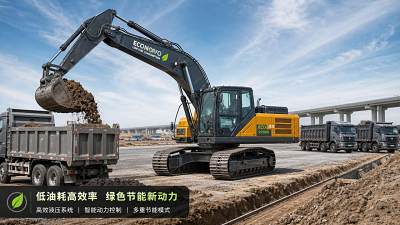
The first judgment standard is simple: savings must come from identifiable engineering, not generic positioning. Useful systems may include smart hydraulic control, auto-idle, engine speed optimization, load-sensing hydraulics, electronic power matching, variable displacement pumps, or work-mode management. Ask the excavator manufacturer with energy-saving features to show which systems create savings, under what operating conditions, and how much each contributes.
2. Verify fuel reduction using real operating data, not brochure percentages
A quoted “15% lower fuel consumption” means little without context. Finance reviewers should ask for field test comparisons against similar tonnage machines in similar applications. Request fuel burn per hour, per cubic meter moved, or per completed cycle. The best suppliers can provide telematics-backed records, customer case studies, or side-by-side project data. If the excavator manufacturer with energy-saving features cannot show methodology, treat the claim as unproven.
3. Compare total cost of ownership, not just fuel expense
Energy-saving technology matters most when it supports a lower total ownership profile. A financially sound comparison should include purchase price, financing cost, fuel, preventive maintenance, wear parts, unscheduled repairs, downtime losses, operator training, and disposal or resale value. Sometimes a model with moderate fuel savings but stronger reliability produces better lifetime economics than a highly advanced machine with expensive service requirements.
4. Evaluate uptime impact as part of the savings case
Energy-saving systems are only valuable if they remain dependable in the field. A technically advanced excavator that suffers frequent sensor faults or software issues can erase fuel savings through lost productivity. Ask for mean time between failures, warranty claim trends, diagnostic support capability, and spare parts lead times. For financial approvers, uptime often carries greater monetary weight than isolated efficiency gains.
5. Confirm operator usability and behavior sensitivity
Some energy-saving features perform well only with disciplined operators. Others are embedded enough to deliver savings regardless of skill level. This distinction matters. If benefits depend on perfect use of work modes, anti-idling routines, or eco-settings, your fleet may capture less than the advertised value. Ask whether the excavator manufacturer with energy-saving features offers operator training, monitoring tools, or telematics dashboards that help sustain performance.
6. Review support network and parts economics
An efficient machine becomes expensive if service delays are long. For buyers sourcing through global industrial channels, support depth matters as much as machine specification. Review dealer presence, technician coverage, service response commitments, and price transparency for filters, pumps, control units, and electronic components. A strong excavator manufacturer with energy-saving features should also demonstrate parts continuity for future years.
Practical scorecard for finance approval
To simplify internal review, use a weighted scorecard. This turns engineering differences into decision-ready inputs for procurement and management teams.
What changes by project type or buyer profile
Not every buyer should value energy-saving functions the same way. The impact depends on fleet structure, project intensity, and budget strategy.
- High-utilization contractors: Fuel savings can justify a premium quickly, especially when machines work long shifts in infrastructure or municipal engineering projects.
- Rental fleet operators: Prioritize simple, durable systems. Features that rely heavily on trained operators may not produce stable returns in multi-user fleets.
- Mining and heavy-duty users: Efficiency is important, but cooling capacity, structural durability, and serviceability may outweigh marginal fuel improvements.
- Cost-sensitive emerging market buyers: A lower upfront price may still win if fuel differentials are modest and local technical support for advanced systems is weak.
- ESG-driven enterprises: An excavator manufacturer with energy-saving features may support internal carbon reporting, but finance teams should still monetize the benefit through reduced fuel use and compliance positioning.
Common blind spots that weaken the business case
Several issues are often overlooked during procurement reviews, even by experienced buyers.
- Assuming all “eco modes” create meaningful savings. In some cases, eco settings reduce productivity enough to offset fuel gains.
- Ignoring idle time management. Excessive idle hours can make operator policy more important than machine specification.
- Not calculating the cost of software-related downtime. Advanced control systems may require specialized diagnostics.
- Underestimating spare parts pricing for electronic and hydraulic control components.
- Failing to test resale assumptions in local secondary markets. Some regions reward efficient brands, while others prioritize mechanical simplicity.
- Comparing unlike classes of equipment. Tonage, bucket size, duty cycle, and attachment use must be normalized.
Execution guide: how to verify claims before signing
If your team is actively sourcing through a commercial vehicle and heavy equipment marketplace, use the following sequence to reduce risk and speed approval:
- Request a three-year or five-year cost model from each shortlisted excavator manufacturer with energy-saving features.
- Ask for reference projects in similar terrain, workload, and climate conditions.
- Require a clear list of standard versus optional efficiency systems.
- Confirm telematics availability for monitoring fuel burn, idle time, and maintenance events.
- Review warranty coverage specifically for fuel-saving electronic and hydraulic components.
- Model best-case, expected-case, and conservative-case savings scenarios for internal budgeting.
- Include service contract terms and spare parts pricing in the same comparison sheet as machine price.
This process improves sourcing transparency and aligns technical evaluation with financial accountability.
FAQ for finance decision-makers
Do energy-saving features always justify a higher purchase price?
No. They justify a premium only when expected savings, uptime, and residual value exceed the added capital cost within your ownership horizon.
What is the fastest indicator of real value?
Reliable fuel consumption data from similar applications is usually the fastest indicator, especially when paired with maintenance cost history and parts support information.
Can a smaller efficiency gain still be financially attractive?
Yes. Even moderate savings can matter if the machine runs many hours, fuel prices are high, or the brand also offers superior reliability and resale value.
Should ESG goals influence the approval process?
Yes, but as a secondary layer. ESG alignment is valuable, yet the core approval should still be based on operating cost control, asset efficiency, and risk reduction.
Final decision guidance
So, do energy-saving features really matter in an excavator manufacturer? For most finance-led procurement decisions, the answer is yes—but only when those features are verified, durable, and linked to measurable lifecycle savings. The best excavator manufacturer with energy-saving features is not the one with the most impressive brochure, but the one that can prove lower operating cost, stable support, and predictable asset performance in your actual application.
If your organization wants to move from general comparison to supplier selection, prioritize discussions around fuel data, application fit, service coverage, spare parts pricing, telematics access, warranty scope, delivery timeline, and expected payback period. For global buyers using a specialized heavy truck and equipment B2B platform, these questions make it easier to compare manufacturers, reduce sourcing uncertainty, and choose a solution that supports both operational efficiency and financial discipline.
Trending News
- Truck Cement Wholesale: What Determines Stable Delivery and Margin?
- Truck Trailer Bulk Order Cost Breakdown for 2026 Budget Planning
- Truck Trailer Sourcing: 7 Checks Before You Compare Suppliers
- Truck Trailer OEM vs ODM: Which Model Lowers Supply Risk?
- How to Evaluate a Heavy Truck Chassis Manufacturer With R&D Capability in 2026
Tag
Recommended News
 Technology & InnovationGlobal Heavy-Duty Autonomous Trucks Near CommercializationHeavy-duty autonomous trucks are nearing commercialization — 200+ L4 vehicles deployed in Saudi & Chilean mines, delivering 120,000+ km fault-free haulage.
 Technology & InnovationWhen to Use an Excavator With Long Reach Boom on SiteEXCAVATOR with long reach boom guide: learn when it adds real value for dredging, demolition, slopes, and drainage jobs to improve safety, access, and site efficiency.
 Technology & InnovationGlobal Heavy-Duty Autonomous Truck Testing Reaches Commercial Inflection PointHeavy-duty autonomous truck testing hits commercial inflection point: 1M km L4 mining ops in Saudi Arabia & Chile — key for OEMs, mining logistics & global off-road transport.
 Technology & InnovationWhat Advanced Technology Means in Heavy Truck Chassis DesignDiscover how a heavy truck chassis manufacturer with advanced technology improves strength, durability, payload efficiency, and integration for demanding transport needs.
 Technology & InnovationChina Adds Tractor-Trailers' Battery-Swap Systems to NEV Bus Subsidy SchemeBattery-swap systems for tractor-trailers now qualify for China’s NEV bus subsidy—up to ¥32,000 per system. Key for logistics, mining & port electrification.
 Technology & InnovationPortable Construction Machinery Supplier: Where Mobility Improves Jobsite OutputConstruction machinery supplier with portable options helps contractors cut mobilization time, improve transport efficiency, and boost jobsite output across road, municipal, and multi-site projects.
 Technology & InnovationChina Adds Heavy-Duty Tractor Battery-Swap Systems to EV Bus Subsidy SchemeHeavy-duty tractor battery-swap systems now qualify for China’s 2026 EV bus subsidy—30% off, up to ¥280,000. Act before Dec 31!
 Technology & InnovationDo Energy-Saving Excavators Lower Fuel Use in Daily Jobsite Operations?Excavator manufacturer with energy-saving features: discover how smarter hydraulics, auto idle, and telematics can cut daily fuel use, improve uptime, and lower jobsite operating costs.
 Technology & InnovationL4 Autonomous Trucks Launch on Tianjin Port–Xiong’an RouteL4 autonomous trucks launch on Tianjin Port–Xiong’an route—first routine platooned operations in China’s strategic logistics corridor. Watch EU & Gulf certification unfold.
 Technology & InnovationAre Energy-Saving Excavators Worth It for Long-Term Operations?Excavator manufacturer with energy-saving features: discover if lower fuel use, reduced downtime, and stronger long-term ROI make these machines the smart choice for demanding operations.
 Technology & InnovationSouth China Pioneer Studio Wins Youth May 4th Award for Smart Truck CertificationSmart truck certification breakthrough: South China Pioneer Studio wins Youth May 4th Award for EU R155/R156 compliance — a game-changer for global陆路运输设备 exports.
 Technology & InnovationL4 Autonomous Container Trucks Begin Trial on Tianjin Port–Xiong'an CorridorL4 autonomous container trucks begin trial on Tianjin Port–Xiong'an Corridor—key milestone for cross-border logistics, heavy-equipment transport & smart intermodal supply chains.
 Technology & InnovationQuick Installation Excavators: Do They Reduce Setup Time on Real Sites?Excavator manufacturer with quick installation: discover whether fast-deploy excavators truly cut real-site setup time, lower labor costs, and improve uptime before you buy.
 Technology & InnovationModular Flatbed Trailers: When Design Flexibility Improves UtilizationFind out how a flatbed trailer supplier with modular design helps fleets boost utilization, adapt to varied loads, cut idle assets, and improve long-term ROI.
 Technology & InnovationPortable Construction Machinery: Where Flexible Equipment Saves TimeConstruction machinery supplier with portable options helps cut relocation time, improve transport efficiency, and keep projects moving faster across changing job sites.
 Technology & InnovationSemi Trailer Manufacturer with Lightweight Design: Is Lower Weight Worth It?Semi trailer manufacturer with lightweight design: discover when lower weight boosts payload, fuel savings, and fleet ROI—and when durability, compliance, and repair costs matter more.
![]() Technology & InnovationWhy Quick Installation Matters When Choosing an Excavator ManufacturerExcavator manufacturer with quick installation: discover how faster setup cuts downtime, simplifies maintenance, improves reliability, and keeps heavy equipment projects on schedule.
Technology & InnovationWhy Quick Installation Matters When Choosing an Excavator ManufacturerExcavator manufacturer with quick installation: discover how faster setup cuts downtime, simplifies maintenance, improves reliability, and keeps heavy equipment projects on schedule. Technology & InnovationHow Modular Design Changes the Value of a Flatbed Trailer SupplierFlatbed trailer supplier with modular design: discover how modular platforms cut lifecycle costs, boost fleet flexibility, and improve ROI for logistics, construction, and industrial buyers.
 Technology & InnovationHow Portable Construction Machinery for Mining Helps Remote Projects Move FasterConstruction machinery for mining helps remote projects move faster with easier transport, quick setup, and flexible deployment. Learn how to cut delays and improve site efficiency.
 Technology & InnovationTruck Tipper OEM: How Custom Body Design Changes Worksite PerformanceTruck tipper OEM solutions with custom body design can boost unloading efficiency, durability, and site safety. Learn how to compare suppliers and choose the right fit for demanding jobs.
 Technology & InnovationHow Energy-Saving Features Change Excavator Value Over TimeDiscover how an excavator manufacturer with energy-saving features can lower fuel costs, improve uptime, and boost resale value with a smart long-term buying checklist.
 Technology & InnovationDo Energy-Saving Features Really Matter in an Excavator ManufacturerExcavator manufacturer with energy-saving features: learn how to verify fuel savings, uptime, service support, and ROI before choosing the right supplier.
 Technology & InnovationKunming Blue Jacaranda-Themed Buses Launch with Domestic V2X & LMPF BatteryKunming's blue jacaranda buses feature domestic V2X & LMPF battery tech — a proven, export-ready blueprint for urban transit and airport GSE suppliers targeting Middle East & LATAM markets.
 Technology & InnovationPortable Construction Machinery: Where Flexible Equipment Delivers More ValueConstruction machinery supplier with portable options: use this practical checklist to compare mobility, setup, service, and lifecycle value for faster, smarter project decisions.
 Technology & InnovationHow Construction Machinery for Mining Is Shifting Toward Higher UptimeConstruction machinery for mining is shifting from raw power to higher uptime. Learn how smarter maintenance, diagnostics, and parts support help cut risk, control costs, and improve project performance.