Truck Cooling System Failures That Raise Operating Costs
Truck Cooling System Failures That Raise Operating Costs
A truck cooling system failure is more than an overheating problem—it can quickly increase fuel consumption, engine wear, repair costs, and vehicle downtime.
For aftermarket maintenance teams, identifying early warning signs and understanding common failure points is essential to keeping heavy trucks operating efficiently.
This guide explains the cooling system issues that most often drive up operating costs and offers practical checks for stronger fleet reliability.
Why Truck Cooling System Checks Should Be Checklist-Based
Heavy-duty engines work under high thermal load during long-haul transport, construction hauling, mining support, and regional distribution.
A truck cooling system must control combustion heat, protect oil viscosity, and prevent cylinder head distortion under changing road and load conditions.
When inspections depend only on visible leaks or dashboard warnings, early-stage problems often remain hidden until failure becomes expensive.
Checklist-based diagnostics reduce guesswork and help separate minor service issues from faults that threaten engine life.
The approach also improves parts planning, labor scheduling, and warranty documentation across aftermarket service operations.
Core Truck Cooling System Failure Checklist
Use the following checklist during preventive maintenance, roadside diagnosis, pre-delivery inspection, and post-repair validation.
- Check coolant level after the engine cools, then confirm whether loss comes from leaks, evaporation, hose seepage, or internal engine consumption.
- Inspect radiator cores for dust, mud, insects, bent fins, corrosion, and oil contamination that restrict airflow and reduce heat transfer.
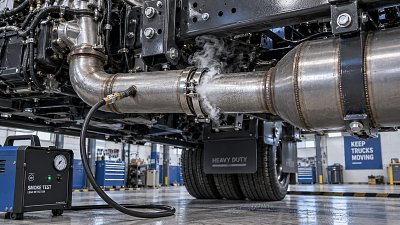
- Pressure-test the truck cooling system to locate small leaks at clamps, plastic tanks, heater lines, gaskets, and expansion reservoirs.
- Verify coolant concentration with a refractometer, not only color, because incorrect mixture reduces boiling protection and corrosion resistance.
- Examine hoses for swelling, hardening, cracking, soft spots, abrasion marks, and internal collapse near bends or suction points.
- Test the thermostat opening temperature and movement, because a stuck thermostat can cause overheating or inefficient warm-up cycles.
- Check water pump condition for bearing noise, shaft wobble, weep-hole stains, impeller damage, and poor coolant circulation.
- Inspect fan clutch engagement, electric fan response, shroud alignment, and sensor signals under idle, climbing, and stop-and-go conditions.
- Scan engine control data for coolant temperature trends, derate events, sensor drift, and abnormal temperature differences under load.
- Confirm radiator cap pressure rating and seal condition, since a weak cap lowers boiling point and increases coolant loss.
- Flush contaminated coolant only after identifying the source, especially when oil, rust, scale, or combustion gas is present.
- Record service findings by unit number, mileage, operating route, load type, coolant brand, and replaced components for trend tracking.
Failures That Increase Fuel Consumption
A poorly controlled truck cooling system can keep the engine outside its ideal thermal range.
When coolant temperature stays too low, combustion efficiency drops and aftertreatment systems may operate less effectively.
A stuck-open thermostat often causes long warm-up time, higher idle consumption, and unnecessary fuel burn during short-haul delivery routes.
A restricted radiator or weak fan clutch can also increase engine load as the control system tries to manage excess heat.
In severe cases, overheating triggers torque derate, forcing longer travel time and inefficient gear selection on demanding routes.
Failures That Accelerate Engine Wear
The truck cooling system protects more than the radiator and coolant passages.
It protects pistons, liners, bearings, cylinder heads, turbochargers, EGR coolers, and engine oil from excessive thermal stress.
Overheating weakens oil film strength and increases friction between moving parts.
Repeated high-temperature operation can distort cylinder heads, damage head gaskets, and shorten the service life of seals.
Low-quality coolant is another cost driver because depleted inhibitors allow corrosion, cavitation, and scale buildup inside metal passages.
These problems may not stop the truck immediately, but they quietly raise future overhaul risk.
High-Risk Components to Inspect First
Some parts fail more often because they face vibration, pressure cycling, road contamination, and temperature swings.
This sequence helps identify truck cooling system problems before replacing expensive components unnecessarily.
Different Operating Scenarios and Cooling Risks
Long-Haul Highway Transport
Long-haul trucks usually face sustained engine load, high road speed, and long operating hours.
A truck cooling system issue may appear gradually as climbing temperature, increased fan operation, or frequent coolant top-ups.
Radiator restriction, weak pressure caps, and coolant degradation are common in this scenario.
Urban Distribution and Stop-Start Routes
Urban trucks spend more time idling, accelerating, and operating at low airflow speed.
Fan control faults become more serious because natural ram air cannot support the truck cooling system at low speed.
Service teams should check electric fans, viscous clutches, relays, sensors, and shroud sealing more frequently.
Construction, Mining, and Off-Road Work
Dust, mud, stone impact, and high engine load make off-road applications especially demanding.
External radiator blockage can happen quickly, even when coolant quality and pump performance remain acceptable.
Cleaning procedures should avoid fin damage, because crushed fins reduce the truck cooling system’s ability to reject heat.
Cold Climate Operation
Cold weather does not remove cooling system risk.
Incorrect antifreeze concentration can freeze, crack components, restrict flow, or cause poor heater performance during operation.
A truck cooling system must also reach proper temperature fast enough to support fuel economy and aftertreatment performance.
Commonly Ignored Risks That Raise Costs
Ignoring small coolant loss: A minor top-up habit can hide hose seepage, cap failure, EGR cooler leakage, or early head gasket trouble.
Mixing incompatible coolants: Combining formulas can reduce inhibitor performance, create deposits, and shorten truck cooling system component life.
Replacing parts without root-cause testing: Installing a new radiator or pump may not solve sensor drift, air pockets, or fan control faults.
Skipping air bleeding: Trapped air creates hot spots, unstable gauge readings, heater complaints, and cavitation risk inside the cooling circuit.
Overlooking the radiator cap: This low-cost part controls pressure, boiling protection, and coolant recovery in the truck cooling system.
Using water only: Plain water promotes corrosion, scaling, cavitation, freezing damage, and reduced boiling resistance under heavy-duty operating conditions.
Practical Execution Advice for Maintenance Teams
- Build a standard inspection sheet covering coolant quality, pressure testing, fan operation, thermostat behavior, hoses, radiator condition, and scan data.
- Schedule inspections by engine hours, route severity, ambient temperature, load type, and previous truck cooling system repair history.
- Use diagnostic tools consistently, including refractometers, pressure testers, infrared thermometers, scan tools, and combustion leak detection kits.
- Separate emergency repair from permanent correction, especially when coolant loss, overheating, or derate events occur during revenue service.
- Standardize approved coolant types, hose grades, clamps, caps, thermostats, and water pumps to reduce compatibility and quality variation.
- Train technicians to document exact symptoms, temperature readings, failure location, replaced parts, and final validation results after repair.
These steps make truck cooling system maintenance measurable, repeatable, and easier to improve across multiple vehicle models.
Parts Selection and Supplier Evaluation Considerations
Cooling parts should match engine specification, duty cycle, installation space, and expected operating environment.
Radiators, intercoolers, expansion tanks, hoses, thermostats, caps, pumps, and sensors must be verified against vehicle application data.
For global sourcing, compare suppliers by product range, certification, fitment accuracy, testing capability, packaging, and after-sales support.
A professional heavy truck industry platform can support product discovery, supplier comparison, and cross-border collaboration for truck cooling system components.
Reliable sourcing reduces repeat failure, improves maintenance planning, and supports longer service intervals for commercial vehicles.
Summary and Next-Step Action Guide
A truck cooling system failure can raise operating costs through fuel waste, engine wear, emergency repair, and unplanned downtime.
The most effective response is not waiting for overheating, but building a disciplined inspection process around measurable checks.
Start with coolant condition, pressure integrity, airflow, circulation, temperature control, and electronic diagnostics.
Then match repair decisions with route severity, load profile, climate, and historical failure records.
For better results, review current inspection sheets, identify repeated cooling-related repairs, and standardize approved replacement parts.
A proactive truck cooling system program helps keep heavy trucks available, efficient, and ready for demanding land transportation operations.
Trending News
- CATL Unveils Heavy-Truck Battery Range Extension, Signs Deals for 13,000 Vehicles
- CATL Unveils Tianxing II Electric-to-Electric Range-Extended Heavy Truck Solution
- How much torque does a truck engine need for heavy-duty hauling?
- How to assess a crane truck distributor's spare parts support
- Volvo Group Forms Volvo Mining to Integrate Equipment and Autonomous Solutions
Tag
Recommended News
 Truck TechnologyHow to locate a truck exhaust system leak before replacing partsLocate a truck exhaust system leak before replacing parts. Learn how to spot soot trails, confirm leaks safely, and identify root causes to avoid costly guesswork and repeat repairs.
 Truck TechnologyDoes a cab chassis truck for fire department have enough frame capacity?Cab chassis truck for fire department: assess frame strength, axle loads, tank weight, stability and compliance for a safer, reliable fire apparatus build.
 Truck TechnologyWhen does a truck off road setup need locking differentials?Truck off road setups need locking differentials when uneven, low-grip terrain causes wheelspin. Learn how to choose the right axle locks for safer, reliable mobility.
 Truck TechnologyEPA Remote-Diagnostics Rules Take Effect for Diesel EnginesEPA Remote-Diagnostics Rules take effect for diesel engines sold in the U.S. Learn how OTA updates, real-time NOx reporting, and fault-code retention may impact compliance, OEM projects, and imports.
 Truck TechnologyCab Chassis Truck for Military Use: Key Specs That Affect Mission ReadinessCab chassis truck for military use: explore the key specs that drive mission readiness, off-road mobility, integration flexibility, and lifecycle support for smarter fleet decisions.
 Truck TechnologyBULLDOZER with GPS Tracking: What Improves on Remote Job SitesBULLDOZER with GPS tracking improves remote job sites with better visibility, reduced idle time, stronger fleet coordination, and smarter earthmoving decisions across harsh terrain.
 Truck TechnologyTruck Body Materials Compared: Steel, Aluminum, or Composite?Truck body material comparison made practical: explore steel, aluminum, and composite options for payload, durability, corrosion resistance, and lifecycle cost.
 Truck TechnologyBest Cab Chassis Truck Setups for Municipal Engineering TasksCab chassis truck for municipal engineering: compare the best setups for sanitation, tanker, utility, and dump tasks to improve uptime, safety, and long-term fleet value.
 Truck TechnologyTruck Electrical System Faults: Common Causes and Fast ChecksTruck electrical system faults can cause no-starts, dim lights, and costly downtime. Learn common causes, fast checks, and practical steps to diagnose issues quickly.
 Truck TechnologyASEAN-ICV Opens Mutual Access for Connected Heavy VehiclesASEAN-ICV opens mutual access for connected heavy vehicles, cutting duplicate V2X testing across Thailand, Vietnam, Indonesia, and Malaysia. See what it means for exports, compliance, and fleet delivery.
![]() Truck TechnologyTruck Concrete Mixer Basics: Capacity, Drum Type, and Jobsite FitTruck concrete mixer basics explained: compare capacity, drum type, and jobsite fit to improve pour efficiency, cut delays, and choose the right mixer truck with confidence.
Truck TechnologyTruck Concrete Mixer Basics: Capacity, Drum Type, and Jobsite FitTruck concrete mixer basics explained: compare capacity, drum type, and jobsite fit to improve pour efficiency, cut delays, and choose the right mixer truck with confidence. Truck TechnologyBrazil Requires Dual-Mode Tracking on Imported Heavy TrucksBrazil requires dual-mode tracking on imported heavy trucks. Learn how BeiDou+GPS, SISFROTA, and ABNT NBR 16501:2025 rules affect licensing, compliance, and market access.
 Truck TechnologyWater Truck OEM Options: Tank Size, Pump Output, and Road ConditionsWater truck OEM selection starts with the right match of tank size, pump output, and road conditions. Learn how to compare specs, improve uptime, and choose a fleet-ready solution.
 Truck TechnologyChile Requires Remote Diagnostics on Imported Heavy TrucksChile Requires Remote Diagnostics on Imported Heavy Trucks: learn how NCh3871:2026, OTA, ISO 22161, and VHMP rules will impact truck imports, registration, and fleet planning.
 Truck TechnologyHow to Compare Logging Truck OEM Specs for Drivetrain and Load StabilityLogging truck OEM specs compared the right way: learn how to evaluate drivetrain torque, axle ratios, suspension, and load stability for safer forestry hauling.
 Truck TechnologyIndia Drafts BS-VI Phase II Remote OBD Upload RuleIndia Drafts BS-VI Phase II Remote OBD Upload Rule: learn how India’s new real-time OBD upload proposal could impact truck exporters, T-Box upgrades, certification timelines, and market access.
 Truck TechnologyMilitary Truck Payload vs Mobility: What Matters in Harsh TerrainMilitary truck performance in harsh terrain depends on more than payload. Discover how mobility, traction, axle load, and suspension affect real-world mission success.
 Truck TechnologyLogging Truck OEM Options: Key Specs for Harsh Forestry RoutesLogging truck OEM options for forestry routes: compare axle layouts, frame strength, traction, braking, and service support to choose a durable, high-uptime truck.
 Truck TechnologyVietnam to Require VCA Checks for Imported Heavy TrucksVietnam to Require VCA Checks for Imported Heavy Trucks from August 1, 2026. Learn how VCA testing, CAN, HVIL, and OBD-II rules could impact truck exports, certification, and delivery planning.
 Truck TechnologyMexico Enforces CAN FD Rule for Imported TrucksMexico Enforces CAN FD Rule for Imported Trucks: learn how NOM-042-SEMARNAT-2026 impacts OBD-II+, ANCE verification, ECU strategy, and Mexico-bound truck compliance.
 Truck TechnologyBrazil ANP Rule Requires H₂ Leak Sensors on Imported Gas TractorsBrazil ANP rule requires H₂ leak sensors on imported gas tractors from Oct 1, 2026. Learn the compliance impact, IEC 60079-29-1 standard, and what exporters must do now.
 Truck TechnologyTruck Brake System Basics: Components, Failure Risks, and Safety ChecksTruck brake system basics explained: key components, common failure risks, and practical safety checks to improve fleet uptime, compliance, and road safety.
 Truck TechnologySupply Chain Expo Opens With Focus on Heavy Truck Core SystemsHeavy truck core systems take center stage at the Supply Chain Expo, spotlighting battery systems, electric drive axles, and by-wire technologies shaping export opportunities.
 Truck TechnologyTruck Control Unit Failures: Common Symptoms and Fix StrategiesTruck control unit failures often start with small warning signs. Learn key symptoms, root causes, and smart repair strategies to cut downtime and avoid costly misdiagnosis.
 Truck TechnologyEU V2X Rule Sets 2027 Deadline for New Heavy Truck ApprovalEU V2X Rule Sets 2027 Deadline for New Heavy Truck Approval: learn how ETSI EN 302 637-2 and UN R155 reshape EU truck compliance, certification, sourcing, and export planning.