How a Truck Cement Manufacturer Ensures Consistent Load Quality
For quality control and safety teams, choosing a reliable truck cement manufacturer means more than checking output capacity. Consistent load quality depends on strict material selection, accurate batching, durable vehicle design, and stable production standards. This article explores how leading manufacturers maintain performance, reduce transport risks, and support safer, more efficient operations across demanding construction and logistics environments.
What Quality and Safety Teams Really Need to Know First
When users search for a truck cement manufacturer, they usually want one answer first: can this supplier deliver stable, safe, repeatable load performance under real operating conditions?
For quality control personnel, the issue is not only product availability. It is whether each load meets the same standards for material consistency, weight control, moisture resistance, and transport reliability.
For safety managers, the concern goes even further. Inconsistent load quality can affect truck balance, discharge behavior, braking stability, rollover risk, and onsite handling safety during delivery.
That is why the best manufacturers are judged less by marketing claims and more by their process discipline. Consistency comes from controlled inputs, validated equipment, traceable production, and routine verification.
In practical terms, a dependable supplier should be able to explain how it manages raw materials, calibrates production systems, designs the truck body, and documents quality performance over time.
Why Consistent Load Quality Matters in Cement Transport
Cement transport is highly sensitive to quality variation. If load density, moisture exposure, or material flow behavior changes from one batch to another, downstream operations can be disrupted quickly.
On construction projects, inconsistent cement loads may affect unloading speed, storage behavior, batching performance, and the final quality of concrete or other mixed construction materials.
For fleet operators, inconsistent loads can also create hidden equipment stress. Uneven weight distribution may increase tire wear, reduce handling stability, and place extra pressure on suspension and braking systems.
Safety teams should pay close attention to these issues because transport risk is not only related to driving behavior. It is also influenced by how well the truck and load interact under road vibration.
A professional truck cement manufacturer understands that load quality is both a material issue and a vehicle engineering issue. The two must be managed together, not as separate concerns.
It Starts with Raw Material Selection and Control
Consistent load quality begins before the truck is assembled or the material is loaded. Leading manufacturers control the quality of steel, sealing components, pneumatic systems, and structural parts from the start.
For bulk cement transport trucks, the tank body material must be strong enough to withstand pressure cycles, road shock, and long-term abrasion from powder movement during loading and unloading.
If steel thickness varies too much, weld quality is inconsistent, or anti-corrosion treatment is weak, the truck may experience fatigue cracks, sealing failures, or structural deformation over time.
Quality control teams should ask whether suppliers inspect incoming materials by batch, verify supplier certifications, and maintain documented standards for mechanical strength, durability, and dimensional consistency.
This same discipline also applies to air compressors, valves, pipelines, and discharge systems. Poor component quality often causes unstable unloading performance, leakage, and higher maintenance-related safety risks.
Accurate Manufacturing and Batching Are Core to Repeatability
A truck cement manufacturer that delivers consistent quality usually has strong control over fabrication precision. This includes cutting, forming, welding, alignment, and final assembly of the tank and chassis interface.
Even small dimensional errors can affect capacity consistency, load center distribution, and air-assisted discharge efficiency. Over time, those issues influence both productivity and safe operating behavior.
Welding quality is especially important. Poor weld penetration, uneven seams, or weak joint finishing can compromise structural integrity when the vehicle is repeatedly exposed to pressure loading and rough roads.
Manufacturers with mature systems use welding procedures, fixture-based assembly, and inspection checkpoints to reduce variation. They also verify whether the finished tank matches design specifications before release.
In this context, consistency is not accidental. It comes from process repeatability, equipment calibration, and operator discipline across every production stage, not just final visual inspection.
Tank Design Has a Direct Impact on Load Stability
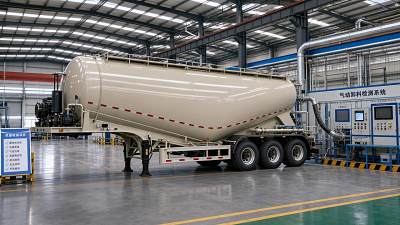
Quality and safety teams should not evaluate a cement transport truck only by capacity. Tank geometry plays a major role in how the load behaves during transport and pneumatic unloading.
A well-designed tank promotes smooth material flow, reduces residue after discharge, and helps maintain balanced internal distribution. This improves operational efficiency and lowers the chance of unstable handling.
Manufacturers may use V-shaped or specialized internal structures depending on the application. The goal is to optimize discharge performance while maintaining structural stability and road-safe weight distribution.
Bad design choices can create dead zones where powder accumulates, inconsistent discharge rates, or shifting stress points. These conditions may increase downtime and create additional cleaning or maintenance hazards.
For safety managers, good tank design supports safer unloading because it reduces abnormal pressure events, unexpected material retention, and manual intervention near the discharge system.
Sealing Performance Is Critical for Cement Quality Protection
Cement is sensitive to moisture. If a truck does not maintain reliable sealing during storage and transport, the material can cake, lose flowability, or partially harden before reaching the destination.
This is one of the most important yet overlooked indicators when evaluating a truck cement manufacturer. A truck may look well built but still fail in real use if hatch covers, joints, and valves leak.
Strong sealing performance protects material quality, reduces waste, and helps maintain a cleaner, safer operating environment. It also lowers the risk of dust escape, which is important for occupational safety compliance.
Quality teams should review how the manufacturer tests airtightness, what sealing materials are used, and whether those materials are compatible with repeated pressure cycles and harsh weather conditions.
Consistent load quality depends on preserving the material from the plant to the delivery point. Without good sealing, other quality controls become far less meaningful.
Weighing Accuracy and Load Distribution Must Be Controlled
Another major source of inconsistency is inaccurate loading. If the truck is overloaded, underloaded, or unevenly filled, both quality control and transport safety are affected immediately.
Reliable manufacturers work with loading systems that support accurate volume and weight management. They also design tanks and feed points to help ensure more uniform material distribution inside the vessel.
For quality teams, accurate loading supports contract compliance, material accountability, and process predictability at the receiving site. For safety teams, it protects vehicle stability and regulatory compliance.
Uneven distribution can shift axle loads and influence braking, steering response, and rollover resistance. This is especially important on long-distance routes, uneven roads, and infrastructure job sites with restricted access.
When screening suppliers, ask how they validate rated capacity, confirm load distribution assumptions, and support customers with operating guidelines for safe loading practice.
Process Standardization Is What Separates Reliable Manufacturers
A capable truck cement manufacturer usually has formal production standards rather than relying on individual worker experience alone. That distinction matters when buyers need stable quality across many units.
Standardization includes documented work instructions, controlled assembly steps, calibration records, inspection criteria, and clear handling procedures for nonconforming components or finished products.
Without process standardization, even experienced factories may produce trucks with noticeable differences in weld quality, tank alignment, sealing effectiveness, or discharge system performance.
For buyers managing fleets across regions, this variation creates operational uncertainty. Spare parts planning becomes harder, maintenance patterns become less predictable, and safety inspection results may vary by unit.
Manufacturers with mature quality systems reduce these risks by making performance repeatable, measurable, and traceable from one production batch to the next.
Inspection and Testing Should Be More Than a Final Checklist
One of the strongest signs of a reliable supplier is a layered inspection system. Good manufacturers do not wait until final delivery to discover quality issues.
They inspect key dimensions during fabrication, check weld integrity during assembly, verify pressure-related systems before completion, and confirm functional performance before shipment.
Depending on the product type, testing may include airtightness tests, pressure retention checks, discharge system trials, load simulation, coating inspection, and roadworthiness verification.
Quality control teams should value objective test records over broad promises. Ask for sample inspection reports, traceability methods, and acceptance criteria for major structural or functional characteristics.
A trustworthy manufacturer should also have a process for root-cause analysis and corrective action when defects are identified. This shows the supplier can improve, not just produce.
Durability Over Time Is Part of Load Quality Assurance
Consistent load quality is not just about how the truck performs on day one. It also depends on whether that performance remains stable after months or years of service.
If the tank loses sealing performance, internal wear increases, or pneumatic components degrade quickly, then material consistency and unloading behavior will eventually become unreliable.
That is why durability should be part of supplier evaluation. Manufacturers that understand long-term quality choose wear-resistant materials, reinforce high-stress zones, and design for easier maintenance access.
For safety managers, durability affects inspection intervals, failure probability, and unplanned exposure to hazardous maintenance conditions. For quality teams, it affects repeatable delivery performance across the vehicle lifecycle.
Suppliers who can discuss expected service conditions, maintenance recommendations, and common wear points usually have a stronger grasp of practical field performance.
Documentation, Traceability, and Supplier Transparency Matter
For professional buyers, a manufacturer’s transparency is often as important as the physical product. If quality records are incomplete, it becomes difficult to verify whether consistency is truly being managed.
Good suppliers provide documentation for material sources, inspection results, testing outcomes, equipment specifications, and production batch information when appropriate for the transaction.
This traceability helps buyers investigate issues faster, manage compliance requirements, and compare actual supplier performance over time. It also supports internal audits and risk assessment programs.
From a safety perspective, documentation can reveal whether a supplier follows stable engineering and control practices or simply reacts to problems after they appear in the field.
When evaluating a truck cement manufacturer, buyers should favor partners who communicate clearly, answer technical questions directly, and support evidence-based decision-making.
How Quality and Safety Teams Can Evaluate a Manufacturer Effectively
The most effective evaluation approach combines technical review, production assessment, and risk analysis. Looking only at price or production scale is rarely enough for cement transport applications.
Start by reviewing the truck structure, tank design, sealing system, discharge configuration, material specifications, and compatibility with your planned operating environment and route conditions.
Then assess the manufacturer’s quality system. Ask about incoming material inspection, welding procedure control, calibration schedules, testing methods, and records for nonconformance management.
Safety teams should also review maintenance accessibility, pressure system protection, load stability considerations, and any operating instructions provided for loading, transport, and unloading stages.
If possible, request case references, field performance feedback, or sample units for inspection. Real-world usage evidence often reveals more than product brochures or general sales presentations.
Why the Right Manufacturer Supports Safer and More Efficient Operations
Choosing the right truck cement manufacturer creates value beyond equipment purchase. It helps reduce transport interruptions, material loss, inconsistent unloading, and unexpected safety incidents.
For quality teams, that means stronger confidence in delivery consistency, easier process control at receiving sites, and fewer disputes related to material handling performance or load deviation.
For safety managers, it means more predictable vehicle behavior, fewer leakage and pressure-related risks, and lower exposure to unsafe corrective maintenance caused by premature component failure.
In large fleet or project environments, these benefits compound over time. Stable truck quality improves planning reliability, reduces lifecycle costs, and supports a more controlled operating system overall.
This is why experienced buyers focus on supplier capability, not only initial specifications. A well-managed manufacturing process is often the clearest predictor of field performance.
Conclusion
A dependable truck cement manufacturer ensures consistent load quality through disciplined material control, precise fabrication, effective tank design, reliable sealing, accurate loading, and standardized inspection systems.
For quality control and safety professionals, the key question is not whether a supplier can build trucks. It is whether the supplier can deliver repeatable performance with documented evidence and low operational risk.
Manufacturers that combine engineering quality, process consistency, and transparent verification are better positioned to support demanding cement transport applications in construction and logistics environments.
When you evaluate suppliers through the lens of load consistency, durability, and safety performance, you make better purchasing decisions and build a more resilient transport operation.
Trending News
- Truck Trailer Exporter Comparison: Pricing, Certification, and After-Sales
- Truck Cement Exporter Selection: Compliance Points for Cross-Border Deals
- Dump Truck Distributor Trends in 2026: Margin, Stock, and Service
- How a Truck Cement Manufacturer Ensures Consistent Load Quality
- Dump Truck Bulk Order Risks: What to Confirm Before Signing
Tag
Recommended News
 Truck Parts IndustryHow a Truck Cement Manufacturer Ensures Consistent Load QualityTruck cement manufacturer standards directly affect load consistency, safety, and efficiency. Learn how top suppliers control design, sealing, batching, and testing for reliable transport.
 Truck Parts IndustryTruck Parts Price Trends in 2026: What Is Driving Cost Changes?Truck parts price trends in 2026 are driven by steel, energy, freight, currency, and compliance costs. Discover what raises prices, which parts face the most pressure, and how buyers can source smarter.
 Truck Parts IndustryTruck Parts Wholesale: How to Balance Price, Quality, and Lead TimeTruck parts wholesale made smarter: learn how to balance price, quality, and lead time by application to cut downtime, reduce hidden costs, and source with more confidence.
 Truck Parts IndustryTruck Spare Parts Supplier with Bulk Order Discounts: Savings vs Stock RiskTruck spare parts supplier with bulk order discounts: learn when bulk buying cuts fleet costs and when stock risk hurts cash flow, uptime, and sourcing efficiency.
 Truck Parts IndustryTruck Spare Parts Supplier in Europe: Compliance Checks Before OrderingTruck spare parts supplier in Europe selection starts with compliance. Learn the key checks for safety, fitment, traceability, and import documents before you order.
 Truck Parts IndustryChoosing a Heavy Truck Parts Manufacturer with OEM Services for Stable SupplyHeavy truck parts manufacturer with OEM services: learn how to secure stable supply, consistent quality, and lower sourcing risk with practical buyer evaluation tips.
 Truck Parts IndustryHeavy Truck Parts for Construction: Durability vs Replacement CostHeavy truck parts manufacturer for construction insights: learn how to balance durability, replacement cost, and uptime across rough ground, urban projects, and severe-duty fleets.
 Truck Parts IndustryCold Storage Vehicle Parts That Reduce Failure RatesCommercial vehicle parts for cold storage that cut failure rates: explore seals, insulation, cooling, and electrical upgrades to protect cargo, reduce downtime, and improve fleet uptime.
 Truck Parts IndustryGermany Heavy Truck Parts Manufacturers: Quality and Supply RisksHeavy truck parts manufacturer in Germany: learn how to assess quality, certifications, and supply risks to secure safer sourcing, stable deliveries, and long-term fleet performance.
 Truck Parts IndustryVietnam to Enforce New Used Truck Import Rules from Q4 2026Vietnam's new used truck import rules (Q4 2026) require OEM remanufacturing certification & traceability—key for Chinese exporters, assemblers & logistics providers.
 Truck Parts IndustryChoosing a Truck Parts Exporter: Lead Time, Compliance, and Quality RisksTruck parts exporter selection affects uptime, compliance, and cost. Learn how to compare lead time, certification, and quality control to avoid delays, claims, and fleet-wide failures.
 Truck Parts IndustryGermany Heavy Truck Parts Manufacturers: Quality and Supply RisksHeavy truck parts manufacturer in Germany selection guide: compare quality systems, traceability, testing, and supply risks to secure reliable truck parts sourcing.
 Truck Parts IndustryIrkeshtam Port’s 24-Hour Freight Clearance Boosts Exports to KyrgyzstanIrkeshtam Port’s 24-hour freight clearance slashes heavy-truck component clearance to <15 mins—boosting road transport equipment exports to Kyrgyzstan.
 Truck Parts IndustryHeavy Truck Parts for Construction: Which Components Fail Most OftenHeavy truck parts manufacturer for construction insights: discover which brake, suspension, filter, and drivetrain components fail most often—and how smarter sourcing cuts downtime and repair costs.
 Truck Parts IndustryBulk Order Discounts on Truck Spare Parts: When Savings Become RiskTruck spare parts supplier with bulk order discounts: learn when lower prices increase downtime, quality, and inventory risk—and how to source smarter for reliable fleet performance.
 Truck Parts IndustryTruck Parts Wholesale: How to Balance Price, Quality, and Stock RiskTruck parts wholesale success depends on balancing price, quality, and inventory risk. Learn practical sourcing checks to protect margins, reduce dead stock, and choose reliable suppliers.
 Truck Parts IndustryHow OEM Services Reduce Downtime in Heavy Truck Parts SupplyHeavy truck parts manufacturer with OEM services helps cut downtime with accurate fit, faster lead times, and stable supply—discover smarter sourcing for fleet maintenance.
 Truck Parts IndustryErenhot-Mongolia 24-Hour Freight Clearance Boosts Trucking EfficiencyErenhot-Mongolia 24-hour freight clearance slashes truck clearance time by 40%—boosting efficiency for auto parts, cold-chain & cross-border trucking.
 Truck Parts IndustryKazakhstan Extends Zero-Tariff for Truck Parts on China-Europe Rail Routes to 2027Kazakhstan extends zero-tariff for truck parts—including ADAS controllers, ECUs & T-BOX units—on China-Europe rail routes until 2027. Boost your logistics & export strategy now!
 Truck Parts IndustryHow Low-Maintenance Truck Spare Parts Reduce Downtime Over TimeTruck spare parts supplier with low maintenance solutions help fleets cut downtime, reduce repair frequency, and improve workshop efficiency. Discover how durable parts boost long-term truck performance.
![]() Truck Parts IndustryHeavy Truck Parts Manufacturer for Construction: How to Judge Product ConsistencyHeavy truck parts manufacturer for construction selection starts with consistency. Learn how to judge batch stability, traceability, and quality control to reduce risk and improve fleet safety.
Truck Parts IndustryHeavy Truck Parts Manufacturer for Construction: How to Judge Product ConsistencyHeavy truck parts manufacturer for construction selection starts with consistency. Learn how to judge batch stability, traceability, and quality control to reduce risk and improve fleet safety.![]() Truck Parts IndustryTruck Parts Price in 2026: What Is Driving Replacement Cost HigherTruck parts price in 2026 is rising fast. Discover the key cost drivers, category risks, and sourcing tips buyers need to reduce replacement costs and make smarter purchasing decisions.
Truck Parts IndustryTruck Parts Price in 2026: What Is Driving Replacement Cost HigherTruck parts price in 2026 is rising fast. Discover the key cost drivers, category risks, and sourcing tips buyers need to reduce replacement costs and make smarter purchasing decisions. Truck Parts IndustryHow to Compare Truck Tipper Distributors by Parts Response TimeTruck tipper distributor comparison starts with parts response time. Learn how to assess stock speed, technical support, and supply reliability to cut downtime and choose the right partner.
 Truck Parts IndustryCommercial Vehicle Parts for Cold Storage: What Improves ReliabilityCommercial vehicle parts for cold storage that boost uptime, temperature stability, and fleet reliability. Learn which components reduce breakdowns and protect cargo in demanding cold-chain transport.
 Truck Parts IndustryTruck Parts Wholesale: How to Balance Price, Lead Time, and QualityTruck parts wholesale guide for distributors: learn how to balance price, lead time, and quality to reduce risk, protect margins, and choose suppliers with confidence.