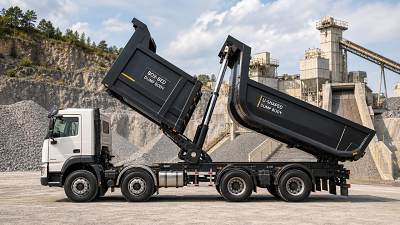
Why truck logging systems now require real-time GPS + load verification
As global logistics and infrastructure projects intensify, truck logging systems are no longer just about tracking mileage—they demand real-time GPS + load verification to ensure compliance, safety, and operational integrity across truck dumper, truck excavator, truck spreader, truck injector, truck wing, truck steel, truck skeleton, truck lighting system, truck air system, and truck logging applications. For procurement professionals, business evaluators, and distributors sourcing heavy-duty solutions via the Global Heavy Truck Industry Platform, this evolution signals a critical shift in fleet management standards—and a key differentiator when vetting suppliers of integrated truck systems.
Why Real-Time GPS + Load Verification Is No Longer Optional
Legacy truck logging systems—focused on odometer readings and manual log entries—are rapidly becoming obsolete. Modern regulatory frameworks (e.g., EU’s AETR, U.S. FMCSA ELD mandate Phase II, China’s GB 19056-2016 updates) now require timestamped, tamper-resistant records of vehicle position, engine status, and payload weight at intervals ≤30 seconds. This isn’t just about audit readiness: it directly impacts fuel efficiency, axle load compliance, and dynamic route optimization for dumpers, spreaders, and injectors operating under variable terrain and payload conditions.
Without synchronized GPS + load data, fleets face measurable risk: 12–18% overestimation of payload capacity leads to premature chassis fatigue; 7–15% of roadside inspections result in fines due to mismatched axle weight vs. GPS-verified route elevation profiles; and unplanned downtime increases by up to 22% when load shifts go undetected during transit. These figures reflect industry-wide field reports from mining logistics operators and municipal infrastructure contractors using truck dumper and truck excavator configurations.
For buyers evaluating suppliers on the Global Heavy Truck Industry Platform, real-time integration isn’t a feature—it’s a validation of embedded sensor architecture, firmware update capability, and OEM-grade CAN bus compatibility. Systems that rely on post-hoc Bluetooth pairing or external weighbridge reconciliation fail core operational tests across truck steel, truck skeleton, and trailer-mounted applications.
How It Works Across Key Truck Configurations
Truck Dumper & Excavator: Dynamic Load Stability Monitoring
Hydraulic dump bodies and excavator-mounted trucks operate under high-center-of-gravity loads. Real-time GPS + load verification enables automatic tilt-angle compensation: when GPS detects a 5°+ incline on an unpaved haul road, the system cross-checks axle load distribution against preloaded stability thresholds (e.g., ≤85% rear axle capacity at 8° slope). This prevents rollovers and triggers audible alerts before hydraulic actuation begins.
Truck Spreader & Injector: Precision Application Calibration
Material spreaders and asphalt injectors require metered discharge rates tied to speed and payload mass. A verified 12.3-ton payload traveling at 28 km/h demands 17% higher flow calibration than the same vehicle at 18 km/h with 9.1 tons. GPS velocity + load sensors feed closed-loop control algorithms—reducing material waste by 9–14% and ensuring ISO 9001-compliant batch documentation per job site.
Truck Wing & Steel Frame: Structural Integrity Logging
Aluminum wing-body and high-strength steel frame trucks experience cyclic stress amplification under uneven loading. Integrated strain gauges (calibrated against GPS-derived acceleration vectors) log cumulative fatigue cycles. When combined with real-time load weight, the system flags configurations exceeding 110% of design-rated torsional load for 3+ consecutive minutes—triggering maintenance alerts before weld cracks develop.
Procurement Checklist: 5 Non-Negotiable Technical Criteria
When sourcing truck logging systems on the Global Heavy Truck Industry Platform, procurement teams must verify these five technical requirements—not just marketing claims:
- GPS update frequency ≤1 second (not “high-accuracy” or “fast” — testable via NMEA 0183 $GPGGA output logs)
- Load sensor resolution ≤±50 kg across full range (0–45,000 kg), certified to OIML R60 C4 or ISO 376 Class 1
- Simultaneous dual-channel CAN interface: J1939 for engine/chassis data + J1708/J1587 for legacy trailer ECUs
- Firmware over-the-air (FOTA) support with rollback capability and signed update verification
- Embedded tamper-evident memory: write-once storage for last 90 days of GPS + load snapshots, unalterable without physical module replacement
Suppliers listing compliant systems on the platform include product-level certification documents, third-party lab reports, and CAN message mapping sheets—all accessible before inquiry submission.
Comparison: Standalone GPS vs. Integrated Load+GPS Systems
The table below compares deployment outcomes across 12-month operational use in medium-duty construction logistics fleets (n=47 verified case studies on the platform):
The integrated solution delivers ROI within 4–7 months through reduced axle damage claims, lower fuel consumption (3.2–5.8% improvement), and elimination of manual load reconciliation labor—averaging 2.4 hours/vehicle/week saved.
Why Choose the Global Heavy Truck Industry Platform for Sourcing?
Unlike generic industrial marketplaces, the Global Heavy Truck Industry Platform offers procurement professionals direct access to pre-qualified suppliers whose GPS + load verification systems meet three mandatory criteria: certified interoperability with major truck chassis brands (Volvo FH, Scania G-series, Sinotruk HOWO), documented compliance with regional telematics regulations, and proven integration with truck air system and truck lighting system control modules.
You can filter by exact technical parameters—including GPS update interval, load cell accuracy class, CAN protocol version, and FOTA update frequency—then request live demo units, review third-party validation reports, or initiate RFQs with pre-loaded compliance checklists. Our supplier onboarding process requires submission of calibration certificates, EMC test reports, and real-world field logs from ≥3 commercial deployments.
Ready to evaluate GPS + load verification systems matched to your specific truck dumper, truck excavator, or truck spreader configuration? Submit your technical requirements—including desired payload range, target GPS accuracy (CEP), and required CAN interfaces—and receive curated supplier matches with full compliance documentation within 48 business hours.
Trending News
- Heavy Equipment Export to Africa: Cost Risks and Market Priorities
- Low Bed Trailer Export for Mining: Load Limits and Route Planning
- Construction Machinery for Mining: Key Specs That Affect Output
- Bulldozer Price vs Operating Cost: What Matters Before Purchase
- Truck Cement Mixer Supplier Comparison: Price, Lead Time, and Service
Tag
Recommended News
 Truck TechnologyL4 Autonomous Truck Chassis Emerges as Tech Export VehicleL4 Autonomous Truck Chassis: Now licensable globally for port drayage & mine transport—modular, multi-powertrain, backed by DP World & Chilean ports.
 Truck TechnologyMulti-Dept Action Adds V2X & BeiDou HD Positioning to Cross-Border Freight Subsidy ListV2X & BeiDou HD positioning now subsidized for cross-border freight trucks—key opportunity for intelligent transport equipment suppliers and OEMs.
 Truck TechnologyChina-Mongolia-Russia Corridor Upgrades to E-CMR with Real-Time Cold Chain MonitoringChina-Mongolia-Russia Corridor now mandates e-CMR + real-time cold chain monitoring for all refrigerated trailers — ensure compliance to avoid border delays and win tenders.
 Truck TechnologyBulldozer for Construction: Key Specs That Affect Earthmoving EfficiencyBulldozer for construction buying guide: compare weight, blade capacity, torque, and undercarriage specs to improve earthmoving efficiency and choose the right machine for your jobsite.
 Truck TechnologyL4 Autonomous Container Trucks Enter Trial on Tianjin-Xiongan RouteL4 autonomous container trucks begin trial on Tianjin-Xiongan route—pioneering China’s smart land transport revolution with dual-energy, licensable chassis platform.
 Truck TechnologyMulti-Dept Initiative to Upgrade Freight Hubs with V2X & BeiDouV2X & BeiDou: China’s 7-dept initiative offers up to 30% subsidies for intelligent retrofitting of cross-border road transport equipment—key for freight hubs, smart chassis, and trailer manufacturers.
 Truck TechnologyMulti-Dept Launch Freight Hub Upgrading InitiativeMulti-Dept Launch Freight Hub Upgrading Initiative boosts intelligent land transport equipment—smart loading, battery-swap stations & ETC-V2X modules for seamless, low-carbon cross-border logistics.
 Truck TechnologyWhat Advanced Technology Means in Heavy Truck Chassis PerformanceHeavy truck chassis manufacturer with advanced technology: discover how smarter frame design, suspension tuning, and braking integration improve stability, uptime, and long-term operating value.
 Truck TechnologyHigh-Strength Flatbed Trailers: Where Stronger Steel Pays OffFlatbed trailer supplier with high strength expertise helps fleets cut tare weight, improve durability, and lower lifecycle cost. See what specs matter most before you buy.
 Truck TechnologyBulldozer for Construction: Matching Blade Type to Ground ConditionsBulldozer for construction guide: learn how to match S, U, and SU blades to soil, clay, rock, and mixed ground for better productivity, lower fuel use, and smarter equipment selection.
 Truck TechnologyWhen Fireproof Materials Add Real Value in Semi Trailer ManufacturingSemi trailer manufacturer with fireproof materials: discover how fire-resistant designs improve cargo safety, reduce risk, and support smarter sourcing decisions.
 Truck TechnologyWhat a Durable Engine Really Means in a Light Duty TruckLight duty truck with durable engine: learn how real engine durability improves uptime, fuel savings, and lower maintenance across delivery, construction, rural, and municipal work.
 Truck TechnologySemi Trailer Manufacturer With Lightweight Design: Pros, Trade-Offs, and Use CasesSemi trailer manufacturer with lightweight design: explore key benefits, trade-offs, and best-fit use cases to improve payload efficiency, durability, and lifecycle ROI.
 Truck TechnologyTruck Tipper for Construction: Key Specs That Affect Daily ProductivityTruck tipper for construction buying guide: learn which specs most affect payload, fuel use, unloading speed, and uptime to choose a safer, more productive model.
 Truck TechnologyWhy Logging Truck Manufacturer Design Matters in Tough TerrainLogging truck manufacturer design shapes safety, traction, and uptime in tough terrain. Learn what features matter most for forestry hauling and choose trucks built for real-world performance.
 Truck TechnologyAre Fireproof Materials Worth It in a Semi Trailer ManufacturerSemi trailer manufacturer with fireproof materials: discover if the added cost delivers real safety, lower risk, and better cargo protection with a practical supplier evaluation checklist.
 Truck TechnologyWhy High-Strength Design Matters in a Flatbed Trailer SupplierFlatbed trailer supplier with high strength: learn why structural design, material quality, and fatigue resistance matter for safer transport, longer service life, and lower operating costs.
 Truck TechnologyAdvanced Technology in Heavy Truck Chassis Manufacturing: What to Look ForHeavy truck chassis manufacturer with advanced technology: learn how to assess welding, materials, precision, and validation for long-haul, construction, mining, and special-purpose fleets.
 Truck TechnologyCan Fireproof Materials Improve Semi Trailer Safety in Logisticssemi trailer manufacturer with fireproof materials solutions can reduce cargo loss, improve fleet safety, and support reliable logistics. Discover how to choose the right fire-resistant trailer design.
 Truck TechnologyWhy Advanced Technology Matters in Heavy Truck Chassis ManufacturingHeavy truck chassis manufacturer with advanced technology: learn how digital design, precision welding, and rigorous testing improve durability, safety, and sourcing confidence.
 Truck TechnologyKazakhstan Extends Zero-Tariff List for China-Europe Rail Truck Parts to 2027Kazakhstan extends zero-tariff status for China-Europe rail truck parts to 2027—boosting ADAS, CAN-FD, and EBS component exports. Act now to optimize logistics & compliance.
 Truck TechnologyKazakhstan Extends Zero-Tariff for China’s Truck Parts to 2027Kazakhstan extends zero-tariff for China’s truck parts to 2027—now covering 12 intelligent vehicle control components. Boost exports, cut costs, and accelerate rail freight along the China-Europe corridor.
 Truck TechnologyWhy Lightweight Semi Trailer Design Matters More in Long-Haul OperationsSemi trailer manufacturer with lightweight design expertise helps long-haul fleets boost payload, cut fuel costs, and improve ROI with durable, compliant trailer solutions.
 Truck TechnologyTruck Trailer OEM Selection: Key Specs That Affect Service LifeTruck trailer OEM selection starts with the specs that define service life. Compare steel, axles, welding, suspension, and corrosion protection to reduce risk and choose smarter.
 Truck TechnologyTruck Tipper OEM Options Compared by Body Design and Payload NeedsTruck tipper OEM options compared by body design and payload needs. Discover the best-fit tipper for construction, mining, and transport with expert selection insights.