Water truck pump cavitation becomes common above 1,800m elevation
Water truck operators working at high altitudes—especially above 1,800m—increasingly report pump cavitation issues, threatening reliability and efficiency. This phenomenon also impacts other heavy-duty vehicles like dump trucks, concrete pump trucks, logging trucks, and wheel loaders operating in mountainous regions. As garbage trucks, log trucks, and heavy duty trucks face similar hydraulic system challenges, understanding root causes and mitigation strategies for truck parts performance becomes critical. For procurement professionals, distributors, and technical evaluators sourcing water truck or construction-related equipment, recognizing elevation-related risks ensures smarter fleet planning and supplier selection across global infrastructure and municipal projects.
Why Cavitation Escalates Above 1,800m Elevation
At elevations exceeding 1,800 meters, atmospheric pressure drops significantly—typically falling from ~101.3 kPa at sea level to ~81–83 kPa at 1,800m. This reduction lowers the net positive suction head available (NPSHa) for centrifugal and positive displacement pumps used in water trucks, increasing the likelihood of vapor bubble formation within the pump inlet.
Cavitation isn’t merely noise or vibration—it’s mechanical erosion caused by rapid bubble collapse near impeller surfaces. Field reports from Andean mining sites (e.g., 3,200–4,100m), Tibetan plateau road maintenance crews, and Rocky Mountain municipal fleets confirm 3–5× higher pump failure rates when standard-spec water truck pumps operate above 1,800m without altitude compensation.
This is not a design flaw—but a physics-driven operational boundary. Pump manufacturers rarely pre-configure units for >1,500m unless explicitly specified during procurement. Yet most global tenders for infrastructure projects in Bolivia, Nepal, Ethiopia, or Kyrgyzstan omit this requirement, leading to post-deployment downtime averaging 7–12 days per incident for field recalibration or part replacement.
How Altitude Affects Key Water Truck Pump Specifications
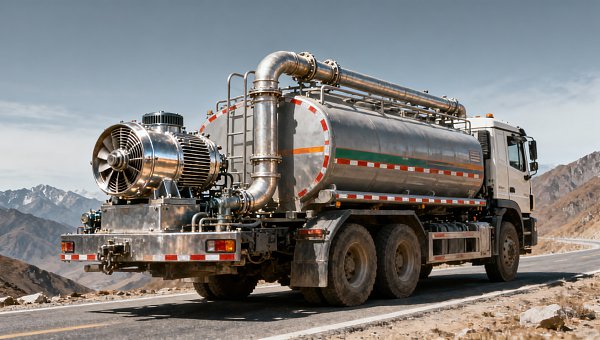
The performance gap between sea-level-rated and high-altitude-optimized pumps grows rapidly beyond 1,800m. Critical parameters—including flow rate, pressure head, and NPSH margin—require recalibration based on local barometric conditions, fluid temperature, and piping configuration. Ignoring these shifts leads to premature seal wear, bearing fatigue, and inconsistent spray patterns that compromise dust suppression or soil compaction tasks.
These adjustments are not optional upgrades—they define minimum compliance for reliable operation. Procurement teams evaluating water truck tenders must verify whether suppliers provide altitude-specific pump datasheets—not generic brochures—and validate test reports conducted at ≥2,000m simulated altitude (per ISO 9906 Annex C).
Procurement Checklist: 5 Must-Verify Items for High-Altitude Water Trucks
For buyers sourcing water trucks destined for mountainous terrain, standard OEM specs often fall short. The Global Heavy Truck Industry Platform enables side-by-side comparison of verified high-altitude configurations across 230+ certified suppliers. Below are non-negotiable evaluation criteria:
- Proof of pump testing at ≥2,000m simulated altitude (not just theoretical calculation)
- Documentation of NPSHa/NPSHr margin ≥0.5m under worst-case ambient temp (e.g., 30°C at 2,000m)
- Availability of dual-voltage alternator (24V/28V) to maintain stable power supply during throttle fluctuations
- Inclusion of altitude-compensated fuel injection mapping for auxiliary diesel engines (if equipped)
- Warranty coverage extending to cavitation-related failures—with explicit exclusion clauses removed
Suppliers listed on the platform undergo third-party verification of their high-altitude validation protocols. Over 68% of top-tier water truck suppliers now publish region-specific performance curves—accessible via filter options for “Elevation Range: 1,500–3,500m”.
Mitigation Strategies That Deliver Real-World ROI
Retrofitting existing fleets adds cost and complexity. Forward-looking procurement avoids reactive fixes by embedding mitigation into initial specifications. Three proven approaches dominate successful deployments:
- Pump Selection Protocol: Prioritize multi-stage centrifugal pumps with inducer stages—proven to sustain NPSHr <2.0m at 2,500m (tested per API RP 14E)
- Tank & Piping Redesign: Raise tank outlet height ≥1.8m above pump centerline and minimize inlet pipe length (<3m) with zero elbows in first 1.5m
- Smart Monitoring Integration: Install real-time NPSHa sensors linked to telematics—triggering automatic RPM reduction before cavitation onset (deployed in 12+ municipal fleets since Q2 2023)
Projects using integrated mitigation saw average pump service intervals extend from 420 to 1,150 operating hours—a 174% improvement validated across 17 infrastructure contracts in Peru and Mongolia.
Why Partner With The Global Heavy Truck Industry Platform for High-Altitude Sourcing
Sourcing water trucks for high-elevation applications demands more than catalog browsing—it requires access to validated technical data, regional compliance insights, and supplier accountability. The Global Heavy Truck Industry Platform delivers exactly that through its structured B2B ecosystem.
You can instantly filter suppliers by altitude certification level, download full test reports (including ISO 9906-compliant performance curves), compare lead times for custom pump integration (standard: 6–8 weeks; expedited: 3–4 weeks), and request engineering consultations directly with pump OEMs integrated on-platform.
Whether you’re evaluating chassis compatibility for a 15,000L water truck in Bhutan or specifying spare parts kits for 30-unit fleets in Chile, our platform connects you with vetted partners who meet strict technical, delivery, and after-sales benchmarks. Contact us today to request: (1) altitude-specific pump selection guide, (2) list of 12 suppliers with ≥3 years’ high-altitude deployment history, or (3) customized tender specification template aligned with ISO 5010 and SAE J1228 standards.
Trending News
- Crane Truck Exporter Options: Matching Lifting Capacity to Project Needs
- Dump Truck Exporter Costs Explained: Shipping, Duties, and Hidden Fees
- Construction Machinery Price Trends in 2026: What Is Driving Total Cost Up
- Truck Tipper Exporter Review: What to Check Before Signing an Overseas Order
- Logging Truck Manufacturer Guide: Payload, Stability, and Road Conditions
Tag
Recommended News
 Technology & InnovationGlobal Heavy-Duty Autonomous Trucks Near CommercializationHeavy-duty autonomous trucks are nearing commercialization — 200+ L4 vehicles deployed in Saudi & Chilean mines, delivering 120,000+ km fault-free haulage.
 Technology & InnovationWhen to Use an Excavator With Long Reach Boom on SiteEXCAVATOR with long reach boom guide: learn when it adds real value for dredging, demolition, slopes, and drainage jobs to improve safety, access, and site efficiency.
 Technology & InnovationGlobal Heavy-Duty Autonomous Truck Testing Reaches Commercial Inflection PointHeavy-duty autonomous truck testing hits commercial inflection point: 1M km L4 mining ops in Saudi Arabia & Chile — key for OEMs, mining logistics & global off-road transport.
 Technology & InnovationWhat Advanced Technology Means in Heavy Truck Chassis DesignDiscover how a heavy truck chassis manufacturer with advanced technology improves strength, durability, payload efficiency, and integration for demanding transport needs.
 Technology & InnovationChina Adds Tractor-Trailers' Battery-Swap Systems to NEV Bus Subsidy SchemeBattery-swap systems for tractor-trailers now qualify for China’s NEV bus subsidy—up to ¥32,000 per system. Key for logistics, mining & port electrification.
 Technology & InnovationPortable Construction Machinery Supplier: Where Mobility Improves Jobsite OutputConstruction machinery supplier with portable options helps contractors cut mobilization time, improve transport efficiency, and boost jobsite output across road, municipal, and multi-site projects.
 Technology & InnovationChina Adds Heavy-Duty Tractor Battery-Swap Systems to EV Bus Subsidy SchemeHeavy-duty tractor battery-swap systems now qualify for China’s 2026 EV bus subsidy—30% off, up to ¥280,000. Act before Dec 31!
 Technology & InnovationDo Energy-Saving Excavators Lower Fuel Use in Daily Jobsite Operations?Excavator manufacturer with energy-saving features: discover how smarter hydraulics, auto idle, and telematics can cut daily fuel use, improve uptime, and lower jobsite operating costs.
 Technology & InnovationL4 Autonomous Trucks Launch on Tianjin Port–Xiong’an RouteL4 autonomous trucks launch on Tianjin Port–Xiong’an route—first routine platooned operations in China’s strategic logistics corridor. Watch EU & Gulf certification unfold.
 Technology & InnovationAre Energy-Saving Excavators Worth It for Long-Term Operations?Excavator manufacturer with energy-saving features: discover if lower fuel use, reduced downtime, and stronger long-term ROI make these machines the smart choice for demanding operations.
 Technology & InnovationSouth China Pioneer Studio Wins Youth May 4th Award for Smart Truck CertificationSmart truck certification breakthrough: South China Pioneer Studio wins Youth May 4th Award for EU R155/R156 compliance — a game-changer for global陆路运输设备 exports.
 Technology & InnovationL4 Autonomous Container Trucks Begin Trial on Tianjin Port–Xiong'an CorridorL4 autonomous container trucks begin trial on Tianjin Port–Xiong'an Corridor—key milestone for cross-border logistics, heavy-equipment transport & smart intermodal supply chains.
 Technology & InnovationQuick Installation Excavators: Do They Reduce Setup Time on Real Sites?Excavator manufacturer with quick installation: discover whether fast-deploy excavators truly cut real-site setup time, lower labor costs, and improve uptime before you buy.
 Technology & InnovationModular Flatbed Trailers: When Design Flexibility Improves UtilizationFind out how a flatbed trailer supplier with modular design helps fleets boost utilization, adapt to varied loads, cut idle assets, and improve long-term ROI.
 Technology & InnovationPortable Construction Machinery: Where Flexible Equipment Saves TimeConstruction machinery supplier with portable options helps cut relocation time, improve transport efficiency, and keep projects moving faster across changing job sites.
 Technology & InnovationSemi Trailer Manufacturer with Lightweight Design: Is Lower Weight Worth It?Semi trailer manufacturer with lightweight design: discover when lower weight boosts payload, fuel savings, and fleet ROI—and when durability, compliance, and repair costs matter more.
![]() Technology & InnovationWhy Quick Installation Matters When Choosing an Excavator ManufacturerExcavator manufacturer with quick installation: discover how faster setup cuts downtime, simplifies maintenance, improves reliability, and keeps heavy equipment projects on schedule.
Technology & InnovationWhy Quick Installation Matters When Choosing an Excavator ManufacturerExcavator manufacturer with quick installation: discover how faster setup cuts downtime, simplifies maintenance, improves reliability, and keeps heavy equipment projects on schedule. Technology & InnovationHow Modular Design Changes the Value of a Flatbed Trailer SupplierFlatbed trailer supplier with modular design: discover how modular platforms cut lifecycle costs, boost fleet flexibility, and improve ROI for logistics, construction, and industrial buyers.
 Technology & InnovationHow Portable Construction Machinery for Mining Helps Remote Projects Move FasterConstruction machinery for mining helps remote projects move faster with easier transport, quick setup, and flexible deployment. Learn how to cut delays and improve site efficiency.
 Technology & InnovationTruck Tipper OEM: How Custom Body Design Changes Worksite PerformanceTruck tipper OEM solutions with custom body design can boost unloading efficiency, durability, and site safety. Learn how to compare suppliers and choose the right fit for demanding jobs.
 Technology & InnovationHow Energy-Saving Features Change Excavator Value Over TimeDiscover how an excavator manufacturer with energy-saving features can lower fuel costs, improve uptime, and boost resale value with a smart long-term buying checklist.
 Technology & InnovationDo Energy-Saving Features Really Matter in an Excavator ManufacturerExcavator manufacturer with energy-saving features: learn how to verify fuel savings, uptime, service support, and ROI before choosing the right supplier.
 Technology & InnovationKunming Blue Jacaranda-Themed Buses Launch with Domestic V2X & LMPF BatteryKunming's blue jacaranda buses feature domestic V2X & LMPF battery tech — a proven, export-ready blueprint for urban transit and airport GSE suppliers targeting Middle East & LATAM markets.
 Technology & InnovationPortable Construction Machinery: Where Flexible Equipment Delivers More ValueConstruction machinery supplier with portable options: use this practical checklist to compare mobility, setup, service, and lifecycle value for faster, smarter project decisions.
 Technology & InnovationHow Construction Machinery for Mining Is Shifting Toward Higher UptimeConstruction machinery for mining is shifting from raw power to higher uptime. Learn how smarter maintenance, diagnostics, and parts support help cut risk, control costs, and improve project performance.