When does heavy equipment transport require a lowboy trailer?
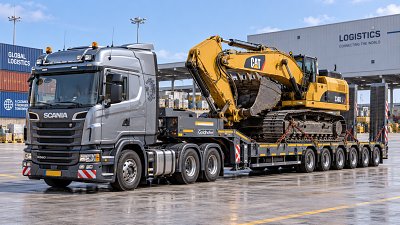
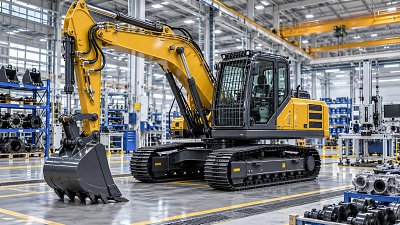
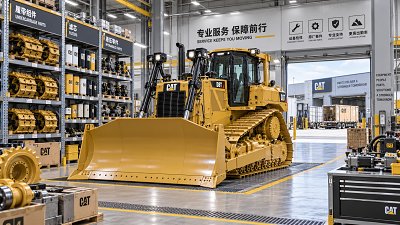
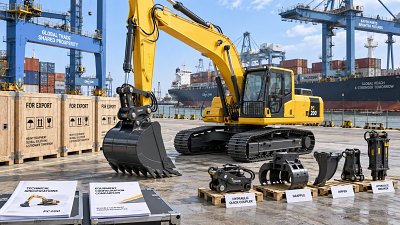
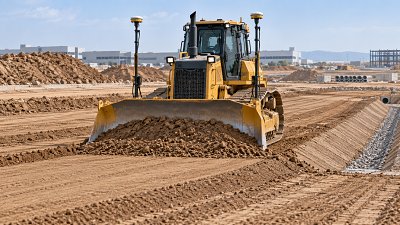
Heavy equipment transport requires a lowboy trailer when a flatbed or step-deck cannot safely accommodate the machine’s loaded height, loading geometry, or concentrated weight within the planned route’s limits. A tall excavator may fit a standard trailer’s payload rating yet exceed an overhead clearance once loaded. A bulldozer may present a different problem: its weight is acceptable, but its ground clearance makes the loading ramps unsuitable.
Choose a lowboy when its lower deck or loading arrangement resolves a verified transport constraint—not simply because the equipment is heavy. The decision starts with the machine in its actual transport configuration, followed by a trailer-specific load assessment and route review. A lowboy can reduce overall height and provide suitable loading access, but it does not automatically eliminate permits, axle restrictions, or securement requirements.
Start with the machine as it will actually travel
Published equipment specifications are a starting point, not a complete transport envelope. Operating weight may use assumptions about fuel, attachments, counterweights, or optional components that differ from the machine being shipped. Height measurements may also describe a working configuration rather than the approved transport position.
Before comparing trailers, establish these details:
- Transport dimensions: overall length, width, and height after positioning the boom, blade, cab accessories, or other movable parts.
- Shipment mass: the machine plus everything carried with it, including attachments and any supporting or securement equipment.
- Support footprint: track or tire contact dimensions and the spacing between the loaded support areas.
- Center of gravity: its approximate longitudinal, lateral, and vertical position in the transport configuration.
- Loading capability: whether the machine can drive aboard, requires winching, or must be lifted into place.
Use the manufacturer’s transport instructions to establish allowable component positions and restraint points. Lowering a boom can reduce height while increasing overall length or changing weight distribution. Removing an attachment may solve one problem but create a separate handling and securement requirement.
The height test: compare loaded envelopes, not trailer names
The clearest reason to select a lowboy is insufficient vertical clearance on a higher-deck trailer. The relevant dimension is the height of the complete loaded combination above the road, not the machine’s height alone.
Loaded height = loaded deck height + equipment height above its support surface + blocking or support height.
Obtain the candidate trailer’s deck height under the intended load and operating configuration. Suspension position, tire specification, and deck deflection can affect that dimension. A brochure’s unloaded deck measurement should not be treated as a guaranteed loaded value.
Compare the resulting envelope against both the applicable height limits and the actual route clearances. Bridges, overhead utilities, tunnel entrances, site gates, and covered unloading areas can each become the controlling restriction. A permitted height does not establish that every overhead obstacle on the route is passable.
A step-deck may be sufficient when its lower deck brings the machine within the required envelope. A lowboy becomes necessary when the step-deck remains too high or cannot support the machine in the position needed to achieve that clearance. When neither option provides adequate clearance, the next decision may involve approved partial dismantling or an alternative route.
Where flatbeds, step-decks, and lowboys differ
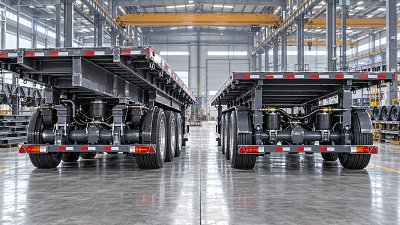
Trailer terminology varies between suppliers and markets. “Lowboy,” “low-loader,” and “low-bed” may describe different layouts rather than interchangeable specifications. Compare drawings, dimensions, loading arrangements, and rating conditions instead of accepting the category name as evidence of suitability.
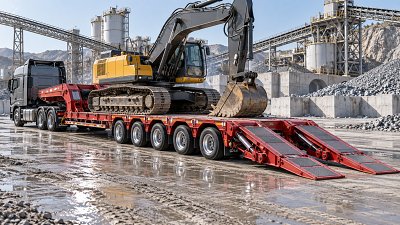
Also distinguish fixed-neck designs from detachable-gooseneck designs. A detachable gooseneck can provide front-loading access, but not every lowboy has that feature. Rear-loading arrangements have their own ramp, approach, and traction constraints.
Capacity depends on where the weight sits
A trailer’s headline payload rating does not confirm that it can carry a particular machine. The rating may assume a specified load distribution or support length. A tracked machine can impose substantial loads over relatively short contact areas, while a wheeled machine applies loads through individual tire footprints.
Ask for the manufacturer’s permissible concentrated-load conditions and compare them with the actual machine footprint. Confirm that the deck, crossmembers, and main beams are suitable for those contact loads. Timber mats or other supports should not be assumed to solve an overload unless their use is included in the approved assessment.
Check the entire combination
Positioning the machine changes the load transferred to the tractor and trailer axles. A trailer can remain below its structural payload rating while exceeding a permitted axle-group load, tractor axle rating, tire rating, or coupling limit. Conversely, moving the machine to correct an axle overload can place it outside the deck’s acceptable loading zone.
The assessment therefore needs the tractor configuration, trailer tare mass, axle spacing, coupling arrangement, and proposed cargo position. Trailer axles, suspension, brakes, tires, and the tractor must all be suitable for the resulting loads.
Additional axles or auxiliary load-distribution equipment can help with some movements, but they are not a universal remedy. Their effect depends on geometry, load transfer, and local rules. Request an axle-load calculation for the proposed combination, then verify actual loaded weights using an appropriate weighing method before dispatch.
Loading can be the deciding constraint
Even when a flatbed meets the height and weight requirements, the machine may not be able to reach its deck safely. Low undercarriage clearance, a long wheelbase, limited traction, or a sensitive attachment can make the ramp transition unacceptable.
A loading assessment must consider three distinct interfaces: the approach onto the ramp, the ramp slope, and the breakover onto the deck. The machine can clear the first interface yet ground at the final transition. Its manufacturer’s operating restrictions also remain relevant; transport suitability does not establish that it can climb a particular ramp.
A front-loading detachable-gooseneck lowboy may offer a more suitable approach for some tracked equipment. Check the actual geometry, ramp or deck-edge capacity, ground bearing conditions, and space required to disconnect and reconnect the neck. A low deck alone does not guarantee easy loading.
For non-running machinery, define the loading method before selecting the trailer. Winch mounting, line routing, anchorage, braking control, and recovery forces require an engineered arrangement. A trailer suitable for drive-on loading may not be equipped for controlled winching.
Loading conditions at both ends matter. A trailer that can be loaded in a prepared yard may be difficult to unload on uneven ground. Confirm the receiving site’s firmness, slope, approach space, and ability to support the trailer during loading operations.
A lower deck creates a different route risk
A lowboy trades reduced cargo height for reduced clearance beneath the trailer. That can introduce grounding risks at railway crossings, crowned roads, steep entrances, drainage channels, and abrupt grade changes. The loaded deck height and the trailer’s underside clearance are different dimensions; both need evaluation.
Route planning should account for the combination’s wheelbase, axle locations, overhang, and lowest structural points. Static ground clearance alone cannot show whether a long trailer will clear a sharp crest. Where geometry is uncertain, use a swept-path and vertical-clearance assessment based on the actual combination.
Some trailers offer adjustable ride height, but adjustment must remain within the manufacturer’s operating limits. Raising the deck to clear an obstacle also raises the cargo, potentially undermining the height advantage that justified the lowboy. It should not be treated as an unrestricted workaround.
Permits remain a separate issue. Depending on the jurisdiction, excessive width, length, gross mass, axle loads, or height may require authorization, escorts, route restrictions, or travel windows. A lower trailer may remove an overheight issue while leaving other oversize or overweight conditions unchanged. Cross-border movements require checks for each jurisdiction along the route.
Turn the assessment into a trailer specification
Once the controlling constraints are known, compare suppliers against a defined transport requirement rather than a generic request for a heavy-duty lowboy. Provide the machine data, route constraints, loading method, and intended tractor configuration, and ask for confirmation against the same conditions.
- Specify usable deck space. Request clear well length and width, deck transitions, wheel recesses where relevant, and any areas that cannot carry the machine’s contact loads.
- Define the rating basis. Require payload, load-distribution assumptions, allowable concentrated loads, and relevant structural limits—not just a maximum capacity figure.
- Confirm geometry under load. Obtain loaded deck height, underside clearance, loading angles, and the permitted range of suspension or ride-height adjustment.
- Review the coupling and axle arrangement. Check compatibility with the tractor, expected axle loads, and any auxiliary equipment needed for the proposed movement.
- Examine securement provisions. Verify rated anchor locations, access for chains or other approved restraints, and compatibility with the machine manufacturer’s tie-down points.
Securement should be planned alongside machine placement. A position that produces acceptable axle loads may obstruct restraint angles or prevent access to designated attachment points. Parking brakes, lowered implements, and hydraulic systems are not substitutes for the required transport restraints.
The final selection should identify exactly why a higher-deck option fails. That reason might be loaded height, an unacceptable loading transition, insufficient concentrated-load capability, or an incompatible support footprint. If a flatbed or step-deck passes all those checks, a lowboy is not inherently required. If the lowboy solves one constraint but introduces an unresolved grounding or axle-load problem, the transport plan still needs revision before equipment is dispatched.
Trending News
- When does heavy equipment transport require a lowboy trailer?
- When does a light commercial vehicle for urban delivery save fleet costs?
- How to choose an off road truck for steep and unstable job sites
- How to match crane truck lifting capacity to your jobsite loads
- What drives logging truck cost beyond the base purchase price?
Tag
Recommended News
 Buying GuideWhen does heavy equipment transport require a lowboy trailer?Does your heavy equipment need a lowboy trailer? Discover how loaded height, weight distribution, loading access, and route limits determine the right choice for safe transport.
 Buying GuideHow to choose an off road truck for steep and unstable job sitesChoose the right off road truck for steep, unstable job sites. Compare traction, braking, stability, clearance, payload, and route-test essentials.
 Buying GuideHow to match crane truck lifting capacity to your jobsite loadsCrane truck capacity planning made clear: calculate gross load, radius, rigging, outriggers, and ground conditions to select safer, job-ready lifting equipment.
 Buying GuideHow to match lowbed trailer deck height to your hauling equipmentLowbed trailer deck height guide: match equipment clearance, ramp geometry, axle loads, tractor fit, and route limits for safer, more efficient hauling.
 Buying GuideWhat to verify before choosing a delivery truck supplier for school transportationDelivery truck supplier for school transportation: verify route fit, payload, safety, compliance, service support, and total cost before choosing a reliable partner.
 Buying GuideWhat an excavator manufacturer catalog should show before you compare modelsExcavator manufacturer catalog guide: verify supplier identity, configurations, hydraulics, compliance, parts support, and delivery readiness before comparing models.
 Buying GuideWhat to check before appointing a bulldozer distributorBulldozer distributor selection guide: evaluate service, parts availability, warranty, pricing, compliance, and lifecycle value to reduce downtime and protect fleet investment.
 Buying GuideWhat to verify before choosing a truck cement mixer supplierTruck cement mixer supplier checklist: verify chassis fit, drum quality, hydraulics, compliance, spare parts, and after-sales support before you buy.
 Buying GuideHow to verify a truck spare parts supplier before placing a bulk orderTruck spare parts supplier verification made practical: learn how to check part specifications, factory control, test records, samples, pricing, and delivery capability before placing a bulk order.
 Buying GuideWhat size truck container is right for a typical freight load?Truck container sizing made simple: compare payload, volume, pallet layouts, route access, and loading needs to choose the most efficient freight solution.
 Buying GuideWhat drives semi trailer price differences between similar models?Semi trailer price differences come down to frame materials, axles, suspension, coating, and configuration. Compare specifications line by line to choose lasting value.
 Buying GuideHow to compare excavator manufacturer price lists before requesting quotesCompare an excavator manufacturer price list with confidence. Learn to normalize configurations, calculate landed costs, assess options and service, and create stronger RFQs.
 Buying GuideHow to choose a mixer truck drum capacity for your concrete pourMixer truck capacity guide: match drum size to pour rate, legal payload, site access, and delivery cycles for efficient, reliable concrete placement.
 Buying GuideHow to size a bulldozer for construction site grading workBulldozer for construction sizing guide: match weight, blade, traction, grade control, and transport needs to improve grading productivity and costs.
 Buying GuideHow to assess a truck cement manufacturer’s build quality before orderingTruck cement manufacturer build quality: assess tank steel, welding, chassis integration, pneumatic systems, factory QC, and inspection evidence before ordering.
 Buying GuideWhen does a truck trailer OEM make sense for private-label fleets?Truck trailer OEM programs help private-label fleets cut lifecycle costs, standardize operations, and improve uptime. Learn when customization delivers real commercial value.
 Buying GuideWhat to verify before choosing a water truck OEM for your fleetWater truck OEM selection guide: verify chassis compatibility, tank quality, pump performance, compliance, and service support to build a safer, more reliable fleet.
 Buying GuideHow to size a cab chassis truck for a fire department apparatusCab chassis truck for fire department sizing guide: balance GVWR, axle loads, wheelbase, water tank placement, and mission needs for safer apparatus design.
 Buying GuideWhat to verify before choosing a truck chassis supplierChoose the right truck chassis supplier with a practical checklist for application fit, axle ratings, body integration, quality control, delivery reliability, and after-sales support.
 Buying GuideHow to choose a logging truck for steep and rough forest roadsLogging truck selection for steep, rough forest roads: compare traction, braking, gearing, chassis strength, tires, and supplier support for safer, more reliable hauling.
 Buying GuideHow to choose a flatbed trailer deck length for oversized loadsFlatbed trailer deck length guide for oversized loads: balance cargo support, axle weight, securement space, overhang, and route access for safer transport.
 Buying GuideHow to assess a truck chassis supplier for trailer manufacturingTruck chassis supplier for trailer manufacturing: learn how to assess technical fit, quality control, engineering support, and delivery reliability for smarter sourcing.
 Buying GuideIs the SHACMAN H3000 6×4 Cement Mixer suitable for large projects?SHACMAN H3000 6×4 Cement Mixer: assess payload, cycle time, traction, and service support to see if it can keep large concrete projects moving efficiently.
 Buying GuideHow to evaluate heavy duty trucks for sale in Russia before buyingHeavy duty trucks for sale in Russia: learn how to compare specifications, winter readiness, service support, supplier reliability, and total ownership costs before buying.
 Buying GuideWhat to verify before choosing a logging truck producerChoose a logging truck producer with confidence: verify chassis strength, load security, compliance, service support, and delivery control for demanding forestry routes.