Crane Truck Manufacturer Comparison for Urban Lifting and Narrow Sites
Choosing the right crane truck manufacturer is critical for urban lifting projects where space is limited, access is tight, and efficiency matters. For project managers and engineering leaders, comparing manufacturers goes beyond price—it requires evaluating lifting performance, maneuverability, safety features, and after-sales support to ensure smooth operations on narrow and demanding job sites.
Why urban lifting projects demand a different manufacturer comparison
In open industrial yards, a standard lifting truck may still complete the job even if turning radius is large, outrigger footprint is wide, or setup time is slow. Urban projects are different. A project manager working in city streets, residential blocks, old commercial districts, or compact infrastructure corridors must evaluate whether a crane truck manufacturer truly understands constrained applications. The best option is not always the one with the biggest rated lifting capacity. It is the manufacturer whose machine can reach the site, stabilize safely, lift precisely, and leave without disrupting traffic, pedestrians, or adjacent structures.
This is why a practical crane truck manufacturer comparison should be scenario-based. Narrow roads, overhead cables, underground utilities, time-restricted work permits, and mixed traffic all create jobsite constraints that directly affect equipment choice. For engineering leaders, the right comparison framework should connect lifting tasks with vehicle dimensions, boom configuration, axle layout, compliance standards, and support availability.
Common urban and narrow-site applications where manufacturer differences matter
A crane truck manufacturer may look competitive on paper, but actual suitability becomes clear only when viewed through common working scenarios. Below are the applications where differences between manufacturers become most visible.
Municipal maintenance and utility installation
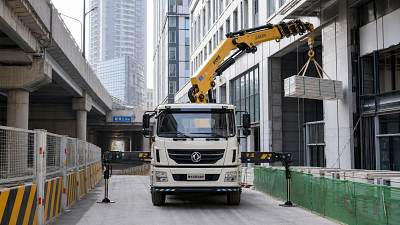
Projects such as streetlight replacement, pipe handling, transformer installation, and roadside barrier work often happen in active traffic zones. Here, compact chassis length, fast outrigger deployment, and strong low-height lifting control are more important than high-capacity long-reach performance. A capable crane truck manufacturer for this segment will typically offer compact bodies, operator-friendly controls, and stable lifting on uneven roadside surfaces.
Urban building material delivery
For steel, glass, packaged equipment, and prefabricated materials delivered into downtown sites, the machine often needs to unload its own cargo in one narrow working window. In this case, self-loading efficiency, folding boom flexibility, and precision placement become key comparison points. Project teams should compare how each crane truck manufacturer handles combined transport and lifting functions, especially when labor and staging space are limited.
Bridge access, underpass, and corridor infrastructure work
These environments involve lane restrictions, overhead clearance limits, and strict timing requirements. Manufacturers that design for low transport height, smoother boom articulation, and faster positioning are often better suited. In these scenarios, advanced load monitoring and safe lifting under partial boom extension also become important differentiators.
Industrial retrofits inside developed city zones
Factory upgrades in older urban districts may involve narrow gates, tight internal roads, and strict noise or emissions controls. Here, buyers should compare whether the crane truck manufacturer provides compliant engine options, compact wheelbase configurations, and easy service access. Downtime is expensive in retrofit work, so parts supply and field service response often matter more than a small purchase price advantage.
Scenario comparison table for project managers
The table below helps project leaders match application conditions with the most important evaluation points when reviewing any crane truck manufacturer.
What to compare beyond lifting capacity
Many buyers begin with tonnage, but a scenario-based comparison should go further. A reliable crane truck manufacturer for narrow urban work should be evaluated across five practical dimensions.
1. Chassis maneuverability
Check turning radius, wheelbase, axle configuration, steering response, and overall vehicle length. In old city blocks or temporary construction lanes, these factors determine whether the truck can enter and position correctly. A larger crane that cannot align with the lift point is often less productive than a smaller, better-balanced unit.
2. Boom type and working envelope
Different manufacturers may specialize in straight boom or knuckle boom designs. For narrow sites and obstacle-heavy environments, a knuckle boom often provides better flexibility for lifting around walls, cables, or building edges. For repetitive vertical lifting with simpler access, a telescopic solution may be more efficient. Compare actual working envelope diagrams, not just maximum reach figures.
3. Stabilization performance
Outrigger extension options, load charts under restricted spread, automatic leveling assistance, and ground pressure management are critical in city operations. A high-quality crane truck manufacturer will publish clear data for partial outrigger operation and provide safety logic that protects the operator when full spread is impossible.
4. Safety and control systems
Urban lifting requires precision. Compare load moment indicators, anti-overload systems, remote control quality, camera visibility, emergency stop functions, and interlocks. For projects near pedestrians or adjacent buildings, smooth micro-movement control can reduce risk and improve placement speed.
5. Service support and parts readiness
Even the strongest crane truck manufacturer loses value if replacement hoses, seals, sensors, or hydraulic components take weeks to arrive. Project managers should review support lead times, distributor coverage, technician training, and documentation quality. In high-pressure infrastructure schedules, after-sales support becomes part of the lifting performance.
How project scale changes the right manufacturer choice
Not every buyer should compare manufacturers the same way. The right choice depends on project volume, fleet size, and operating model.
For contractors handling frequent urban jobs
If your team performs daily lifting tasks across multiple city sites, prioritize a crane truck manufacturer with proven uptime, standardized controls, and broad service coverage. Operator familiarity and maintenance consistency across the fleet will reduce training time and service complexity.
For EPC teams managing one major project
A project-specific buyer may care more about exact task fit than brand standardization. In this case, compare manufacturers based on lift plan compatibility, road permit dimensions, delivery schedule, and available local support during the project window.
For distributors and equipment sourcing teams
A distributor should evaluate product line completeness, certification readiness, parts stocking support, and adaptability for regional regulations. A crane truck manufacturer with strong export documentation and multilingual technical resources often creates fewer downstream issues for commercial buyers.
Common mistakes when comparing a crane truck manufacturer for narrow sites
Several purchasing errors appear repeatedly in urban lifting projects. Recognizing them early helps avoid cost overruns and site delays.
- Choosing based only on nominal lifting capacity instead of real lift radius under constrained setup.
- Ignoring transport dimensions, then discovering access roads, gates, or work zones are too tight.
- Assuming all control systems provide equal precision for delicate urban placement tasks.
- Overlooking local service support and spare parts response for hydraulic or electronic failures.
- Failing to compare full lifecycle cost, including downtime, maintenance frequency, and operator productivity.
A practical evaluation checklist before shortlisting suppliers
Before selecting a crane truck manufacturer, project managers should build a short technical checklist based on actual job conditions. Start with site entry width, turning requirement, overhead obstruction height, ground bearing condition, planned lift radius, and required setup speed. Then map those needs to manufacturer data sheets and ask for real case references from similar urban environments.
A strong supplier should be able to explain not only what the truck can lift, but where it performs best, where it should be used cautiously, and which optional features improve safety in dense city operations. This kind of transparent discussion is often a better indicator of manufacturer quality than promotional claims alone.
FAQ: crane truck manufacturer selection for city projects
Which crane truck manufacturer is best for narrow streets?
The best choice depends on street width, lift radius, and load type. Generally, look for manufacturers offering compact chassis, flexible boom geometry, and safe performance under limited outrigger spread. Ask for application references in urban municipal or downtown construction projects.
Is a knuckle boom better than a straight boom for urban use?
Often yes, especially when working around obstacles or placing loads into tight spaces. However, for repetitive lifts with simpler access and longer direct reach, a straight boom may still be efficient. The right crane truck manufacturer should help match boom type to your site geometry.
How important is after-sales support in manufacturer comparison?
It is extremely important. Urban projects usually run on strict schedules and permit windows. Fast service response, spare parts access, and trained technicians can have a bigger impact on project continuity than a lower initial purchase cost.
Final recommendation for scenario-based sourcing
A successful crane truck manufacturer comparison for urban lifting and narrow sites should begin with the job scenario, not the catalog headline. Project managers should compare access constraints, boom behavior, stabilization limits, control precision, and support readiness against the real conditions of each worksite. The right manufacturer is the one that helps your team complete lifts safely, quickly, and consistently in the places where standard equipment struggles most.
If you are sourcing for municipal engineering, infrastructure upgrades, building material delivery, or compact industrial projects, use a platform that lets you compare manufacturers, specifications, supplier capabilities, and industry resources in one place. The Global Heavy Truck Industry Platform helps buyers across the road transport equipment sector identify suitable suppliers, evaluate commercial vehicle solutions, and connect with trusted global partners for efficient cross-border procurement.
Trending News
- Huanggang Port Freight Operations Cease, Shenzhen-Hong Kong Cross-Border Logistics Shifts to 'East-In-East-Out, West-In-West-Out'
- Erenhot-Mongolia 24-Hour Freight Clearance Boosts Trucking Efficiency
- All 27 Cross-River Bridges of the Pinglu Canal Completed
- Nanning IRP Launches Smart EV Freight Charging & Swapping Station
- Vietnam to Enforce China's Tier 6B Emission Standard for Imported Medium/Heavy Trucks from Q3 2026
Tag
Recommended News
 Truck ReviewsCrane Truck Manufacturer Comparison for Urban Lifting and Narrow SitesCrane truck manufacturer comparison for urban lifting: discover how to choose compact, safe, high-efficiency models for narrow sites, faster setup, and reliable support.
 Truck ReviewsTruck Cement Mixer Manufacturer Comparison: Drum Design, Output, and ServiceTruck cement mixer manufacturer comparison guide covering drum design, real output, and after-sales service. Help your team compare suppliers, reduce sourcing risk, and choose with confidence.
 Truck ReviewsTruck Tipper Manufacturer Comparison: Build Quality Points That MatterTruck tipper manufacturer comparison guide: discover the build quality points that truly affect durability, payload stability, maintenance, and long-term operating cost.
 Truck ReviewsTruck Cement for Sale: How to Judge Value From Photos and Spec SheetsTruck cement for sale buyers can learn to judge true value from photos and spec sheets. Spot wear, compare capacity, and avoid costly mistakes before you contact sellers.
 Truck ReviewsTruck Tipper Manufacturer Comparison: Build Quality Points That MatterTruck tipper manufacturer comparison guide: discover the build quality points that truly affect durability, payload stability, maintenance, and long-term operating cost.
 Truck ReviewsTruck Cement for Sale: How to Judge Value From Photos and Spec SheetsTruck cement for sale buyers can learn to judge true value from photos and spec sheets. Spot wear, compare capacity, and avoid costly mistakes before you contact sellers.
 Truck ReviewsTruck Tipper Manufacturer Comparison: Build Quality Points That MatterTruck tipper manufacturer comparison guide: discover the build quality points that truly affect durability, payload stability, maintenance, and long-term operating cost.
 Truck ReviewsTruck Cement for Sale: How to Judge Value From Photos and Spec SheetsTruck cement for sale buyers can learn to judge true value from photos and spec sheets. Spot wear, compare capacity, and avoid costly mistakes before you contact sellers.
 Truck ReviewsLogging Truck Producer Comparison: Features That Matter in Tough TerrainLogging truck producer comparison for tough terrain: discover the features that impact traction, stability, durability, and uptime to choose the right forestry truck with confidence.
 Truck ReviewsLogging Truck Producer Comparison: Capacity, Durability, and ServiceLogging truck producer comparison guide covering capacity, durability, and service. Compare real-world fit, reduce fleet risk, and choose reliable suppliers for forestry transport.
 Truck ReviewsFlatbed Trailer Supplier With High Strength: What Really MattersFlatbed trailer supplier with high strength: learn how to assess materials, structure, compliance, and lifecycle value to choose reliable trailer partners with confidence.
 Truck ReviewsDoes Quick Installation Really Matter When Choosing an Excavator ManufacturerExcavator manufacturer with quick installation: learn why fast setup only matters when paired with reliable performance, lower downtime, operator support, and long-term jobsite efficiency.
 Truck ReviewsWhat Makes a Truck Tipper for Construction Easier to Maintain On SiteTruck tipper for construction models with easy hydraulic access, modular parts, and clear service points cut downtime, lower repair costs, and keep demanding jobsites running.
 Truck ReviewsWhat Makes a Truck Tipper Manufacturer Reliable in Heavy-Duty UseTruck tipper manufacturer selection starts with reliability. Learn how to compare steel quality, hydraulics, stability, and service support for safer heavy-duty performance.
 Truck ReviewsLogging Truck Manufacturer Comparison for Harsh Terrain WorkLogging truck manufacturer comparison for harsh terrain: evaluate durability, traction, load control, and service support to choose safer, more efficient forestry transport solutions.
 Truck ReviewsQuick Installation Excavators: Do They Really Save Time on SiteExcavator manufacturer with quick installation: learn if these machines truly cut setup delays, improve workflow, and lower site costs before you buy.
 Truck ReviewsWhat Makes a Truck Tipper for Construction Easier to Run on Busy SitesTruck tipper for construction buying guide: discover the features that make busy job sites safer, faster, and easier to manage, from stable tipping to better visibility and lower downtime.
 Truck ReviewsTruck Tipper OEM for Harsh Job Sites: What Really MattersTruck tipper OEM selection for harsh job sites starts with what matters most: durability, hydraulic reliability, safety, and support. Discover how to choose a tipper built for uptime and lower operating costs.
 Truck ReviewsHow to Judge a Logging Truck Producer by Frame and Load DesignLogging truck producer evaluation starts with frame strength and load design. Learn how to compare suppliers for safer timber transport, higher durability, and lower lifecycle costs.
 Truck ReviewsDo Quick-Installation Excavators Really Save Time on SiteExcavator manufacturer with quick installation: discover whether fast-setup excavators truly cut downtime, speed relocations, and boost jobsite productivity before you buy.
 Truck ReviewsIs a Lightweight Semi Trailer Worth It for Daily Freight Usesemi trailer manufacturer with lightweight design: learn if a lightweight semi trailer can boost payload, fuel savings, and daily freight efficiency before you buy.
 Truck ReviewsDelivery truck supplier lead times spiked in Q1 2026—not because of demand, but component traceability gapsDelivery truck supplier lead times spiked in Q1 2026—blame component traceability gaps, not demand. Discover how SHACMAN L3000, X5000, F2000, bulldozer & excavator manufacturers, and flatbed/semi trailer suppliers are restoring reliability.