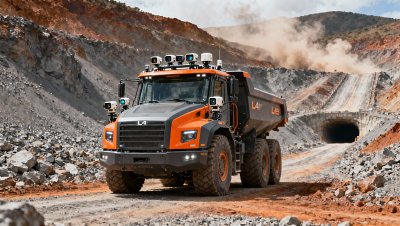
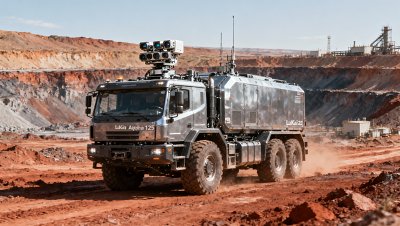
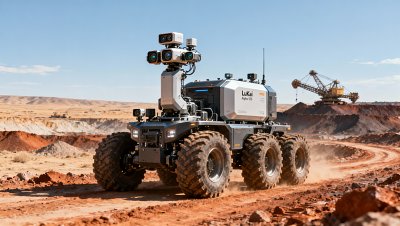
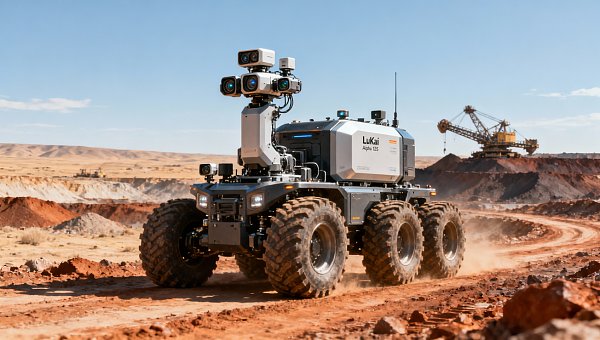
LuKai Alpha 125 Mining Robot Enters Mass Delivery
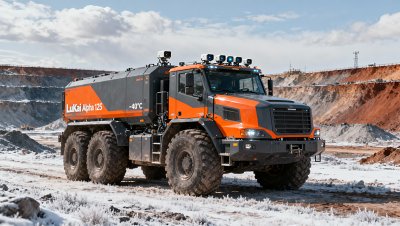
On May 7, 2026, LuKai Intelligent Driving announced the mass production and delivery of its Alpha 125 autonomous mining transport robot — the first Chinese L4-level unmanned heavy-haul transportation system to achieve commercial-scale overseas deployment. This milestone reflects accelerating regulatory acceptance of functional safety-compliant autonomous systems in high-risk industrial environments and signals a shift in global mine automation procurement patterns.
Event Overview
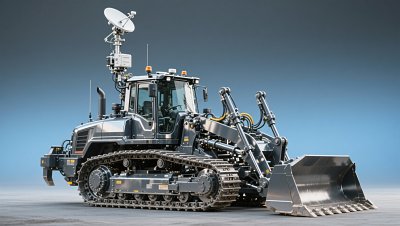
On May 7, 2026, Chinese autonomous driving company LuKai Intelligent Driving announced that the Alpha 125 mining unmanned transport robot had completed mass production and delivery. The first batch was shipped to a large copper mine project in Kazakhstan. Developed on a heavy-duty truck chassis, the Alpha 125 supports 90-ton payload capacity and continuous 7×24-hour unattended operation. It complies with ISO 15638 for vehicle functional safety and operates without GNSS dependency — enabling reliable navigation in underground or GPS-denied mining sites.
Industries Affected
Direct Export Enterprises: Companies engaged in cross-border equipment trade face revised compliance expectations. The Alpha 125’s adherence to ISO 15638 — an internationally recognized functional safety framework — sets a new de facto benchmark for export certification in mining automation. Exporters must now assess whether their existing product documentation, safety validation reports, and technical support infrastructure align with such standards, especially when targeting CIS, ASEAN, or African markets where local regulatory frameworks remain underdeveloped but risk-averse.
Raw Material Procurement Enterprises: Mining operators (e.g., copper, iron ore, lithium producers) are directly impacted by shifting capital expenditure priorities. With proven unmanned haulage now commercially available abroad, procurement teams may accelerate replacement cycles for aging diesel-powered rigid trucks — particularly in labor-constrained or high-safety-liability jurisdictions. This could compress lead times for fleet renewal tenders and increase demand for integrated operations-and-maintenance (O&M) packages, not just hardware.
Equipment Manufacturing Enterprises: Heavy vehicle OEMs and Tier 1 suppliers face dual pressure: first, to retrofit legacy platforms with ISO 15638-aligned autonomy stacks; second, to co-develop next-generation electric-autonomous mining chassis with software-defined safety architectures. The Alpha 125’s successful overseas delivery demonstrates market readiness for such integration — suggesting manufacturers that delay modular, safety-certifiable autonomy integration risk losing competitive positioning in emerging mining markets.
Supply Chain Service Providers: Logistics, customs brokerage, and after-sales service networks must adapt to new operational requirements. For example, GNSS-independent navigation capability reduces dependency on satellite signal calibration at destination ports — but increases demand for on-site commissioning engineers certified in functional safety diagnostics and SIL2-compliant system validation. Providers lacking certified personnel or localized spare parts inventory for autonomous subsystems (e.g., perception fusion units, brake-by-wire controllers) may encounter service bottlenecks.
Key Considerations and Recommended Actions
Evaluate Functional Safety Documentation Readiness
Exporters and integrators should audit current ISO 15638 compliance evidence — including hazard analysis, safety requirement specifications, and verification test logs — against buyer-requested deliverables in tender documents. Gaps may trigger costly revalidation delays, especially in jurisdictions adopting EU-inspired machinery directives.
Assess GNSS-Independent Deployment Capacity
Mining operators planning fleet upgrades should verify whether their site infrastructure (e.g., LiDAR mapping coverage, inertial reference systems, edge compute nodes) supports non-GNSS navigation. Alpha 125’s deployment success underscores that autonomy adoption is no longer contingent on satellite availability — but on robust onboard perception and localization redundancy.
Review After-Sales Support Certification Pathways
Service providers targeting mining automation contracts must prioritize personnel certification in ISO 13849 and IEC 61508 — not only for installation but also for remote diagnostics and over-the-air update validation. Unplanned downtime due to uncertified interventions may void safety integrity level (SIL) claims.
Editorial Perspective / Industry Observation
Observably, the Alpha 125’s Kazakhstan deployment is less about technological novelty and more about regulatory maturation: it represents the first time a Chinese-developed L4 mining robot has cleared both domestic production certification *and* foreign site acceptance under third-party safety oversight. Analysis shows this outcome stems from deliberate alignment with ISO 15638 — a standard previously adopted mainly by European OEMs — rather than reliance on national or proprietary safety frameworks. From an industry perspective, this signals a strategic pivot toward interoperable, audit-ready autonomy systems — one that lowers entry barriers for global mine operators while raising the bar for competitors still operating under fragmented compliance assumptions.
Conclusion
The mass delivery of LuKai’s Alpha 125 marks a structural inflection point: it confirms that L4 unmanned haulage has transitioned from pilot-phase demonstration to contractually enforceable, safety-certified infrastructure. However, broader industry impact depends less on hardware capability and more on whether supporting ecosystems — certification bodies, training institutions, and local regulatory agencies — can scale verification capacity at pace. A rational observation is that regional divergence in safety governance will persist; therefore, scalability hinges on modular, standards-based architecture — not monolithic platform ownership.
Source Attribution
Official announcement by LuKai Intelligent Driving (May 7, 2026); ISO 15638:2015 ‘Intelligent Transport Systems — Functional Safety Framework for Vehicle-Based Systems’; Kazakhstan Ministry of Industry and Construction public tender records (Q1 2026). Note: Long-term performance data, maintenance cost benchmarks, and local regulatory adaptation pathways remain under observation.
Trending News
- How to load an excavator onto a lowbed trailer without tipping
- China’s New Energy Heavy Truck Sales Share Exceeds 50% in September 2026
- CATL Unveils Heavy-Truck Battery Range Extension, Signs Deals for 13,000 Vehicles
- CATL Unveils Tianxing II Electric-to-Electric Range-Extended Heavy Truck Solution
- How much torque does a truck engine need for heavy-duty hauling?
Tag
Recommended News
 Autonomous TrucksHong Kong Expo Highlights New Export Checks for L3+ Truck SystemsHong Kong Expo highlights new export checks for L3+ truck systems, from compliance files to delivery readiness. See what overseas fleet buyers and Tier 1 integrators may require next.
 Autonomous TrucksChina Enacts Unified L3 Truck Rule on June 10China Enacts Unified L3 Truck Rule on June 10: learn how the new L3 autonomous truck rule, V2X mandate, and liability shift reshape compliance, exports, and fleet risk.
 Autonomous TrucksChina Sets Unified Rules for L3 Autonomous TrucksChina sets unified rules for L3 autonomous trucks, defining accident liability within ODD conditions. Explore what it means for truck makers, fleets, compliance, and export growth.
 Autonomous TrucksNational Rule for L3 Autonomous Trucks Takes EffectNational Rule for L3 Autonomous Trucks takes effect nationwide, clarifying liability, insurance, compliance, and supplier risk. Learn what fleets, buyers, and operators must review now.
 Autonomous TrucksCodelco's L4 Mining Truck Tender Requires ISO 34502 ValidationCodelco's L4 mining truck tender mandates ISO 34502 validation — the first global operational use of this standard. Discover compliance insights, supplier impacts, and strategic actions for陆路运输设备 exporters and OEMs.
 Autonomous TrucksLuKai Alpha 125 Mining Transport Robot Enters Mass DeliveryLuKai Alpha 125 mining transport robot enters mass delivery — GNSS-denied, KAZMINE-2026 certified autonomous haulage for copper mines in Kazakhstan.
 Autonomous TrucksL4 Autonomous Container Tractor Chassis Emerges as New Export Vehicle for China's Smart Shipping StrategyL4 autonomous container tractor chassis: China's new export-ready smart shipping solution for global logistics—modular, UN R156-precompliant, and infrastructure-adaptive.
 Autonomous TrucksLuKai Alpha 125 Mining Robot Enters Mass DeliveryLuKai Alpha 125 mining robot — L4 autonomous haulage, 90-ton payload, GNSS-free navigation — now in mass delivery for global mines.
 Autonomous TrucksLuKai Alpha 125 Autonomous Mining Truck Enters Mass DeliveryLuKai Alpha 125 autonomous mining truck enters mass delivery — L4-level, 90-ton payload, −40°C certified. First units deployed in Kazakhstan copper mine.
 Autonomous TrucksBeijing to Open L4 Smart Truck Platoon Test Roads in Q3 2026L4 smart truck platoon testing lanes launching Q3 2026 on Beijing’s JingTai & JingXiong Expressways — key opportunity for V2X, platoon algorithms & smart logistics exporters.
 Autonomous TrucksBeijing to Open L4 Smart Truck Platooning Test on Jingxiong Expressway in 2026L4 smart truck platooning tests launch on Jingxiong Expressway in 2026—key opportunity for global transport tech integrators and fleet operators to validate C-V2X + BeiDou compliance.
 Autonomous TrucksPony.ai Launches Europe's First Commercial Robotaxi Service in CroatiaPony.ai launches Europe's first commercial Robotaxi service in Croatia, showcasing China's L4 autonomous driving tech meeting EU safety standards. A milestone for AV, logistics & transport industries.
 Autonomous TrucksInner Mongolia Pilot Zone Launches Cross-Border Autonomous Transport ChannelInner Mongolia's cross-border autonomous transport channel launches, revolutionizing logistics with smart vehicle tech. Key for automotive, logistics, and trade sectors under China-Mongolia-Russia Economic Corridor.
 Autonomous TrucksNeolix L4 Autonomous Delivery Vehicle Debuts at AMR Expo, Accelerating Global Smart LogisticsNeolix's L4 autonomous delivery vehicle debuts at AMR Expo, featuring temperature control & V2X tech. Approved for road tests in UAE, Singapore & Germany, revolutionizing global smart logistics for last-mile delivery.
 Autonomous TrucksNeolix L4 Autonomous Delivery Vehicle Debuts at AMR Expo, Accelerating 'Last Mile' SolutionsNeolix's L4 autonomous delivery vehicle debuts at AMR Expo, revolutionizing last-mile solutions with CE pre-assessment & UN-R155 certification. Discover how this smart logistics innovation cuts costs 15-20% for e-commerce and cross-border trade.
 Autonomous TrucksInner Mongolia Free Trade Zone Approved, Exploring Cross-Border Autonomous TransportChina's Inner Mongolia Free Trade Zone approval boosts autonomous cross-border transport, creating opportunities for L4 truck makers and Eurasian logistics. Explore policy impacts on smart freight and trade routes.
 Autonomous TrucksInner Mongolia Free Trade Zone Approved, Exploring Cross-Border Autonomous TransportChina's Inner Mongolia Free Trade Zone approved for autonomous cross-border transport, boosting smart logistics & Eurasian trade. Explore key impacts on autonomous driving, freight efficiency, and tech partnerships.
 Autonomous TrucksBeijing-Xiongan Commuter Express Launches with L4 Autonomous ShuttlesDiscover how the Beijing-Xiongan Commuter Express with L4 autonomous shuttles revolutionizes smart mobility. Learn about China's advanced AV technology and export potential for global buyers in transit solutions.
 Autonomous TrucksWhat autonomous driving readiness levels are supported by current GPS-tracked bulldozer platforms?BULLDOZER with GPS tracking supports Level 1–2 autonomy for precision pipeline & infrastructure work. Explore EXCAVATOR for pipeline installation, heavy truck chassis supplier for heavy haulage, and more on The Global Heavy Truck Industry Platform.