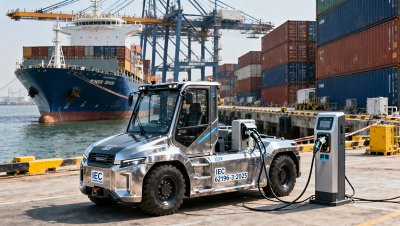
World's Largest Methanol-Fueled Container Ship Named
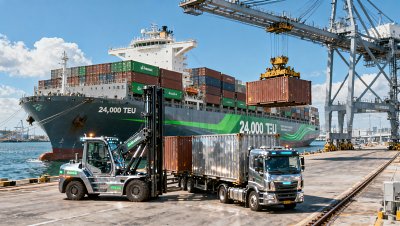
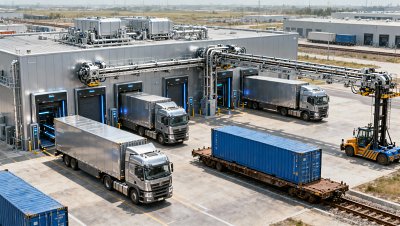
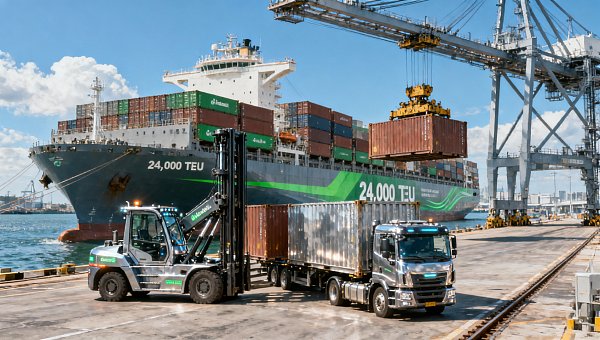
On May 10, 2026, the world’s first 24,000-TEU methanol dual-fuel container ship was named in Nantong, Jiangsu Province — a milestone signaling accelerated green export of China’s land-based port handling equipment. Its propulsion system and bunkering standards are expected to drive upstream adaptation across terminal logistics machinery, including yard tractors, stacker cranes, and reach stackers.
Event Overview
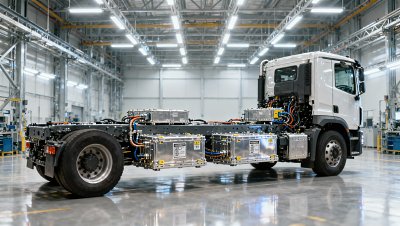
On May 10, 2026, a 24,000-TEU methanol dual-fuel container ship was officially named in Nantong, Jiangsu Province. This vessel is recognized as the largest methanol-fueled container ship globally. Its powertrain architecture and associated methanol fueling specifications have been finalized under IACS and ISO/TC 193 frameworks. Several Chinese specialized vehicle manufacturers have initiated R&D programs for methanol-compatible chassis platforms; pilot production models are scheduled for release in 2027.
Industries Affected
Direct Trading Enterprises
Shipping lines and international freight forwarders operating on Asia–Europe or trans-Pacific routes face near-term pressure to align terminal handling contracts with emerging low-carbon fuel infrastructure. Methanol compatibility at key ports — especially those serving as transshipment hubs — may become a de facto condition for slot allocation or preferential berthing, affecting operational continuity and cost predictability.
Raw Material Procurement Enterprises
Companies sourcing methanol for marine fuel blending or industrial use must reassess supply chain resilience. Current global methanol production remains heavily concentrated in China, the Middle East, and the U.S., but maritime-grade methanol (meeting ISO 8528:2023 purity and trace contaminant thresholds) requires additional purification steps. Procurement teams need to verify supplier certification status and evaluate lead-time variability amid rising demand from shipping and port equipment sectors.
Manufacturing Enterprises
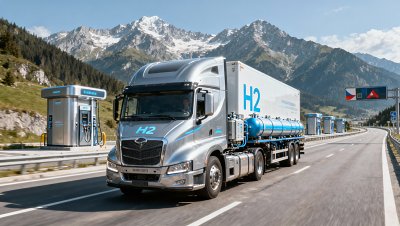
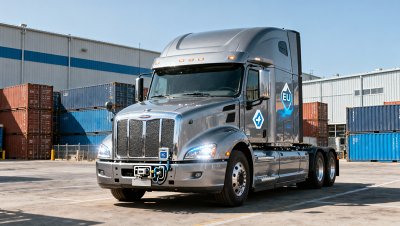
Original Equipment Manufacturers (OEMs) of port-side material handling equipment — particularly those supplying traction units and lifting machinery — are now required to integrate dual-fuel capability (methanol/hydrogen-ready) into next-generation platform designs. This entails revised engine control unit (ECU) calibration, corrosion-resistant fuel delivery systems, and updated safety interlocks. Investment in new test benches and emissions validation labs is becoming non-negotiable for Tier-1 suppliers bidding on port modernization tenders.
Supply Chain Service Providers
Fuel logistics operators, bunker surveyors, and classification society service units must update technical protocols for methanol transfer, storage, and quality verification. Unlike LNG, methanol poses distinct hazards related to toxicity, water miscibility, and material compatibility — requiring revised crew training modules, updated MSDS documentation, and enhanced vapor detection coverage at shore-side facilities.
Key Focus Areas and Recommended Actions
Evaluate Fuel Infrastructure Readiness at Key Terminals
Enterprises should conduct gap assessments against ISO/IEC 8528:2023 and OCIMF Methanol Bunkering Guidelines, focusing on vapor recovery, spill containment, and personnel PPE compliance — especially for terminals handling more than two methanol-fueled vessels per month.
Review Chassis Platform Roadmaps for Dual-Fuel Compatibility
Equipment buyers and lessors should request OEM roadmaps confirming methanol readiness timelines, including software-defined fuel flexibility, retrofit feasibility for legacy units, and third-party certification status (e.g., DNV Type Approval for methanol combustion systems).
Engage Early with Classification Societies on Certification Pathways
Manufacturers and integrators are advised to initiate pre-submission consultations with ABS, DNV, or CCS on methanol-specific notations (e.g., “Methanol-Fueled” or “H₂-Ready”) to avoid design rework and certification delays during type approval.
Editorial Insight / Industry Observation
Observably, this naming event does not represent an isolated technological achievement — rather, it functions as a catalyst accelerating standardization convergence across maritime energy systems and landside logistics hardware. Analysis shows that regulatory momentum (e.g., EU FuelEU Maritime phase-in schedules, China’s ‘Green Port’ action plan) is increasingly favoring interoperable, multi-fuel-capable infrastructure over single-path decarbonization bets. From an industry perspective, the shift is better understood not as a transition *to* methanol, but as a strategic pivot *toward fuel-agnostic platforms* — where methanol serves as both a near-term enabler and a functional testbed for hydrogen integration.
Conclusion
This milestone underscores how vessel-level innovation exerts cascading influence across port ecosystems — transforming fuel choice from a vessel specification into a systemic requirement. A rational interpretation is that competitiveness in global container logistics will increasingly hinge not only on vessel efficiency, but on the speed and coherence of landside equipment modernization. The real benchmark going forward lies in synchronization: between ship design, terminal infrastructure upgrades, and equipment lifecycle planning.
Source Attribution
Official announcement issued by China State Shipbuilding Corporation (CSSC), May 10, 2026; supporting technical parameters verified via DNV Marine Systems Briefing No. MB-2026-041; ISO/TC 193 Working Draft WD 8528-2 (Methanol Fuel Specifications for Maritime Use) remains under balloting — status to be monitored through Q3 2026.
Trending News
- South China Pioneer Studio Wins Youth May 4th Award for Smart Truck Certification
- World's Largest Methanol-Fueled Container Ship Named
- Multi-Dept Launches New Freight Hub Resilience Action
- Kunming Launches Jacaranda-Themed EV Buses; Design Draws Interest from South America
- L4 Autonomous Container Trucks Begin Trial on Tianjin Port–Xiong'an Corridor
Tag
Recommended News
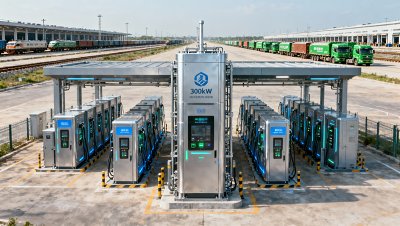
 New Energy TrucksWorld's Largest Methanol-Fueled Container Ship NamedWorld's largest methanol-fueled container ship named — accelerating green adoption across land-based port handling equipment, yard tractors, stacker cranes & reach stackers.
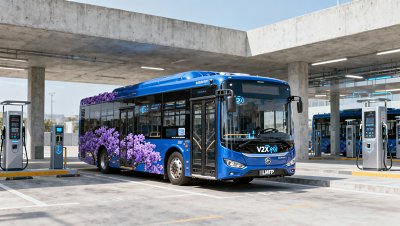
 New Energy TrucksKunming Launches Jacaranda-Themed EV Buses; Design Draws Interest from South AmericaKunming's jacaranda-themed EV buses showcase China's design-led electric bus innovation — drawing strong interest from South America's transport operators.
 New Energy TrucksNanning IRP Launches Smart EV Freight Charging & Swapping StationNanning IRP’s smart EV freight charging & swapping station — China’s first for cross-border heavy-duty trucks — boosts efficiency, cuts downtime, and sets a new benchmark for China–ASEAN green logistics.
 New Energy TrucksNanning IRP Launches First Cross-Border EV Heavy-Duty Charging HubNanning IRP launches China’s first cross-border EV heavy-duty charging hub—enabling 3-min battery swaps, V2G, and TMS integration for China–ASEAN freight.
 New Energy TrucksNanning IRP Launches RCEP-Focused EV Freight Charging HubNanning IRP launches China’s first RCEP-focused EV freight charging hub—300kW fast charge, battery swap & AI dispatch for China–Vietnam/Laos cross-border logistics.
 New Energy TrucksNanning IRP Launches RCEP-Focused EV Freight Charging HubNanning IRP launches China’s first RCEP-focused EV freight charging hub—300kW fast charge, battery swap & AI dispatch for China–Vietnam/Laos cross-border logistics.
 New Energy TrucksNanning IRP Launches RCEP-Focused EV Freight Charging HubNanning IRP launches China’s first RCEP-focused EV freight charging hub—300kW fast charge, battery swap & AI dispatch for China–Vietnam/Laos cross-border logistics.
 New Energy TrucksNanning IRP Launches RCEP-Focused EV Freight Charging HubNanning IRP launches China’s first RCEP-focused EV freight charging hub—300kW fast charge, battery swap & AI dispatch for China–Vietnam/Laos cross-border logistics.
 New Energy TrucksNanning IRP Launches RCEP-Focused EV Freight Charging HubNanning IRP launches China’s first RCEP-focused EV freight charging hub—300kW fast charge, battery swap & AI dispatch for China–Vietnam/Laos cross-border logistics.
 New Energy TrucksKunming's Blue Jacaranda Themed Buses Launch with Domestic Smart Scheduling & New Energy ChassisKunming's blue jacaranda buses debut with domestic smart scheduling & new energy LFMP chassis—key benchmark for global urban transit equipment exporters and smart mobility integrators.
 New Energy TrucksNanning IRP Launches Smart EV Charging Hub for ASEAN FreightNanning IRP's Smart EV Charging Hub powers ASEAN freight with intelligent charging, maintenance & green refueling — a game-changing infrastructure leap for cross-border electric truck operators.
 New Energy TrucksChina Launches New Freight Hub Initiative Targeting Smart EV Truck SwappingSmart EV truck battery-swap hubs take center stage in China’s new National Freight Hub Initiative—unlocking opportunities for OEMs, integrators & global logistics operators.
 New Energy TrucksChina Launches New Freight Hub Strengthening ActionChina's new Freight Hub Strengthening Action prioritizes intelligent battery-swap hubs & multimodal terminals—key for EV truck OEMs, logistics providers, and global supply chain enablers.
 New Energy TrucksGermany Launches H2-Truck Corridor Tender: Chinese OEMs Eligible as PartnersH2-Truck Corridor tender launched in Germany—Chinese OEMs invited as technology partners. €180M cross-border hydrogen freight initiative with EU CBAM credit potential.
 New Energy TrucksUS CBP Launches Traceability Review for EV Heavy-Duty Truck Battery ComponentsEV heavy-duty truck battery components now face US CBP traceability review—learn how firmware hashes, Battery Passports & Tier-3 docs impact your exports.
 New Energy TrucksHebei Launches H2 Heavy-Duty Truck Export Channel to EUH2 heavy-duty truck export channel launched: Hebei opens EU test route for green hydrogen trucks — key for OEMs, certifiers & hydrogen infrastructure.
 New Energy TrucksHebei Unveils '15th Five-Year' Transport Plan: Hydrogen Heavy-Duty Truck Corridor and Export Test ChannelsHydrogen heavy-duty truck manufacturers & international fleet operators: Hebei launches Beijing–Tianjin–Shijiazhuang corridor and Tangshan/Caofeidian export test channels — accelerate global validation and market entry.
 New Energy TrucksJining, Shandong Builds 132 E-Heavy-Duty Truck Charging StationsJining, Shandong builds 132 e-heavy-duty truck charging stations — ultra-fast 360kW liquid-cooled chargers with AI battery monitoring. A global reference for green freight corridors.
 New Energy TrucksNanning IRP Launches EV Freight Charging Station for W. Sea-Air CorridorNanning IRP's new EV freight charging station boosts W. Sea-Air Corridor logistics — 300 V2G terminals, ASEAN-standard support, and cold-chain readiness. Discover how it reshapes cross-border EV freight viability.
 New Energy TrucksHebei's 15th Five-Year Transport Plan Launches Hydrogen Heavy-Duty Truck CorridorHydrogen heavy-duty truck corridor launched in Hebei—key opportunity for manufacturers, logistics operators & clean energy developers targeting Mongolia/Russia markets.
 New Energy TrucksJining, Shandong Builds 132 E-Heavy-Duty Truck Charging StationsJining, Shandong’s 132 e-heavy-duty truck charging stations set a new benchmark for GB/T 20234.3–2025 compliance—key for global exporters, OEMs & infrastructure integrators.
 New Energy TrucksHebei's 15th Five-Year Plan Launches Beijing-Tianjin-Hebei H2 Truck CorridorHebei's 15th Five-Year Plan launches the Beijing-Tianjin-Hebei H2 truck corridor — a strategic gateway for hydrogen heavy-duty vehicle exporters, OEMs, and green transport partners to validate GB/T 34592-compliant trucks in real port logistics environments.
 New Energy TrucksJining, Shandong Builds 132 EV Heavy-Duty Truck Charging StationsEV heavy-duty truck charging stations in Jining, Shandong: 132 sites deployed + local standard launched — a scalable model driving global EPC-plus-operations exports.
 New Energy TrucksNanning Rail Port Builds EV Charging Hub for Western Land-Sea CorridorNanning Rail Port's new EV charging hub accelerates green freight along the Western Land-Sea Corridor — vital for cross-border logistics, EV exporters & ESG-compliant shippers.
 New Energy TrucksChina's First 10,000-Ton Pure-Electric Smart Container Ship Enters ServiceChina's first 10,000-ton pure-electric smart container ship launches—driving urgent 800V/V2G and IEC 62196-3:2025 compliance for port terminal tractors and logistics equipment suppliers.