China Sets Unified Rules for L3 Autonomous Trucks
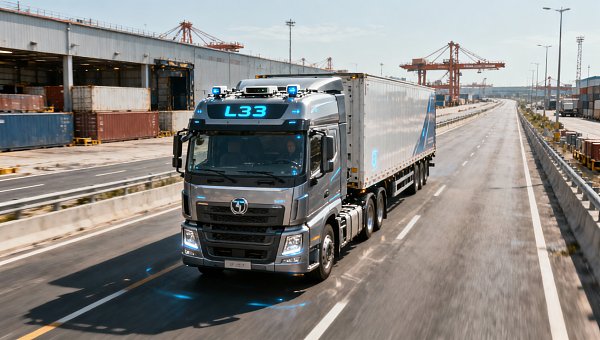
China’s new national rule for L3 autonomous heavy trucks took effect on June 10, 2026, marking the first time accident liability under defined L3 operating conditions has been set out in a formal regulatory framework. For truck makers, fleet operators, supply chain service providers, and companies watching export opportunities, the development is worth close attention because it clarifies how responsibility is assigned when the automated driving system is engaged and also strengthens the domestic legal basis behind Chinese-made L3 trucks entering overseas markets.
What the new rule formally establishes
China’s Ministry of Industry and Information Technology, Ministry of Transport, and Ministry of Public Security jointly issued the Administrative Measures for the Operation of L3 Autonomous Heavy Trucks, referenced as Gong Xin Bu Lian Zhuang [2026] No. 28. The measure came into force on June 10, 2026.
According to the provided information, when an accident occurs while the L3 system is activated, liability falls on the vehicle manufacturer if the vehicle is operating within its Operational Design Domain (ODD) and the driver has not taken over in violation of the rules. The same information also indicates that the rule provides domestic legal support for the overseas expansion of Chinese-produced L3 heavy trucks and is being increasingly referenced by emerging markets including the United Arab Emirates and Chile.
Why different market participants may feel the impact
Vehicle manufacturers face a clearer accountability boundary
From an industry perspective, truck manufacturers are the most directly affected group because the rule links liability to system-activated operation within the defined ODD. That makes ODD definition, system capability claims, compliance documentation, and post-incident traceability especially relevant business points.
Fleet-side operations now depend more on compliant use conditions
Operators and end users may be affected because the practical use of L3 heavy trucks will be judged against whether the vehicle was running inside the approved ODD and whether the driver’s takeover behavior complied with the rules. In business terms, this puts more attention on operating procedures, driver management, and records that support compliant deployment.
Service and supply chain partners may see higher documentation demands
Analysis shows that service providers and supply chain participants may also be affected indirectly. As responsibility becomes more clearly allocated, supporting functions such as delivery records, vehicle status documentation, operating condition confirmation, and communication between manufacturers and users are likely to receive closer scrutiny in actual transactions and service arrangements.
Export-oriented businesses gain a new reference point
Companies involved in overseas market development may view the rule as relevant because the provided information states that it offers domestic legal backing for Chinese L3 heavy trucks going abroad. For export-linked business roles, the main effect is not automatic market access, but a stronger policy reference when discussing compliance logic with overseas customers and regulators in markets that are already looking at this framework.
What companies should watch next in practice
How official language around ODD is applied
What deserves closer attention is the practical meaning of operating within the ODD. The current information confirms that ODD compliance is central to liability allocation, so manufacturers, operators, and customers should pay close attention to how this boundary is described, presented, and evidenced in real business settings.
The gap between legal wording and commercial execution
Analysis shows that a formal rule and day-to-day deployment are not the same thing. Businesses should distinguish between the policy signal itself and how it translates into procurement terms, delivery acceptance, service commitments, and incident-response preparation.
Materials and records used in customer communication
For companies selling, procuring, or deploying L3 heavy trucks, it is worth reviewing which technical and compliance materials are used in customer-facing communication. The reason is straightforward: where liability is condition-based, the accuracy and consistency of operating-condition descriptions become more important.
Developments in reference markets abroad
The provided information notes that emerging markets such as the United Arab Emirates and Chile are accelerating their reference to this rule. Companies with export plans should therefore keep watching how such markets interpret or adapt similar principles, rather than assuming that domestic recognition and overseas implementation are identical.
How this development is best understood at this stage
Observably, this is more than a routine policy release because it introduces a formal liability allocation principle for L3 autonomous heavy trucks under specified conditions. At the same time, it is more appropriate to understand it as both an immediate regulatory change inside China and a longer-term signal for how commercial deployment and cross-border acceptance may evolve.
Analysis shows that the most important point is not simply that a rule has taken effect, but that accountability is now tied to defined technical and operational conditions. That makes compliance boundaries, evidence chains, and system-use scenarios more central to business decisions than broad narratives about autonomous driving adoption.
A clearer rule, but not the final word
In practical terms, this development gives the L3 autonomous heavy truck segment a clearer legal reference point in China, especially on accident liability when the system is engaged within its defined ODD. For the industry, the more rational reading is that the rule reduces one layer of uncertainty, while leaving room for continued observation on implementation, commercial practice, and overseas adoption.
Basis of this article
This article is based on the user-provided news title, event date, and event summary. Information of this kind is typically cross-checked against sources such as official government notices, company statements, industry association updates, authoritative media reporting, and standards-related documents.
A specific official source link was not provided in the input, so the exact official publication path still requires further verification. Where continued observation is needed, the main areas to watch are later official wording, practical implementation in business operations, and how overseas reference markets apply or interpret similar rules.
Trending News
- When does a light commercial vehicle for urban delivery save fleet costs?
- How to choose an off road truck for steep and unstable job sites
- How to match crane truck lifting capacity to your jobsite loads
- What drives logging truck cost beyond the base purchase price?
- How to match lowbed trailer deck height to your hauling equipment
Tag
Recommended News
 Autonomous TrucksHong Kong Expo Highlights New Export Checks for L3+ Truck SystemsHong Kong Expo highlights new export checks for L3+ truck systems, from compliance files to delivery readiness. See what overseas fleet buyers and Tier 1 integrators may require next.
 Autonomous TrucksChina Enacts Unified L3 Truck Rule on June 10China Enacts Unified L3 Truck Rule on June 10: learn how the new L3 autonomous truck rule, V2X mandate, and liability shift reshape compliance, exports, and fleet risk.
 Autonomous TrucksChina Sets Unified Rules for L3 Autonomous TrucksChina sets unified rules for L3 autonomous trucks, defining accident liability within ODD conditions. Explore what it means for truck makers, fleets, compliance, and export growth.
 Autonomous TrucksNational Rule for L3 Autonomous Trucks Takes EffectNational Rule for L3 Autonomous Trucks takes effect nationwide, clarifying liability, insurance, compliance, and supplier risk. Learn what fleets, buyers, and operators must review now.
 Autonomous TrucksCodelco's L4 Mining Truck Tender Requires ISO 34502 ValidationCodelco's L4 mining truck tender mandates ISO 34502 validation — the first global operational use of this standard. Discover compliance insights, supplier impacts, and strategic actions for陆路运输设备 exporters and OEMs.
 Autonomous TrucksLuKai Alpha 125 Mining Transport Robot Enters Mass DeliveryLuKai Alpha 125 mining transport robot enters mass delivery — GNSS-denied, KAZMINE-2026 certified autonomous haulage for copper mines in Kazakhstan.
 Autonomous TrucksL4 Autonomous Container Tractor Chassis Emerges as New Export Vehicle for China's Smart Shipping StrategyL4 autonomous container tractor chassis: China's new export-ready smart shipping solution for global logistics—modular, UN R156-precompliant, and infrastructure-adaptive.
 Autonomous TrucksLuKai Alpha 125 Mining Robot Enters Mass DeliveryLuKai Alpha 125 mining robot — L4 autonomous haulage, 90-ton payload, GNSS-free navigation — now in mass delivery for global mines.
 Autonomous TrucksLuKai Alpha 125 Autonomous Mining Truck Enters Mass DeliveryLuKai Alpha 125 autonomous mining truck enters mass delivery — L4-level, 90-ton payload, −40°C certified. First units deployed in Kazakhstan copper mine.
 Autonomous TrucksBeijing to Open L4 Smart Truck Platoon Test Roads in Q3 2026L4 smart truck platoon testing lanes launching Q3 2026 on Beijing’s JingTai & JingXiong Expressways — key opportunity for V2X, platoon algorithms & smart logistics exporters.
 Autonomous TrucksBeijing to Open L4 Smart Truck Platooning Test on Jingxiong Expressway in 2026L4 smart truck platooning tests launch on Jingxiong Expressway in 2026—key opportunity for global transport tech integrators and fleet operators to validate C-V2X + BeiDou compliance.
 Autonomous TrucksPony.ai Launches Europe's First Commercial Robotaxi Service in CroatiaPony.ai launches Europe's first commercial Robotaxi service in Croatia, showcasing China's L4 autonomous driving tech meeting EU safety standards. A milestone for AV, logistics & transport industries.
 Autonomous TrucksInner Mongolia Pilot Zone Launches Cross-Border Autonomous Transport ChannelInner Mongolia's cross-border autonomous transport channel launches, revolutionizing logistics with smart vehicle tech. Key for automotive, logistics, and trade sectors under China-Mongolia-Russia Economic Corridor.
 Autonomous TrucksNeolix L4 Autonomous Delivery Vehicle Debuts at AMR Expo, Accelerating Global Smart LogisticsNeolix's L4 autonomous delivery vehicle debuts at AMR Expo, featuring temperature control & V2X tech. Approved for road tests in UAE, Singapore & Germany, revolutionizing global smart logistics for last-mile delivery.
 Autonomous TrucksNeolix L4 Autonomous Delivery Vehicle Debuts at AMR Expo, Accelerating 'Last Mile' SolutionsNeolix's L4 autonomous delivery vehicle debuts at AMR Expo, revolutionizing last-mile solutions with CE pre-assessment & UN-R155 certification. Discover how this smart logistics innovation cuts costs 15-20% for e-commerce and cross-border trade.
 Autonomous TrucksInner Mongolia Free Trade Zone Approved, Exploring Cross-Border Autonomous TransportChina's Inner Mongolia Free Trade Zone approval boosts autonomous cross-border transport, creating opportunities for L4 truck makers and Eurasian logistics. Explore policy impacts on smart freight and trade routes.
 Autonomous TrucksInner Mongolia Free Trade Zone Approved, Exploring Cross-Border Autonomous TransportChina's Inner Mongolia Free Trade Zone approved for autonomous cross-border transport, boosting smart logistics & Eurasian trade. Explore key impacts on autonomous driving, freight efficiency, and tech partnerships.
 Autonomous TrucksBeijing-Xiongan Commuter Express Launches with L4 Autonomous ShuttlesDiscover how the Beijing-Xiongan Commuter Express with L4 autonomous shuttles revolutionizes smart mobility. Learn about China's advanced AV technology and export potential for global buyers in transit solutions.
 Autonomous TrucksWhat autonomous driving readiness levels are supported by current GPS-tracked bulldozer platforms?BULLDOZER with GPS tracking supports Level 1–2 autonomy for precision pipeline & infrastructure work. Explore EXCAVATOR for pipeline installation, heavy truck chassis supplier for heavy haulage, and more on The Global Heavy Truck Industry Platform.