China’s Commercial Vehicle Exports Jump 50.28%
On June 5, 2026, the latest data from China’s Ministry of Commerce showed that commercial vehicle exports reached 327,900 units in the first four months of the year, up 50.28% year on year. Within that, pure electric heavy truck exports rose 137%, with Chile, Brazil, Thailand, and Vietnam identified as key destinations. For manufacturers, parts suppliers, exporters, and procurement teams, this update is worth watching because it points not only to stronger vehicle shipments, but also to faster demand formation around electric heavy truck chassis, battery packs, and intelligent electronic control systems in overseas markets.
What the latest export data confirms
According to the information provided, China exported 327,900 commercial vehicles from January to April 2026, representing a year-on-year increase of 50.28%. The same update states that pure electric heavy truck exports increased 137% over the same period.
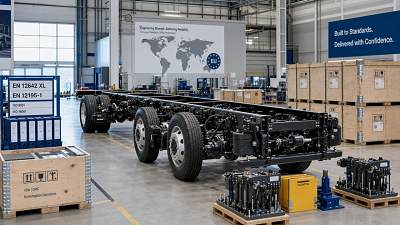
The main destinations mentioned for these pure electric heavy trucks are Chile, Brazil, Thailand, and Vietnam. The summary also indicates that faster local infrastructure development and the rollout of charging facility subsidy policies have contributed to a sharp rise in procurement demand for electric heavy truck chassis, battery packs, and intelligent electronic control systems.
The information further shows that this demand change is opening a window for Chinese component suppliers to pursue localized supporting cooperation in those markets.
Why the impact reaches beyond vehicle exports
Export traders are likely to focus on product mix changes
From an industry perspective, the significance for direct trading companies is not limited to higher shipment volume. The sharper increase in pure electric heavy truck exports suggests that the export structure itself deserves closer attention. What matters in business terms is whether customer inquiries and order discussions are increasingly tied to complete vehicle delivery plus follow-on component support.
Parts manufacturers may see demand shift toward localized matching
Analysis shows that chassis, battery pack, and intelligent electronic control suppliers are among the most directly affected participants in the chain because these categories are specifically referenced in the summary as seeing stronger procurement demand. The practical impact may appear in quotation cycles, technical coordination, product matching, and cooperation discussions linked to localized supply support.
Supply chain and delivery teams need to watch execution details
For supply chain service providers and fulfillment teams, the update matters because rising overseas demand for electric heavy truck-related systems can increase the importance of delivery rhythm, documentation readiness, and coordination across vehicle and component orders. Observably, the issue is not only whether demand is rising, but how quickly supporting supply arrangements must adapt to market-specific project timing.
Overseas buyers may move from vehicle interest to systems procurement
For procurement-side participants in Chile, Brazil, Thailand, and Vietnam, the information suggests that demand is extending beyond finished vehicles into supporting systems and key assemblies. That means business conversations may increasingly center on compatibility, supply continuity, and localized supporting capacity rather than on export pricing alone.
What companies should track next
Watch whether official wording becomes more specific
What deserves closer attention is whether subsequent official releases provide more detailed wording on export categories, destination market developments, or implementation signals tied to electric heavy truck demand. For companies, this affects how aggressively they interpret the current data point.
Prioritize the named markets and product categories
Based on the confirmed information, Chile, Brazil, Thailand, and Vietnam are the markets currently most directly mentioned, while chassis, battery packs, and intelligent electronic control systems are the product areas most clearly tied to rising procurement demand. Companies involved in these lines may need to prioritize customer communication and market follow-up around these intersections first.
Separate policy momentum from order conversion
Analysis shows that infrastructure acceleration and charging subsidy rollout are meaningful signals, but they are not the same as fully realized long-term orders. Businesses should distinguish between policy support, inquiry growth, and actual procurement execution when planning production, inventory, and market development actions.
Prepare for tighter coordination on documents and lead times
For exporters and component suppliers, the current signal points to the need for clearer preparation around supplier qualifications, technical documentation, delivery schedules, and customer-facing response plans. If localized supporting cooperation becomes more active, these practical details can become more important than broad market narratives.
How this signal should be interpreted for now
In observation terms, this update is more than a simple export growth headline because the strongest growth highlighted in the summary is concentrated in pure electric heavy trucks, and the downstream demand points are already linked to specific component categories. That gives the development a clearer industrial meaning than a generic trade rebound.
At the same time, it is more appropriate to understand this as a strong directional signal rather than a fully settled long-term outcome. The current information confirms growth, target markets, and procurement interest drivers, but it does not by itself establish how broad or durable the localized cooperation trend will become across all markets and suppliers.
What the industry can reasonably take from this update
A balanced reading of this development is that China’s commercial vehicle export growth is being accompanied by a more visible expansion in electric heavy truck demand, especially in parts of Latin America and Southeast Asia named in the update. For the industry, the practical meaning lies in the growing connection between vehicle exports and component-level cooperation opportunities.
At this stage, the news is best understood as an actionable market signal with clear relevance for exporters, parts suppliers, procurement teams, and delivery operators, while still requiring continued observation on how policy support translates into sustained local business execution.
Basis of this article and items requiring further verification
This article is based on the user-provided news title, event date, and event summary. The specific official source link was not provided in the input, so the underlying official release still requires ongoing verification.
For this type of industry update, commonly relevant source categories may include official government announcements, company disclosures, industry association information, authoritative media reports, and standards-related documents. The areas that merit further tracking are whether later disclosures add detail on market implementation, category-specific export trends, and the progress of localized supporting cooperation in the named destinations.
Tag
Recommended News
 Global Truck MarkeChina’s Commercial Vehicle Exports Jump 50.28%China’s commercial vehicle exports jump 50.28%, led by surging electric heavy truck demand. Explore key markets, EV truck parts opportunities, and export trends shaping global procurement.
 Global Truck MarkeCommercial Trucks Manufacturer in Germany: Market Position in 2026Commercial trucks manufacturer in Germany insights for 2026: explore market position, technology readiness, export strength, and supplier value to identify smarter sourcing opportunities.
 Global Truck MarkeHow to Vet a Logging Truck Distributor Before Entering a New MarketLogging truck distributor vetting starts with market knowledge, service reach, and compliance checks. Discover key questions, red flags, and smart verification tips before expanding.
 Global Truck MarkeCommercial Trucks Manufacturer in Germany: Market Strengths in 2026Commercial trucks manufacturer in Germany insights for 2026: explore market strengths, export reliability, sourcing trends, and smart buying tips for global fleet decisions.
 Global Truck MarkeLight Duty Truck Manufacturer in USA: What Sets Leading Models ApartLight duty truck manufacturer in USA guide: compare fuel efficiency, payload, safety, upfit flexibility, and dealer support to choose the best model for delivery, service, or construction.
 Global Truck MarkeTruck Chassis Supplier in Europe: What to Compare Beyond Unit PriceTruck chassis supplier in Europe: compare compliance, customization, delivery reliability, and after-sales support beyond unit price to reduce sourcing risk and improve lifecycle value.
 Global Truck MarkeHeavy Equipment Export to Africa: Market Gaps and Practical Entry PointsHeavy equipment export to Africa: uncover market gaps, high-demand equipment segments, and practical entry points to reduce risk, find reliable partners, and grow faster in Africa.
 Global Truck MarkeIs a Semi Trailer Distributor Better for Faster Regional CoverageSemi trailer distributor solutions for faster regional coverage: compare models, reduce sourcing risk, improve delivery speed, and expand dealer reach with stronger local support.
 Global Truck MarkeDelivery Truck Supplier in USA: How to Compare Service and Lead TimeDelivery truck supplier in USA comparison guide: learn how to evaluate service quality, response speed, and realistic lead times to reduce sourcing risk and choose with confidence.
 Global Truck MarkeCommercial Trucks Manufacturer in Germany: What Makes Them CompetitiveCommercial trucks manufacturer in Germany insights: discover why German brands lead in engineering, efficiency, safety, and export strength across long-haul, construction, and urban fleet applications.
 Global Truck MarkeLight Duty Truck Manufacturer in USA: How to Compare Local OptionsLight duty truck manufacturer in USA comparison guide: learn how to evaluate local suppliers by application, service network, upfit support, and total cost to source smarter.
 Global Truck MarkeCommercial Trucks Manufacturer in Germany: What Global Buyers CompareCommercial trucks manufacturer in Germany: discover what global buyers compare most—engineering, compliance, delivery, TCO, and after-sales support—to source smarter and reduce fleet risk.
 Global Truck MarkeWhat to Expect from a Light Duty Truck Manufacturer in USA in 2026Light duty truck manufacturer in USA trends for 2026: explore smarter tech, better fuel efficiency, stronger compliance, and fleet-ready support to choose the right supplier.
 Global Truck MarkeHow to Compare Logging Truck Distributors Across RegionsLogging truck distributor comparison made practical: learn how to evaluate regional compliance, specs, lead times, service support, and total cost for smarter fleet sourcing.
 Global Truck MarkeWhy Light Duty Truck Manufacturers in the USA Are Gaining AttentionLight duty truck manufacturer in USA trends are reshaping delivery, utility, and fleet sourcing. Discover key market drivers, buyer tips, and how to choose the right supplier.
 Global Truck MarkeTruck Trailer Manufacturer Trends Reshaping Export Orders in 2026Truck trailer manufacturer trends in 2026 are reshaping export orders through compliance, customization, and supply chain pressure. Discover smarter sourcing insights now.
 Global Truck MarkeTruck Mining Demand in 2026: Where Growth Looks StrongestTruck mining demand in 2026 is rising across construction truck, lowbed trailer, truck mounted crane, refrigerated truck, mixer truck and fuel tank truck segments—see where growth is strongest.
 Global Truck MarkeSemi Trailer Manufacturer Lead Times Are Changing in Global MarketsSemi trailer manufacturer lead times are shifting globally. Learn how truck export, truck hydraulic, truck tanker, truck aluminum and key parts affect delivery risk and smarter sourcing.
 Global Truck MarkeGlobal Truck Market Signals That Could Affect Parts Demand Next YearTruck turbocharger and engine assembly trends could reshape industrial transportation parts demand next year. Explore truck gearbox, filter, bearing, and compressor signals for smarter sourcing.
 Global Truck MarkeWhy Semi Trailer Price Quotes Vary So Much Across Export MarketsTruck trailer price and semi trailer price quotes vary by specs, Incoterms, compliance, and freight. Learn how to compare a semi trailer supplier and truck trailer for sale offers wisely.
 Global Truck MarkeConstruction machinery distributor tiering: How regional reps differ from national partnersCompare water truck cost, crane truck quotation & truck parts quotation across Tier-1 national partners vs. Tier-2 regional reps—optimize pricing, lead time & compliance.
 Global Truck MarkeWater truck distributor networks in Southeast Asia: Who controls supply and pricing?Discover water truck cost drivers, construction machinery quotation benchmarks, and crane truck distributor margins across SEA—get transparent, data-backed pricing insights now.
 Global Truck MarkeLogging truck OEM delivery timelines: why Q3 2026 orders face extended port delaysLogging truck OEM delays hit Q3 2026 orders—8–12 week port bottlenecks impact heavy duty trucks for sale in Canada, Australia, South Africa. Bulldozer supplier & excavator supplier planning must adapt now.
 Global Truck MarkeLogging truck bulk order lead times jumped 42% in Q1 2026 — what’s causing the delay?Logging truck bulk order delays up 42% in Q1 2026 — explore root causes, cross-segment impacts on water truck OEM, construction machinery OEM & more, and actionable mitigation strategies.
 Global Truck MarkeTruck crane lifting capacity drops above 2,000m elevation — is derating mandatory?Truck crane derating above 2,000m is mandatory—impacting truck hydraulic system, engine, brake system, suspension & axle performance. Verify altitude-certified models now.