EU Enforces Heavy-Duty Truck Carbon Footprint Rules from June 2026
Starting 1 June 2026, the European Commission will require all heavy-duty trucks—including chassis, complete vehicles, and modified units—exported to the EU market to submit third-party Product Environmental Footprint Category Rules (PEFCR)-compliant carbon footprint reports. This development directly affects Chinese heavy-truck OEMs, specialized vehicle exporters, and their upstream component suppliers, marking a significant shift in environmental compliance requirements for automotive exports to the EU.
Event Overview
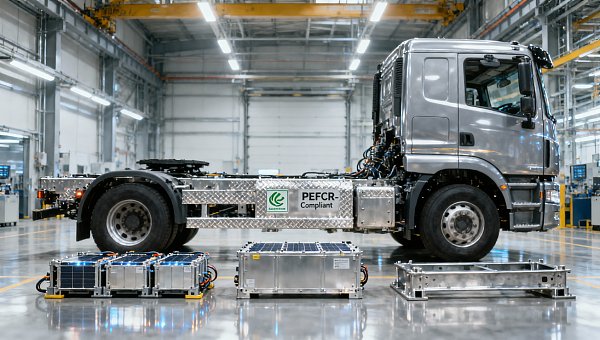
The European Commission has officially announced that, effective 1 June 2026, all heavy-duty trucks placed on the EU market must be accompanied by a PEFCR-aligned environmental footprint report verified by an accredited third party. The scope explicitly covers key subsystems including battery systems, driver cabs, and chassis frames. Products failing to meet this requirement will be ineligible for CE type-approval and subsequent customs clearance in EU member states.
Industries Affected
Direct Exporters (Heavy-Truck & Specialized Vehicle OEMs)
These companies face immediate regulatory exposure: CE type-approval is a mandatory pre-market step, and absence of a valid PEFCR report blocks certification. For Chinese exporters, this means existing export pathways may stall unless LCA (life cycle assessment) modeling and data collection are completed and validated ahead of the deadline.
Component Suppliers (Tier 1–2, especially battery, cab, and frame manufacturers)
Since the PEFCR mandate applies to individual subsystems—not just final vehicles—suppliers must generate and share granular, auditable environmental data. Smaller suppliers report longer testing lead times and higher per-unit verification costs, creating bottlenecks in joint certification efforts with OEMs.
Supply Chain Service Providers (LCA consultants, testing labs, certification bodies)
Demand for PEFCR-aligned LCA support is rising sharply, particularly among Chinese firms unfamiliar with EF methodology or lacking internal environmental data infrastructure. However, limited availability of EU-accredited verifiers familiar with Chinese manufacturing processes may constrain scalability of support services.
What Enterprises and Practitioners Should Focus On Now
Monitor official guidance updates from the European Commission and EFTA authorities
The PEFCR for heavy-duty vehicles is still under refinement; final versions of sector-specific rules, data requirements, and acceptable databases (e.g., ELCD, ecoinvent) are expected before Q4 2025. Stakeholders should track publications via the EU’s Joint Research Centre (JRC) and the European Environment Agency (EEA).
Prioritize subsystem-level data collection for battery systems, cabs, and chassis
These three components are explicitly named in the regulation as covered categories. Exporters and suppliers should begin inventorying raw material sourcing, energy mix in production, transport logistics, and end-of-life assumptions—using ISO 14040/44-compliant LCA frameworks—to avoid last-minute gaps.
Distinguish between policy signal and operational readiness
While the 2026 enforcement date is fixed, transitional arrangements (e.g., grace periods for SMEs or phased reporting) have not been confirmed. Companies should treat the rule as binding but remain alert to potential flexibility mechanisms announced closer to implementation.
Initiate cross-tier alignment and documentation protocols now
OEMs should formalize data-sharing agreements with key suppliers—including confidentiality clauses and format standards (e.g., ILCD or OpenLCA-compatible exports)—to ensure seamless integration into vehicle-level PEFCR reports. Early alignment reduces rework risk and accelerates joint verification timelines.
Editorial Perspective / Industry Observation
Observably, this regulation signals a structural tightening of environmental due diligence at the product level—not merely a reporting exercise. It reflects the EU’s broader shift toward embedding lifecycle transparency into market access conditions. Analysis shows the PEFCR requirement functions less as a standalone standard and more as a foundational layer enabling future policies such as carbon border adjustments or green public procurement criteria. From an industry perspective, it is better understood not as a one-time compliance hurdle, but as the first enforceable milestone in a multi-year trajectory toward full environmental traceability across global automotive supply chains.
Conclusion
For Chinese exporters and their partners, the 2026 PEFCR mandate represents a material operational inflection point—not a distant policy footnote. Its significance lies not only in its technical scope, but in how it reshapes responsibility across tiers: from final assemblers down to material producers. Currently, it is more accurate to interpret this rule as a binding regulatory trigger requiring proactive adaptation, rather than a flexible guideline open to negotiation. Preparedness hinges on early data governance, tiered collaboration, and disciplined alignment with evolving EU technical specifications.
Source Information:
Primary source: European Commission official announcement (published May 2024, referencing Regulation (EU) No 2021/1119 and delegated acts under the Environmental Footprint initiative).
Note: Final PEFCR documents for heavy-duty vehicles remain pending publication; stakeholders should continue monitoring JRC and EEA channels for updates through 2025.
Trending News
- CATL Unveils Tianxing II Electric-to-Electric Range-Extended Heavy Truck Solution
- How much torque does a truck engine need for heavy-duty hauling?
- How to assess a crane truck distributor's spare parts support
- Volvo Group Forms Volvo Mining to Integrate Equipment and Autonomous Solutions
- How to verify spare parts availability with a crane truck supplier
Tag
Recommended News
 New Energy TrucksCATL Unveils Tianxing II Electric-to-Electric Range-Extended Heavy Truck SolutionCATL Tianxing II Electric-to-Electric Range-Extended Heavy Truck Solution signals a new era for battery swapping, fleet procurement, and logistics coordination. Explore key industry impacts and practical considerations.
 Buying GuideHow much torque does a truck engine need for heavy-duty hauling?How much truck engine torque do you need? Explore the 1,250–2,050 lb-ft range and learn how load, gearing, and gradients shape the right choice for heavy-duty hauling.
 Buying GuideHow to assess a crane truck distributor's spare parts supportAssess a crane truck distributor's spare parts support with practical checks for stock, delivery, and technical expertise. Discover how to reduce downtime and buy with confidence.
 Company NewsVolvo Group Forms Volvo Mining to Integrate Equipment and Autonomous SolutionsVolvo Mining will unite Volvo Group trucks, construction equipment and autonomous solutions from January 2027. Explore what this could mean for mining procurement and operational support.
 Buying GuideHow to verify spare parts availability with a crane truck supplierChoosing a crane truck supplier? Learn how to verify spare parts stock, compatibility, delivery times, and support commitments to reduce downtime and buy with confidence.
 Buying GuideHow to verify a truck trailer OEM's claimed payload capacityVerify a truck trailer OEM's payload claim with tare records, load calculations, and structural evidence. Learn key checks to avoid costly mistakes and buy with confidence.
 Buying GuideHow does operating weight affect the price of a new excavator?See how operating weight affects excavator price, transport costs, and productivity. Compare configurations and uncover the best value for your next equipment purchase.
 Buying GuideHow to compare concrete mixer truck suppliers by total landed costCompare truck cement mixer supplier quotes by total landed cost, including freight, duties, and delivery. Uncover hidden charges and choose the best-value truck for your fleet.
 Policy & RegulationsHow axle load limits affect low bed trailer exports to Southeast AsiaPlanning low bed trailer export to Southeast Asia? Learn how axle load limits affect legal payload, axle layouts, and route compliance to avoid costly mistakes before ordering.
 Truck TechnologyHow to locate a truck exhaust system leak before replacing partsLocate a truck exhaust system leak before replacing parts. Learn how to spot soot trails, confirm leaks safely, and identify root causes to avoid costly guesswork and repeat repairs.
 Buying GuideWhen does heavy equipment transport require a lowboy trailer?Does your heavy equipment need a lowboy trailer? Discover how loaded height, weight distribution, loading access, and route limits determine the right choice for safe transport.
 Fleet ManagementWhen does a light commercial vehicle for urban delivery save fleet costs?Light commercial vehicle for urban delivery: learn when route density, payload utilization, access, and driver productivity can reduce fleet cost per successful stop.
 Buying GuideHow to choose an off road truck for steep and unstable job sitesChoose the right off road truck for steep, unstable job sites. Compare traction, braking, stability, clearance, payload, and route-test essentials.
 Buying GuideHow to match crane truck lifting capacity to your jobsite loadsCrane truck capacity planning made clear: calculate gross load, radius, rigging, outriggers, and ground conditions to select safer, job-ready lifting equipment.
 Transportation CostsWhat drives logging truck cost beyond the base purchase price?Logging truck cost goes far beyond the base price. Explore chassis, cranes, trailers, fuel, compliance, and support factors to make a smarter timber-hauling investment.
 Buying GuideHow to match lowbed trailer deck height to your hauling equipmentLowbed trailer deck height guide: match equipment clearance, ramp geometry, axle loads, tractor fit, and route limits for safer, more efficient hauling.
 Truck ExportWhat documents are needed to export a low bed trailer to Southeast Asia?Low bed trailer export to Southeast Asia: discover essential shipping, customs, origin, and technical documents to avoid delays and ensure smooth import clearance.
 Buying GuideWhat to verify before choosing a delivery truck supplier for school transportationDelivery truck supplier for school transportation: verify route fit, payload, safety, compliance, service support, and total cost before choosing a reliable partner.
 Buying GuideWhat an excavator manufacturer catalog should show before you compare modelsExcavator manufacturer catalog guide: verify supplier identity, configurations, hydraulics, compliance, parts support, and delivery readiness before comparing models.
 Buying GuideWhat to check before appointing a bulldozer distributorBulldozer distributor selection guide: evaluate service, parts availability, warranty, pricing, compliance, and lifecycle value to reduce downtime and protect fleet investment.
 Truck ExportHow to verify supplier reliability when sourcing bulldozers overseasBulldozer sourcing made safer: learn how to verify overseas suppliers, inspect quality, confirm specifications, manage export documents, and reduce lifecycle risk.
 Buying GuideWhat to verify before choosing a truck cement mixer supplierTruck cement mixer supplier checklist: verify chassis fit, drum quality, hydraulics, compliance, spare parts, and after-sales support before you buy.
 Buying GuideHow to verify a truck spare parts supplier before placing a bulk orderTruck spare parts supplier verification made practical: learn how to check part specifications, factory control, test records, samples, pricing, and delivery capability before placing a bulk order.
 Buying GuideWhat size truck container is right for a typical freight load?Truck container sizing made simple: compare payload, volume, pallet layouts, route access, and loading needs to choose the most efficient freight solution.
 Buying GuideWhat drives semi trailer price differences between similar models?Semi trailer price differences come down to frame materials, axles, suspension, coating, and configuration. Compare specifications line by line to choose lasting value.