Bulk Cement Tanker Selection: Capacity, Unloading Speed, and Downtime
Selecting a bulk cement tanker is rarely a simple matter of choosing the largest vessel available. In road transport equipment, tanker size, discharge speed, and serviceability shape how much material moves per shift and how often a vehicle sits idle. For operations tied to construction schedules, concrete batching plants, or dry bulk distribution, small specification gaps can turn into recurring delays, higher fuel use, and avoidable maintenance stops.
That is why a sound evaluation goes beyond catalog capacity. A practical bulk cement tanker decision considers payload efficiency, axle limits, blower performance, pipeline layout, material behavior, and the ease of keeping the unit in working condition. In a market where buyers increasingly compare suppliers through digital sourcing platforms and technical buying guides, selection discipline has become part of fleet productivity.
What a bulk cement tanker must do well
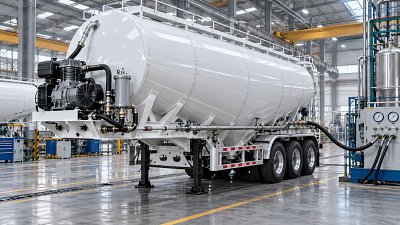
A bulk cement tanker is designed to carry powdered materials in sealed conditions and discharge them pneumatically. Cement is the most common cargo, but similar trailers may also handle fly ash, lime powder, or other dry bulk products with comparable flow characteristics.
In practice, the trailer performs three linked tasks. It must maximize legal payload, unload within acceptable site time, and return to service with minimal intervention. If one of these elements is weak, the overall transport cycle suffers.
This explains why the same nominal capacity can deliver very different business results. Two units may both be sold as a 40 m³ bulk cement tanker, yet one may discharge faster, resist contamination better, and require fewer unscheduled repairs.
Capacity is not only about cubic meters
Capacity is usually the first parameter reviewed, but volume alone can mislead. Dry bulk density changes by material type, moisture exposure, and compaction during transit. A tanker that looks ideal on paper may underperform if payload is constrained by gross vehicle weight or road regulations.
Matching vessel size to route reality
Long highway routes with stable unloading infrastructure often justify larger tankers. Short shuttle operations may benefit more from faster turnarounds than from maximum vessel volume. Urban access restrictions can also favor more compact configurations.
The useful question is not “How big is the tanker?” but “How much saleable material can it move within legal and operational limits?” That shifts attention from headline dimensions to transport efficiency.
For that reason, a bulk cement tanker used for pure cement distribution may be specified differently from one serving mixed dry bulk duties across several industrial customers.
Unloading speed shapes daily output
Discharge performance often decides whether a trailer supports smooth delivery or creates bottlenecks at the destination. A slow unloading process can erase the productivity gained from a larger payload.
Pneumatic unloading depends on the air compressor or blower, tank pressure management, cone angle, internal fluidization design, pipe diameter, and hose condition. Material quality also matters. Damp or poorly flowing cement increases resistance and extends discharge time.
The system matters more than one component
It is tempting to focus on compressor power alone. Yet a strong blower cannot compensate for restrictive piping, poor sealing, or badly designed internal geometry. A balanced system usually performs more reliably than an oversized single component.
- Check stated unloading rate under realistic pressure and material conditions.
- Review pipe routing for unnecessary bends and flow restrictions.
- Confirm compatibility with site silos, couplings, and hose standards.
- Assess how easily operators can inspect valves, filters, and discharge lines.
A bulk cement tanker that unloads consistently in varied site conditions often delivers greater value than one that reaches an impressive peak rate only in ideal circumstances.
Downtime usually begins with design details
Downtime is not only caused by major component failure. It often starts with recurring small issues: valve leakage, clogged filters, cracked hoses, uneven pressure, poor access to service points, or difficult cleaning after material contamination.
For a bulk cement tanker, maintenance-friendly design deserves the same attention as carrying capacity. If regular inspection takes too long or requires special disassembly, preventive work gets delayed and failure risk rises.
Materials and structure affect lifecycle cost
Steel grade, weld quality, surface protection, and fatigue resistance influence long-term durability. Lightweight aluminum designs may improve payload in some markets, but they require careful evaluation of operating conditions, repair capability, and lifecycle economics.
The same applies to suspension, landing gear, manholes, and pressure accessories. These are not secondary details. They influence workshop frequency, spare parts planning, and roadside reliability.
Where operating scenarios change the right specification
Not every transport task needs the same bulk cement tanker setup. Route length, climate, road condition, unloading infrastructure, and material consistency all shift the optimal balance.
For high-volume cement plant distribution, repeatability is critical. Standardized couplings, dependable blower output, and low residue discharge may outweigh flexibility. In remote infrastructure projects, service access and spare parts availability can matter even more.
Mining support routes or rough-road construction zones place extra stress on frames, suspension, and seals. Cross-border transport may add compliance requirements, dimensional limits, and support challenges for replacement components.
This is one reason digital B2B sourcing has become more valuable in heavy transport equipment. When platforms aggregate supplier data, product categories, and buying references across trailers, trucks, construction machinery, and spare parts, comparison becomes more structured. It becomes easier to check whether a bulk cement tanker specification matches regional operating needs rather than a generic brochure claim.
A practical framework for evaluation
A disciplined review process helps separate attractive specifications from usable ones. The goal is to compare tankers as operating assets, not just manufactured products.
Points worth verifying before shortlisting
- Actual payload under local axle and gross weight rules.
- Typical unloading time for the intended material, not a best-case figure.
- Compressor or blower brand, duty cycle, and service interval.
- Availability of valves, hoses, seals, and wear parts.
- Tank material, manufacturing quality, and pressure system certification.
- Compatibility with tractor units, site connections, and workshop capability.
It is also useful to compare supplier responsiveness. Technical drawings, test data, spare parts lists, and after-sales clarity often reveal more than promotional language. Reliable documentation reduces procurement uncertainty and supports long-term fleet planning.
Selection decisions should support fleet productivity
The best bulk cement tanker is not automatically the largest, lightest, or fastest unloading model. It is the one that fits the route profile, material type, legal load environment, and maintenance capacity without creating hidden delays.
For many buyers, the next step is to build a comparison sheet around three measurable outcomes: tons delivered per trip, minutes required for complete discharge, and hours lost to maintenance or faults over a defined operating period. Those figures create a clearer basis for supplier comparison than headline specifications alone.
When market intelligence, supplier access, and technical references are available in one place, the evaluation process becomes more efficient. That makes it easier to identify a bulk cement tanker that performs well not only at delivery, but across its full working life.
Trending News
- CATL Unveils Tianxing II Electric-to-Electric Range-Extended Heavy Truck Solution
- How much torque does a truck engine need for heavy-duty hauling?
- How to assess a crane truck distributor's spare parts support
- Volvo Group Forms Volvo Mining to Integrate Equipment and Autonomous Solutions
- How to verify spare parts availability with a crane truck supplier
Tag
Recommended News
 Buying GuideHow much torque does a truck engine need for heavy-duty hauling?How much truck engine torque do you need? Explore the 1,250–2,050 lb-ft range and learn how load, gearing, and gradients shape the right choice for heavy-duty hauling.
 Buying GuideHow to assess a crane truck distributor's spare parts supportAssess a crane truck distributor's spare parts support with practical checks for stock, delivery, and technical expertise. Discover how to reduce downtime and buy with confidence.
 Buying GuideHow to verify spare parts availability with a crane truck supplierChoosing a crane truck supplier? Learn how to verify spare parts stock, compatibility, delivery times, and support commitments to reduce downtime and buy with confidence.
 Buying GuideHow to verify a truck trailer OEM's claimed payload capacityVerify a truck trailer OEM's payload claim with tare records, load calculations, and structural evidence. Learn key checks to avoid costly mistakes and buy with confidence.
 Buying GuideHow does operating weight affect the price of a new excavator?See how operating weight affects excavator price, transport costs, and productivity. Compare configurations and uncover the best value for your next equipment purchase.
 Buying GuideHow to compare concrete mixer truck suppliers by total landed costCompare truck cement mixer supplier quotes by total landed cost, including freight, duties, and delivery. Uncover hidden charges and choose the best-value truck for your fleet.
 Buying GuideWhen does heavy equipment transport require a lowboy trailer?Does your heavy equipment need a lowboy trailer? Discover how loaded height, weight distribution, loading access, and route limits determine the right choice for safe transport.
 Buying GuideHow to choose an off road truck for steep and unstable job sitesChoose the right off road truck for steep, unstable job sites. Compare traction, braking, stability, clearance, payload, and route-test essentials.
 Buying GuideHow to match crane truck lifting capacity to your jobsite loadsCrane truck capacity planning made clear: calculate gross load, radius, rigging, outriggers, and ground conditions to select safer, job-ready lifting equipment.
 Buying GuideHow to match lowbed trailer deck height to your hauling equipmentLowbed trailer deck height guide: match equipment clearance, ramp geometry, axle loads, tractor fit, and route limits for safer, more efficient hauling.
 Buying GuideWhat to verify before choosing a delivery truck supplier for school transportationDelivery truck supplier for school transportation: verify route fit, payload, safety, compliance, service support, and total cost before choosing a reliable partner.
 Buying GuideWhat an excavator manufacturer catalog should show before you compare modelsExcavator manufacturer catalog guide: verify supplier identity, configurations, hydraulics, compliance, parts support, and delivery readiness before comparing models.
 Buying GuideWhat to check before appointing a bulldozer distributorBulldozer distributor selection guide: evaluate service, parts availability, warranty, pricing, compliance, and lifecycle value to reduce downtime and protect fleet investment.
 Buying GuideWhat to verify before choosing a truck cement mixer supplierTruck cement mixer supplier checklist: verify chassis fit, drum quality, hydraulics, compliance, spare parts, and after-sales support before you buy.
 Buying GuideHow to verify a truck spare parts supplier before placing a bulk orderTruck spare parts supplier verification made practical: learn how to check part specifications, factory control, test records, samples, pricing, and delivery capability before placing a bulk order.
 Buying GuideWhat size truck container is right for a typical freight load?Truck container sizing made simple: compare payload, volume, pallet layouts, route access, and loading needs to choose the most efficient freight solution.
 Buying GuideWhat drives semi trailer price differences between similar models?Semi trailer price differences come down to frame materials, axles, suspension, coating, and configuration. Compare specifications line by line to choose lasting value.
 Buying GuideHow to compare excavator manufacturer price lists before requesting quotesCompare an excavator manufacturer price list with confidence. Learn to normalize configurations, calculate landed costs, assess options and service, and create stronger RFQs.
 Buying GuideHow to choose a mixer truck drum capacity for your concrete pourMixer truck capacity guide: match drum size to pour rate, legal payload, site access, and delivery cycles for efficient, reliable concrete placement.
 Buying GuideHow to size a bulldozer for construction site grading workBulldozer for construction sizing guide: match weight, blade, traction, grade control, and transport needs to improve grading productivity and costs.
 Buying GuideHow to assess a truck cement manufacturer’s build quality before orderingTruck cement manufacturer build quality: assess tank steel, welding, chassis integration, pneumatic systems, factory QC, and inspection evidence before ordering.
 Buying GuideWhen does a truck trailer OEM make sense for private-label fleets?Truck trailer OEM programs help private-label fleets cut lifecycle costs, standardize operations, and improve uptime. Learn when customization delivers real commercial value.
 Buying GuideWhat to verify before choosing a water truck OEM for your fleetWater truck OEM selection guide: verify chassis compatibility, tank quality, pump performance, compliance, and service support to build a safer, more reliable fleet.
 Buying GuideHow to size a cab chassis truck for a fire department apparatusCab chassis truck for fire department sizing guide: balance GVWR, axle loads, wheelbase, water tank placement, and mission needs for safer apparatus design.
 Buying GuideWhat to verify before choosing a truck chassis supplierChoose the right truck chassis supplier with a practical checklist for application fit, axle ratings, body integration, quality control, delivery reliability, and after-sales support.