How to Compare a Semi Trailer Manufacturer Beyond Unit Price
When evaluating a semi trailer manufacturer, unit price is only one part of the decision. Buyers involved in truck export and fleet sourcing should also compare production capability, quality control, delivery reliability, and component support for products such as truck hydraulic systems, truck pump units, truck tanker bodies, and truck aluminum structures. This guide helps research teams and procurement professionals make smarter, lower-risk supplier comparisons.
In the road transport equipment industry, a trailer that looks competitive on paper can become expensive after 6 to 18 months if weld quality, axle matching, coating durability, or spare parts support are weak. For procurement teams, distributors, and commercial evaluators, the real comparison should focus on total operating value, not only factory quotation.
This is especially important in cross-border sourcing, where buyers may compare suppliers from several countries, each with different production standards, lead times, and after-sales capabilities. A professional B2B sourcing platform can reduce this risk by helping buyers review supplier capabilities, compare product categories, and assess whether a manufacturer is suitable for long-term cooperation.
Look at Total Cost of Ownership, Not Just the Quoted Unit Price
A low initial price often hides costs in maintenance, downtime, early tire wear, repainting, or delayed delivery. In semi trailer procurement, total cost of ownership usually covers the first 3 to 5 years of use. That period is long enough for structural quality, component compatibility, and service responsiveness to affect fleet profitability.
For example, a trailer with a lower purchase price but poor suspension configuration may produce higher tire replacement frequency within 40,000 to 60,000 km. Similarly, weak anti-corrosion treatment may require earlier refurbishment in coastal, mining, or chemical transport environments. These costs are often much larger than a 3% to 8% difference in factory pricing.
Buyers should also compare the supplier’s approach to key subassemblies. A manufacturer that can integrate truck hydraulic systems, truck pump units, tanker bodies, and aluminum structures with consistent engineering support will often reduce future adaptation costs. This matters for fleets operating tipper trailers, tanker trailers, and application-specific transport equipment.
The table below shows how procurement teams can compare headline price with broader operating impact.
The key conclusion is simple: a semi trailer manufacturer should be compared by lifecycle economics. A trailer that saves 5% at purchase but creates 12% more maintenance and downtime cost is not the better sourcing decision.
Key ownership cost questions to ask
- What is the expected maintenance interval for suspension, braking, and hydraulic components under normal road conditions?
- How long is the coating system expected to resist corrosion in humid, coastal, or chemical cargo environments?
- Are replacement parts standardized and available within 7 to 15 days for export customers?
- Does the manufacturer support mixed configurations such as tanker body integration, aluminum sidewalls, or hydraulic tipping systems?
Assess Production Capability and Engineering Depth
Production capacity is not only about how many units a factory can build per month. It also includes process stability, engineering discipline, fixture accuracy, and the ability to repeat quality across batches of 10, 50, or 200 trailers. Buyers who skip this step often discover variation in dimensions, welding consistency, or paint finish after delivery.
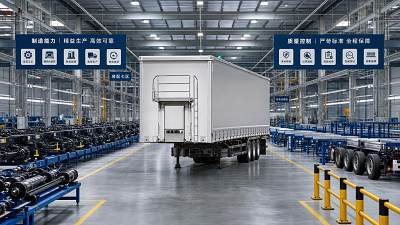
A capable semi trailer manufacturer should demonstrate clear process flow from raw material cutting to welding, shot blasting, painting, assembly, and final inspection. In practical terms, buyers should ask about steel thickness control, tolerance management, jigs for beam alignment, and whether the plant can handle special structures such as tanker compartments or aluminum superstructures.
Engineering depth becomes even more important for application-based products. A standard flatbed and a tanker trailer do not require the same design logic. Tanker bodies involve volume distribution, baffle layout, pump matching, and loading-unloading safety. Tipper or hydraulic applications require cylinder compatibility, center-of-gravity control, and chassis reinforcement.
For fleet buyers and distributors, engineering flexibility can shorten customization cycles from 6 to 8 weeks down to a more manageable development window. It also reduces miscommunication when the project includes truck pump units, PTO-related hydraulic functions, or local market compliance adjustments.
What production capability really includes
Instead of asking only about annual output, compare the supplier on four operational levels: fabrication equipment, engineering support, batch consistency, and export execution. A factory that produces 300 units per month is not automatically better than one producing 120 units if the second supplier offers tighter process control and stronger technical documentation.
Practical indicators for factory evaluation
- Whether the factory can provide drawings, load calculations, and configuration sheets before order confirmation.
- Whether special applications such as tanker trailer bodies or aluminum structures are produced in-house or outsourced.
- Whether welding, blasting, and painting are integrated within one controlled workflow.
- Whether the plant can maintain delivery consistency over at least 2 to 3 consecutive export batches.
In B2B sourcing, this level of detail is essential because distributors and project buyers often need repeatable products, not one-off factory samples that cannot be reproduced at scale.
Verify Quality Control, Materials, and Component Matching
Quality control should be tested beyond a general statement such as “we inspect every unit.” Buyers should ask how inspection is performed at 3 levels: incoming materials, in-process fabrication, and final assembly. Without this structure, defects can move downstream and become expensive warranty issues in the destination market.
For semi trailers, the most common quality risks involve main beam alignment, weld penetration, axle positioning, brake system matching, and paint adhesion. In demanding road transport environments, even a few millimeters of deviation can influence tire wear and load stability. For hydraulic or tanker applications, connection interfaces and sealing quality add another risk layer.
Material choice also deserves close review. The buyer does not always need the highest specification, but the specification should match the operating load and route profile. Over-specification increases cost unnecessarily, while under-specification can lead to fatigue cracking, deformation, or higher repair frequency. The same principle applies to truck aluminum structures, where weight reduction must still meet durability requirements.
The following table can be used as a practical checklist during supplier comparison.
A reliable manufacturer should be able to explain not only what components are used, but why those components are selected for a specific payload, route condition, or transport duty. That level of technical reasoning is far more valuable than generic sales language.
Common quality mistakes buyers make
- Comparing only axle count and trailer size without reviewing suspension, braking, or beam design.
- Accepting photos as proof of quality instead of requesting inspection records, production details, or sample checks.
- Ignoring component sourcing stability for wear parts that may need replacement every 6 to 12 months.
- Assuming a lower tare weight is always better, even when it may reduce durability in heavy-duty use.
Compare Delivery Reliability, Export Readiness, and Documentation
In international trailer sourcing, delivery reliability is often as important as manufacturing quality. A supplier that misses shipment windows by 2 to 4 weeks can affect fleet deployment, dealer inventory plans, project milestones, and end-customer confidence. This risk increases when orders involve customized tanker structures, hydraulic systems, or mixed-model batches.
Buyers should ask for realistic lead times by production stage. A standard trailer order may require 20 to 35 working days, while customized products can extend to 35 to 60 working days depending on materials, engineering changes, and export inspection steps. The point is not to demand the shortest lead time, but to confirm whether the lead time is credible and repeatable.
Documentation is another important comparison point. A good semi trailer manufacturer should provide clear packing information, parts lists, configuration records, and inspection references. For distributors and agents, this documentation supports resale, installation, customs handling, and after-sales service. Poor documentation can delay clearance or create disputes over what was actually ordered.
The supplier’s export readiness also includes communication discipline. If engineering revisions, production updates, and shipment notices are inconsistent, risk increases. In practical procurement, response speed within 24 to 48 hours is often a useful working benchmark for serious suppliers.
A practical delivery comparison framework
The table below helps procurement teams compare manufacturers on operational delivery performance instead of relying on promises.
A strong supplier is not simply the one that offers the fastest schedule. It is the one that can explain the schedule, maintain communication, and deliver documentation that supports repeat business in global road transport markets.
Review After-Sales Support, Spare Parts, and Platform-Based Supplier Comparison
After-sales capability often determines whether a manufacturer is suitable for one project only or for long-term regional distribution. In the semi trailer business, support should cover spare parts response, technical clarification, warranty handling, and configuration continuity for future orders. This is particularly important for fleets that need standardized maintenance across 20, 50, or 100 units.
Buyers should confirm whether critical parts can be supplied in batches and whether the supplier can support products related to the broader truck ecosystem. This includes truck hydraulic systems, pump units, tanker body components, and aluminum structural parts. A manufacturer that works well within this broader supply chain often creates better long-term value than a supplier focused only on one isolated trailer model.
This is where a professional international B2B platform becomes useful. Instead of evaluating a supplier through quotations alone, buyers can compare multiple manufacturers by product categories, technical range, and business responsiveness. For research teams and commercial evaluators, that improves market visibility and shortens the early screening process from weeks to a more efficient sourcing cycle.
A global heavy truck industry platform also helps distributors and agents identify suppliers across connected categories, from trailers and semi-trailers to truck chassis, complete trucks, construction machinery, and spare parts. This matters because many procurement decisions are ecosystem decisions. The trailer must work with the tractor, the hydraulic system, the pump unit, the body structure, and the operating route.
What good after-sales support looks like
- A spare parts response process that can identify urgent items within 24 to 72 hours.
- Documentation support for distributors managing service networks in multiple regions.
- Configuration continuity so repeat orders maintain the same core parts unless changes are approved.
- Technical guidance for application-specific equipment such as tanker fittings, hydraulic functions, or lightweight aluminum body options.
FAQ for procurement teams
How many suppliers should a buyer compare before selecting one?
For most B2B trailer sourcing projects, comparing 3 to 5 qualified manufacturers is practical. Fewer than 3 may limit visibility. More than 5 can slow decision-making unless the project is large, highly customized, or part of a long-term distributor strategy.
What is the most overlooked comparison point?
Component support is often overlooked. Buyers focus on frame price but fail to check future availability of suspension parts, brake components, hydraulic fittings, or tanker accessories. Over a 12- to 36-month period, this can have major cost impact.
Is customization always an advantage?
Not always. Customization is useful when payload, route condition, or cargo type clearly requires it. However, unnecessary customization may increase lead time by 2 to 4 weeks, complicate spare parts planning, and reduce interchangeability across fleet units.
How can a platform help reduce sourcing risk?
A specialized industry platform helps buyers review multiple supplier profiles, compare related product categories, and access market information in one place. That supports faster initial screening and more informed supplier discussions before factory visits or order negotiation.
Choosing a semi trailer manufacturer beyond unit price means comparing the full business case: lifecycle cost, production capability, quality control, delivery discipline, and after-sales support. For information researchers, procurement teams, distributors, and business evaluators, the most reliable supplier is usually the one that can combine sound engineering with stable execution across the broader heavy truck supply chain.
If you want to compare global suppliers more efficiently, review product categories such as trailers, truck hydraulic systems, tanker bodies, pump units, and aluminum structures through a professional heavy truck B2B marketplace. Contact us to explore suitable manufacturers, request tailored sourcing support, and learn more about practical solutions for your next road transport equipment project.
Trending News
- Truck Tipper Exporter Compliance Risks in Cross-Border Deliveries
- Truck Trailer Distributor Trends Shaping Regional Market Growth in 2026
- Crane Truck for Sale: 7 Checks Before You Choose a Model
- How to Compare a Truck Trailer Supplier Beyond Unit Price
- Bulldozer for Construction: Key Specs That Affect Earthmoving Efficiency
Tag
Recommended News
 Buying GuideCrane Truck for Sale: 7 Checks Before You Choose a ModelCrane truck for sale: discover 7 essential checks to compare models, reduce procurement risk, control total cost, and choose the right truck for safer, more efficient operations.
 Buying GuideHow to Compare a Truck Trailer Supplier Beyond Unit PriceTruck trailer supplier comparison should go beyond unit price. Learn how to assess quality, compliance, delivery, and after-sales support to reduce risk and secure long-term value.
 Buying GuideSemi Trailer Bulk Order Checklist for Delivery Risk and Lead TimeSemi trailer bulk order success starts with a clear checklist. Learn how to reduce delivery risk, control lead time, compare suppliers, and keep large trailer procurement on schedule.
 Buying GuideTruck Tipper OEM vs Standard Models: Which Lowers Project Costs?Truck tipper OEM vs standard models: discover which option cuts total project costs through better uptime, compliance, payload fit, and lower lifecycle expenses.
 Buying GuideHow to Evaluate a Heavy Truck Chassis Manufacturer with R&D CapabilityHeavy truck chassis manufacturer with R&D capability: learn how to assess engineering strength, validation, customization, and compliance to choose a reliable supplier with confidence.
 Buying GuideLogging Truck Price Guide: Spec Choices That Change Total Ownership CostLogging truck price is more than the upfront quote. Discover how axle setup, engine sizing, durability, and service support shape total ownership cost and smarter buying decisions.
 Buying GuideLogging Truck Supplier Selection: Load Capacity, Terrain Fit, and DowntimeLogging truck supplier selection guide: compare load capacity, terrain fit, parts support, and downtime risk to choose reliable forestry trucks and cut operating costs.
 Buying GuideCrane Truck Manufacturer Comparison: Boom Stability, Payload, and SupportCrane truck manufacturer comparison guide covering boom stability, payload, chassis integration, and support to help buyers choose safer, more efficient trucks with long-term value.
 Buying GuideHow to Evaluate a Heavy Truck Chassis Manufacturer With R&D CapabilityHeavy truck chassis manufacturer with R&D capability: learn how to assess engineering strength, testing, customization, and long-term support to choose a reliable partner.
 Buying GuideDump Truck Supplier With Quick Delivery: What to Verify FirstDump truck supplier with quick delivery: learn what to verify first, from factory credibility and capacity to compliance, landed cost, and after-sales support before you buy.
 Buying GuideCab Chassis Truck for Fire Department: Key Fitment PointsCab chassis truck for fire department selection starts with fitment. Learn key points on GVWR, wheelbase, PTO, safety, and body integration to improve uptime and response performance.
 Buying GuideHow to Evaluate a Heavy Truck Chassis Manufacturer With R&D CapabilityLearn how to evaluate a heavy truck chassis manufacturer with R&D capability using practical criteria for design, testing, customization, and long-term fleet value.
 Fleet ManagementDelivery Truck Supplier in USA: What Matters Most for Fleet ExpansionDelivery truck supplier in USA selection impacts uptime, cost, and fleet growth. Learn how to compare suppliers by route needs, service support, and long-term scalability.
 Buying GuideCost-Effective Delivery Truck Supply: What Low Price May Leave OutDelivery truck supplier with cost-effective solutions: learn what low prices may leave out, from compliance and after-sales support to lifecycle value, so you can source smarter and avoid hidden costs.
 FAQDelivery Truck for School Transportation: Safety Points Before OrderingDelivery truck supplier for school transportation: review key safety points before ordering, from braking and visibility to compliance and passenger protection.
 Buying GuideHow to Choose a Truck Trailer Distributor for Stable After-Sales SupportTruck trailer distributor selection starts with after-sales strength. Learn how to compare service networks, parts support, warranty response, and technical help for long-term uptime.
 Buying GuideWhat to Check Before Choosing a Truck Cement Mixer SupplierTruck cement mixer supplier selection starts with the right checks. Learn how to compare quality, compliance, delivery, and after-sales support to reduce risk and choose with confidence.
 Buying GuideBulldozer Price Guide: What Affects Cost Across Jobsite TypesBulldozer price guide for construction, mining, roadwork, and municipal projects. Compare key cost drivers, avoid overbuying, and source the right dozer with confidence.
 Fleet ManagementHow to Choose Commercial Vehicle Parts for Warehouse Fleet UptimeCommercial vehicle parts for warehouse fleets directly impact uptime. Learn how to choose durable, accurate-fit parts and reliable suppliers to reduce downtime and control maintenance costs.
 Buying GuideLogging Truck Supplier Selection: Durability Points That Matter in Tough TerrainLogging truck supplier selection starts with durability. Discover the key strength, traction, braking, and support factors that reduce downtime in tough terrain.
 FAQDump Truck Sourcing Mistakes That Delay Construction ProjectsDump truck sourcing mistakes can delay construction projects, raise hidden costs, and disrupt site schedules. Learn the key risks to avoid and source smarter for faster, more reliable project delivery.
 Buying GuideWhat Makes a Delivery Truck Supplier Suitable for School TransportationDelivery truck supplier for school transportation: learn how to assess safety, compliance, body design, and after-sales support for urban, rural, and school logistics needs.
 Buying GuideHow to Plan a Semi Trailer Bulk Order Without Costly Specification MistakesSemi trailer bulk order planning starts with the right specs. Learn how to avoid costly mistakes, compare suppliers wisely, and secure compliant, fleet-ready trailers.
 Fleet ManagementWhy a Light Duty Truck Manufacturer in USA Still Matters for Fleet ReliabilityLight duty truck manufacturer in USA choices still shape fleet uptime, parts access, and lifecycle value. See what buyers should compare for more reliable operations.
![]() Buying GuideFlatbed Trailer Supplier for Logistics Transportation: What to Check Before OrderingFlatbed trailer supplier for logistics transportation: learn what to check before ordering, from load capacity and compliance to customization and supplier reliability.
Buying GuideFlatbed Trailer Supplier for Logistics Transportation: What to Check Before OrderingFlatbed trailer supplier for logistics transportation: learn what to check before ordering, from load capacity and compliance to customization and supplier reliability.