EU Tire Label Rule Hits Chinese Truck Exports
On June 16, 2026, the European Commission formally put the ECE R117-03 tire labeling rule into force for newly registered heavy trucks and semi-trailers, creating an immediate compliance issue for Chinese export batches entering the EU market. The change matters not only to vehicle exporters, but also to tire suppliers, certification workflows, delivery planning, and post-shipment document management, because non-compliant labeling can now directly affect vehicle registration and trigger follow-up checks on units already shipped.
What the rule now requires
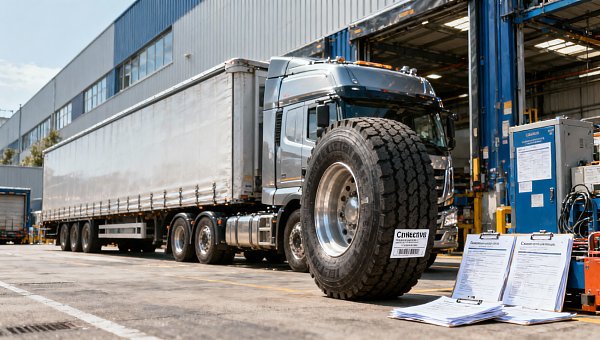
According to the information provided, the ECE R117-03 version of the tire performance labeling regulation took effect on June 16, 2026. It requires tires fitted to all newly registered heavy trucks and semi-trailers to carry A–E ratings for three categories: rolling resistance, wet grip braking, and external noise.
The same information states that the relevant tires must also complete type approval through EU-designated laboratories, including examples such as TUV SUD and BACL. Vehicles without labels, or with non-compliant labels, will be refused registration. For vehicles already exported, supplementary compliance declarations must also be completed and those vehicles may be subject to spot checks.
Where the pressure shows up across the export chain
Vehicle export programs face a registration bottleneck
From an industry perspective, exporters of heavy trucks and semi-trailers are the most directly exposed because the rule links tire labeling compliance to registration eligibility in the destination market. The immediate business risk is not abstract policy exposure, but whether delivered vehicles can complete local registration on schedule.
Tire sourcing becomes a documentation issue, not only a product issue
Analysis shows that tire selection for export vehicles now has a clearer compliance dimension. It is no longer enough for a tire to be installed as part of vehicle delivery; the associated label content and type-approval status become part of the transaction risk, especially for batches moving toward new registration in the EU.
Certification and testing workflows become part of delivery timing
Supply chain service providers and compliance teams may also feel the impact because EU-designated laboratory approval is explicitly referenced in the rule summary provided. What deserves closer attention is the operational link between certification status, shipment readiness, and customer handover, particularly where export schedules were built around earlier assumptions.
Already shipped units are not fully outside the scope
Observably, this is not limited to future shipments. The requirement for supplementary compliance declarations for already exported vehicles means after-sales, legal, and customer coordination teams may need to track documentation gaps and prepare for possible spot checks even after goods have left China.
What companies should watch now
Check whether label execution matches registration use
Companies should focus on whether tires fitted to new heavy truck and semi-trailer registrations in the EU carry the required A–E markings for rolling resistance, wet grip braking, and external noise. In practice, the key issue is whether what is mounted on the vehicle can support the registration process without a last-minute compliance dispute.
Confirm type-approval status before shipment commitments
Analysis shows that type approval through EU-designated laboratories is a practical checkpoint rather than a background formality. Exporters, OEM teams, and procurement functions should pay closer attention to whether tire-related approvals are complete before shipment promises are locked in.
Prepare document follow-up for vehicles already exported
The provided information makes clear that already exported vehicles may still need supplementary compliance declarations and may face spot checks. That means companies should review which batches could require follow-up paperwork and how customer communication will be handled if documents must be supplemented after delivery.
Separate policy wording from execution readiness
What deserves closer attention is the difference between knowing the rule exists and being ready to operate under it. For many businesses, the real test will be whether tire labels, laboratory approvals, batch records, and customer-facing compliance files can be aligned quickly enough to avoid registration delays.
Why this looks like an immediate compliance shift, not a distant signal
In editorial observation, this development is more appropriate to understand as an active market-entry condition rather than a long-range policy hint. The reason is straightforward: the information provided ties compliance directly to registration acceptance, and it also extends compliance pressure to vehicles already exported through supplementary declarations and spot-check exposure.
At the same time, it should not be overstated beyond the confirmed facts. Analysis shows that the current signal is strongest in execution risk: registration, documentation, labeling, and certification coordination. Broader market effects may emerge later, but those outcomes are not established by the provided information alone.
How the industry may best read this development
The most balanced reading is that ECE R117-03 has moved from a standards issue into a day-to-day export control point for affected vehicle programs. For companies involved in heavy truck and semi-trailer exports to the EU, the immediate implication is not simply awareness of a new rule, but the need to connect tire compliance details with registration outcomes, shipment planning, and post-export document handling.
It is more appropriate to understand this as a short-term operational change with possible longer-term implications, rather than as a purely symbolic regulatory update. Further impact will depend on how consistently the rule is checked in practice and how businesses adapt their compliance processes.
Basis of this article and points for continued verification
This article is generated based on the user-provided news title, event date, and event summary. The summary states that the European Commission formally implemented the ECE R117-03 tire labeling requirement on June 16, 2026, covering newly registered heavy trucks and semi-trailers, requiring A–E ratings in three performance categories, EU-designated laboratory type approval, registration refusal for non-compliant labeling, and supplementary compliance declarations plus spot checks for already exported vehicles.
Typical source types for this kind of industry update may include official regulatory notices, company compliance statements, industry association releases, authoritative media coverage, and standard-setting documentation. However, a specific official source link was not provided in the input, so the exact underlying publication path still needs continued verification. Areas that warrant follow-up include any further official wording, implementation details in registration practice, and how supplementary declaration requirements are applied to already exported batches.
Trending News
- How axle load limits affect low bed trailer exports to Southeast Asia
- How to locate a truck exhaust system leak before replacing parts
- When does heavy equipment transport require a lowboy trailer?
- When does a light commercial vehicle for urban delivery save fleet costs?
- How to choose an off road truck for steep and unstable job sites
Tag
Recommended News
 Policy & RegulationsHow axle load limits affect low bed trailer exports to Southeast AsiaPlanning low bed trailer export to Southeast Asia? Learn how axle load limits affect legal payload, axle layouts, and route compliance to avoid costly mistakes before ordering.
 Policy & RegulationsGermany Ends EV Subsidy ExtensionGermany ends EV subsidy extension, reshaping EV and commercial vehicle plans in Europe. See how importers, distributors, and Chinese NEV suppliers should respond.
 Policy & RegulationsEU Rule Sets LCA Certification for Truck ImportsEU Rule Sets LCA Certification for Truck Imports: learn how the new EU LCA and EPD compliance rule will affect truck approvals, export timelines, costs, and delivery planning.
 Policy & RegulationsEU Requires LCA Reports for Imported HDVs from Oct 2026EU LCA reports for imported HDVs become mandatory from Oct 2026. Learn how the new EU heavy-duty vehicle carbon compliance rule affects exporters, suppliers, costs, and delivery readiness.
 Policy & RegulationsChina Tightens Export Filing for New Energy Heavy TrucksChina Tightens Export Filing for New Energy Heavy Trucks: learn how new HS code rules and CNAS carbon-footprint reports may impact customs clearance, compliance, and delivery timelines.
 Policy & RegulationsEU Updates CO2 Rules for Heavy-Duty Vehicle ApprovalEU Updates CO2 Rules for Heavy-Duty Vehicle Approval: learn how new lifecycle carbon and battery due diligence requirements affect EU market access, approval timing, and compliance costs.
 Policy & RegulationsChina Customs Adds New Export Fields for Road Transport EquipmentChina Customs adds new export fields for road transport equipment from Aug 15, 2026. Learn how drive type and certification data may affect compliance, clearance speed, and export planning.
 Policy & RegulationsEU Tightens Truck WVTA Brake and Lighting TestsEU Tightens Truck WVTA Brake and Lighting Tests: learn how Regulation (EU) 2026/1387 reshapes brake response, headlamp compliance, certification timing, and EU market access.
 Policy & RegulationsEU Sets CO2 Rules for New Heavy Trucks from 2027EU Sets CO2 Rules for New Heavy Trucks from 2027: learn how new EU CO2 limits, OBD, and remote data upload requirements could reshape type approval, costs, and delivery planning.
 Policy & RegulationsEU Brings Forward Cybersecurity Approval for Heavy TrucksEU heavy truck cybersecurity approval moves to August 1, 2026. Learn how WVTA, UNECE R155, OTA and telematics rules will impact EU exports, type approval and delivery plans.
 Policy & RegulationsEU Moves Truck Cybersecurity WVTA Forward to Aug 1, 2026EU truck cybersecurity WVTA moves to Aug 1, 2026. Learn how UN R155 and EU 2022/1426 affect heavy truck type approval, exports, suppliers, and compliance planning.
 Policy & RegulationsEU Brings Forward WVTA Cybersecurity Approval for TrucksEU Brings Forward WVTA Cybersecurity Approval for Trucks: learn how the 2026 deadline impacts heavy truck exports, retrofit projects, supplier compliance, costs, and EU market-entry planning.
 Policy & RegulationsEU Brings Forward WVTA Cybersecurity Approval for Heavy TrucksEU heavy truck WVTA cybersecurity approval now starts on August 1, 2026. Learn how EU type approval, CSMS audits, ADAS, OTA, and registration risks affect exporters and manufacturers.
 Policy & RegulationsEU Cybersecurity Approval Rule Takes Effect for Heavy TrucksEU Cybersecurity Approval Rule now reshapes heavy trucks market access. Learn how CSMS, UNECE R155, and WVTA deadlines could impact certification, delivery, and EU export readiness.
 Policy & RegulationsEU Requires EN 15038 Declarations for Truck ImportsEU Requires EN 15038 Declarations for Truck Imports: learn how the new EU rule affects heavy truck customs clearance, compliance timing, and export readiness.
 Policy & RegulationsEU Rule Brings SCIP Filing to Imported Truck Battery PartsSCIP filing for imported truck battery parts becomes critical in the EU from Oct 1, 2026. Learn how the rule impacts heavy-duty truck exports, aftermarket parts, and customs compliance.
 Policy & RegulationsEU REACH Expands to Truck Battery PartsEU REACH expands to truck battery parts, covering lithium-ion battery modules, BMS units, and thermal systems. Learn how SCIP filing, SVHC disclosure, and EU export compliance may affect truck suppliers.
 Policy & RegulationsEU Sets Battery Footprint Rule for Heavy TrucksEU Sets Battery Footprint Rule for Heavy Trucks: learn how the 2027 EU battery carbon footprint requirement could impact type approval, customs clearance, and truck exports.
 Policy & RegulationsEU Requires Certified V2X Modules in Heavy TrucksEU Requires Certified V2X Modules in Heavy Trucks from July 22, 2026. Learn how UN R155 and ETSI EN 303 648 rules will impact EU type approval, registration, and exports.
 Policy & RegulationsEU Tightens V2X Approval for Heavy TrucksHeavy trucks entering the EU face tougher V2X approval from July 22, 2026. Learn how UNECE R155/R156 and EU Type Approval will affect registration, exports, and delivery readiness.
 Policy & RegulationsEU Rule Takes Effect: Heavy Trucks Need V2X from July 22, 2026Heavy trucks entering the EU from July 22, 2026 need V2X modules and UN R155 approval. Learn how this rule impacts compliance, certification, exports, and delivery.
 Policy & RegulationsEU Opens Euro 7 Transition for Heavy TrucksEU Opens Euro 7 Transition for Heavy Trucks: learn how new filing rules, battery carbon footprint declarations, and OBD II checks will impact EU truck exports and compliance planning.
 Policy & RegulationsEPA Update Removes Seven Chinese Diesel Engine ModelsEPA Update Removes Seven Chinese Diesel Engine Models: learn how this EPA compliance change could affect North American truck exports, sourcing, certification, and delivery planning.
 Policy & RegulationsEU Enforces Euro 7 for New Heavy TrucksEU Enforces Euro 7 for New Heavy Trucks: learn how stricter NOx, NH₃, and brake particle certification impacts EU market access, registration timing, and exporter compliance costs.
 Policy & RegulationsLight Duty Truck Manufacturer in USA: Key Compliance ChecksLight duty truck manufacturer in USA selection starts with compliance. Learn the key checks for FMVSS, emissions, load ratings, and traceability before you buy.