Light Duty Truck Manufacturer in USA: Key Compliance Checks
Choosing a light duty truck manufacturer in USA is rarely a simple matter of unit price, payload, or lead time. In road transport equipment procurement, the larger risk often sits in compliance gaps that only appear after delivery. A truck may look fit for service, yet still create exposure through incomplete FMVSS conformity, weak emissions documentation, inconsistent load ratings, or poor component traceability.
That is why the phrase light duty truck manufacturer in USA carries more than a sourcing label. It points to a compliance environment shaped by federal rules, state-level operating realities, fleet safety expectations, and growing pressure for transparent supply chains. For businesses comparing manufacturers or global sourcing partners, the key question is not only who can build the truck, but who can prove control over safety, quality, and regulatory risk.
Why this topic matters now
Light-duty trucks serve dense, practical roles across logistics, municipal services, utility support, field maintenance, and last-mile distribution. They operate in environments where uptime matters, but so do braking stability, visibility, emissions status, body integration, and safe loading behavior.
At the same time, supply chains are more international than they appear. A light duty truck manufacturer in USA may assemble domestically while sourcing axles, lighting, electronics, frames, or body systems from multiple regions. This creates a wider compliance surface.
In practice, buyers need a structured review method. Platforms that aggregate truck categories, supplier profiles, spare parts resources, and industry intelligence can help narrow options. The value is not just discovery. It is better comparison, better documentation review, and fewer blind spots before approval.
What compliance means for a light-duty truck purchase
Compliance is often misunderstood as a one-time legal checkbox. In real fleet use, it is broader. It includes design conformity, production consistency, documentation integrity, and post-delivery support.
When reviewing a light duty truck manufacturer in USA, the truck itself is only one part of the assessment. The manufacturer’s internal controls matter just as much. A compliant product backed by weak process control can still lead to recalls, service disputes, and uneven field performance.
A practical review usually covers the base vehicle, installed body or upfit, safety-critical parts, emissions status, labeling, serial tracking, and supplier qualification. If one of these areas is unclear, the procurement risk rises quickly.
The core checks that should come first
FMVSS conformity
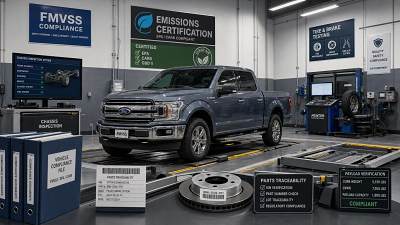
For any light duty truck manufacturer in USA, Federal Motor Vehicle Safety Standards are a baseline review point. This is not just about whether the truck is sold legally. It is about whether the safety system remains valid after body installation, modification, or special configuration.
Attention usually goes to lighting, mirrors, braking, tires, glazing, occupant restraints, and vehicle identification labeling. If the truck is upfitted, the review should confirm that the final-stage or alterer responsibilities are clearly documented.
Emissions and engine certification
Emissions compliance is easy to underestimate, especially when sourcing across regions. EPA certification, California-related requirements where relevant, and engine family documentation should match the actual vehicle specification being offered.
Any mismatch between brochure claims and certification records deserves close review. A reputable light duty truck manufacturer in USA should provide emissions documentation without hesitation and should explain how configuration changes affect compliance status.
GVWR, GAWR, and load integrity
Payload claims often receive more attention than rating logic. Yet the real issue is whether the full vehicle system supports the intended use. Gross Vehicle Weight Rating and Gross Axle Weight Rating must align with suspension, tires, wheels, frame strength, body weight, and cargo distribution.
This matters even more for service bodies, refrigerated units, utility applications, and municipal equipment. A truck can pass a sales review and still become unsafe in daily operation if load assumptions were unrealistic.
Traceability and serial control
Traceability is where many sourcing decisions either become defensible or fragile. VIN records are only the start. Strong manufacturers maintain traceability for major assemblies, safety-critical components, software versions, and supplier batches where failure would create field risk.
If a light duty truck manufacturer in USA cannot explain how parts are traced through production and after-sales support, that weakness will surface during recalls, warranty claims, or incident investigations.
How supplier capability should be judged
Product compliance and supplier capability should be reviewed together. One strong document package does not prove stable production control. The more useful question is whether the manufacturer can repeat the same compliant output over time.
Certification alone should not end the review. A certificate can indicate maturity, but it does not replace evidence of how nonconforming material is handled, how design changes are approved, or how field failures are fed back into manufacturing control.
Typical risk points in real operating scenarios
The same truck platform can perform very differently depending on use case. That is why a light duty truck manufacturer in USA should be reviewed against the intended duty cycle, not only against a general brochure specification.
- Urban delivery fleets should look closely at braking durability, visibility, telematics integration, and stop-start operating stress.
- Utility or service applications should verify body mounting logic, power take-off compatibility, and electrical load handling.
- Municipal and infrastructure support vehicles need careful review of corrosion protection, idle-time impact, and seasonal operating reliability.
- Cross-border sourcing programs should pay extra attention to labeling consistency, spare parts matching, and document validity across markets.
These scenario checks are especially useful when comparing several suppliers on a B2B sourcing platform. Product catalogs help with initial screening, but the real value comes from verifying whether the compliance story fits the actual work environment.
What strong documentation usually looks like
Reliable documentation is detailed, current, and internally consistent. It should connect the quoted vehicle, the certified configuration, and the delivered unit without gaps.
For a light duty truck manufacturer in USA, the following records are often the most revealing:
- vehicle specification sheets tied to VIN or production lot
- FMVSS-related declarations and labeling references
- engine and emissions certification records
- GVWR and GAWR basis, including tire and axle matching
- inspection reports for incoming, in-process, and final release stages
- change notices affecting safety, performance, or compliance status
- warranty and recall handling procedures
When these records are slow to obtain, overly generic, or inconsistent across teams, that usually signals deeper control issues. Good manufacturers rarely struggle to explain their own compliance basis.
Using market platforms without losing technical rigor
Digital sourcing platforms have changed how commercial vehicle buyers compare suppliers. This is especially relevant in the heavy truck and transport equipment sector, where product ranges now span complete trucks, light trucks, chassis systems, trailers, machinery, and spare parts.
A global industry platform can shorten the search process by bringing together supplier directories, product listings, brand information, market insights, and buying guides. That helps reduce noise in the early stage.
Still, discovery should lead into validation. When using a platform to identify a light duty truck manufacturer in USA, it makes sense to move from catalog review to evidence review. In other words, compare suppliers broadly, then test the finalists against the same compliance checklist.
A practical next step for evaluation
A useful approach is to build a short approval matrix before contacting shortlisted suppliers. Keep it focused on the areas that affect operating risk most directly: safety standards, emissions, ratings, traceability, quality controls, and service response.
Then review each light duty truck manufacturer in USA against the same evidence set, not against sales language. That creates a cleaner comparison and makes internal approval easier to defend.
Where the supply chain is complex, add one more step: verify how the manufacturer manages external components and design changes. That single check often reveals whether the supplier is prepared for long-term fleet support.
The market offers many sourcing options, but dependable decisions usually come from disciplined review. Before moving forward, align the truck specification with the real duty cycle, request the technical proof behind the offer, and use industry platforms as a starting point for verification rather than a substitute for it.
Trending News
- How to assess a crane truck distributor's spare parts support
- Volvo Group Forms Volvo Mining to Integrate Equipment and Autonomous Solutions
- How to verify spare parts availability with a crane truck supplier
- How to verify a truck trailer OEM's claimed payload capacity
- How does operating weight affect the price of a new excavator?
Tag
Recommended News
 Policy & RegulationsHow axle load limits affect low bed trailer exports to Southeast AsiaPlanning low bed trailer export to Southeast Asia? Learn how axle load limits affect legal payload, axle layouts, and route compliance to avoid costly mistakes before ordering.
 Policy & RegulationsGermany Ends EV Subsidy ExtensionGermany ends EV subsidy extension, reshaping EV and commercial vehicle plans in Europe. See how importers, distributors, and Chinese NEV suppliers should respond.
 Policy & RegulationsEU Rule Sets LCA Certification for Truck ImportsEU Rule Sets LCA Certification for Truck Imports: learn how the new EU LCA and EPD compliance rule will affect truck approvals, export timelines, costs, and delivery planning.
 Policy & RegulationsEU Requires LCA Reports for Imported HDVs from Oct 2026EU LCA reports for imported HDVs become mandatory from Oct 2026. Learn how the new EU heavy-duty vehicle carbon compliance rule affects exporters, suppliers, costs, and delivery readiness.
 Policy & RegulationsChina Tightens Export Filing for New Energy Heavy TrucksChina Tightens Export Filing for New Energy Heavy Trucks: learn how new HS code rules and CNAS carbon-footprint reports may impact customs clearance, compliance, and delivery timelines.
 Policy & RegulationsEU Updates CO2 Rules for Heavy-Duty Vehicle ApprovalEU Updates CO2 Rules for Heavy-Duty Vehicle Approval: learn how new lifecycle carbon and battery due diligence requirements affect EU market access, approval timing, and compliance costs.
 Policy & RegulationsChina Customs Adds New Export Fields for Road Transport EquipmentChina Customs adds new export fields for road transport equipment from Aug 15, 2026. Learn how drive type and certification data may affect compliance, clearance speed, and export planning.
 Policy & RegulationsEU Tightens Truck WVTA Brake and Lighting TestsEU Tightens Truck WVTA Brake and Lighting Tests: learn how Regulation (EU) 2026/1387 reshapes brake response, headlamp compliance, certification timing, and EU market access.
 Policy & RegulationsEU Sets CO2 Rules for New Heavy Trucks from 2027EU Sets CO2 Rules for New Heavy Trucks from 2027: learn how new EU CO2 limits, OBD, and remote data upload requirements could reshape type approval, costs, and delivery planning.
 Policy & RegulationsEU Brings Forward Cybersecurity Approval for Heavy TrucksEU heavy truck cybersecurity approval moves to August 1, 2026. Learn how WVTA, UNECE R155, OTA and telematics rules will impact EU exports, type approval and delivery plans.
 Policy & RegulationsEU Moves Truck Cybersecurity WVTA Forward to Aug 1, 2026EU truck cybersecurity WVTA moves to Aug 1, 2026. Learn how UN R155 and EU 2022/1426 affect heavy truck type approval, exports, suppliers, and compliance planning.
 Policy & RegulationsEU Brings Forward WVTA Cybersecurity Approval for TrucksEU Brings Forward WVTA Cybersecurity Approval for Trucks: learn how the 2026 deadline impacts heavy truck exports, retrofit projects, supplier compliance, costs, and EU market-entry planning.
 Policy & RegulationsEU Brings Forward WVTA Cybersecurity Approval for Heavy TrucksEU heavy truck WVTA cybersecurity approval now starts on August 1, 2026. Learn how EU type approval, CSMS audits, ADAS, OTA, and registration risks affect exporters and manufacturers.
 Policy & RegulationsEU Cybersecurity Approval Rule Takes Effect for Heavy TrucksEU Cybersecurity Approval Rule now reshapes heavy trucks market access. Learn how CSMS, UNECE R155, and WVTA deadlines could impact certification, delivery, and EU export readiness.
 Policy & RegulationsEU Requires EN 15038 Declarations for Truck ImportsEU Requires EN 15038 Declarations for Truck Imports: learn how the new EU rule affects heavy truck customs clearance, compliance timing, and export readiness.
 Policy & RegulationsEU Rule Brings SCIP Filing to Imported Truck Battery PartsSCIP filing for imported truck battery parts becomes critical in the EU from Oct 1, 2026. Learn how the rule impacts heavy-duty truck exports, aftermarket parts, and customs compliance.
 Policy & RegulationsEU REACH Expands to Truck Battery PartsEU REACH expands to truck battery parts, covering lithium-ion battery modules, BMS units, and thermal systems. Learn how SCIP filing, SVHC disclosure, and EU export compliance may affect truck suppliers.
 Policy & RegulationsEU Sets Battery Footprint Rule for Heavy TrucksEU Sets Battery Footprint Rule for Heavy Trucks: learn how the 2027 EU battery carbon footprint requirement could impact type approval, customs clearance, and truck exports.
 Policy & RegulationsEU Requires Certified V2X Modules in Heavy TrucksEU Requires Certified V2X Modules in Heavy Trucks from July 22, 2026. Learn how UN R155 and ETSI EN 303 648 rules will impact EU type approval, registration, and exports.
 Policy & RegulationsEU Tightens V2X Approval for Heavy TrucksHeavy trucks entering the EU face tougher V2X approval from July 22, 2026. Learn how UNECE R155/R156 and EU Type Approval will affect registration, exports, and delivery readiness.
 Policy & RegulationsEU Rule Takes Effect: Heavy Trucks Need V2X from July 22, 2026Heavy trucks entering the EU from July 22, 2026 need V2X modules and UN R155 approval. Learn how this rule impacts compliance, certification, exports, and delivery.
 Policy & RegulationsEU Opens Euro 7 Transition for Heavy TrucksEU Opens Euro 7 Transition for Heavy Trucks: learn how new filing rules, battery carbon footprint declarations, and OBD II checks will impact EU truck exports and compliance planning.
 Policy & RegulationsEPA Update Removes Seven Chinese Diesel Engine ModelsEPA Update Removes Seven Chinese Diesel Engine Models: learn how this EPA compliance change could affect North American truck exports, sourcing, certification, and delivery planning.
 Policy & RegulationsEU Enforces Euro 7 for New Heavy TrucksEU Enforces Euro 7 for New Heavy Trucks: learn how stricter NOx, NH₃, and brake particle certification impacts EU market access, registration timing, and exporter compliance costs.
 Policy & RegulationsLight Duty Truck Manufacturer in USA: Key Compliance ChecksLight duty truck manufacturer in USA selection starts with compliance. Learn the key checks for FMVSS, emissions, load ratings, and traceability before you buy.