Truck Trailer Sourcing: 7 Risks to Check Before Ordering
Truck trailer sourcing starts with the real operating scene
Truck trailer sourcing affects delivery schedules, cargo safety, and lifetime operating cost long before a unit reaches the road.
A flatbed moving steel coils faces different stresses than a tipper trailer serving quarry routes or a tanker crossing borders.
That is why good sourcing decisions rarely begin with price sheets alone.
In actual projects, the more useful approach is to match trailer specification, supplier capability, and compliance evidence to the intended workload.
This matters even more in a global market where suppliers, standards, and logistics conditions vary by region.
A professional industry platform helps by making products, supplier profiles, and market references easier to compare, but the final judgment still depends on risk checks.
For truck trailer sourcing, the seven risks below are usually the ones that create the most expensive surprises after ordering.
Different trailer jobs create different sourcing priorities
Road transport equipment is often grouped together, yet usage conditions change the sourcing logic quickly.
Highway logistics usually values payload efficiency, axle durability, and easy parts replacement.
Mining or construction routes push harder on frame strength, suspension travel, and brake heat resistance.
Cross-border transport adds another layer, because homologation documents, lighting rules, and dimension limits can decide whether equipment is usable.
A trailer that looks suitable on paper may still create downtime if local roads, loading methods, or service access were not considered.
Truck trailer sourcing works better when these differences are clarified before asking for quotations.
Risk 1 to 3 often appear before production even begins
1. Specification drift between quoted unit and actual use
One of the biggest truck trailer sourcing risks is ordering from a generic quotation that never fully reflects the route, cargo, and loading pattern.
In practice, this happens when deck height, axle spacing, kingpin setting, or suspension type is copied from a previous order.
A familiar model number can hide important differences in weight distribution and road legality.
The safer move is to request a confirmed technical drawing, rated payload basis, and declared operating assumptions before deposit payment.
2. Supplier capacity looks strong, but execution depth is weak
Catalog range alone does not prove reliable manufacturing control.
For truck trailer sourcing, check how the supplier manages steel sourcing, welding procedures, axle partnerships, paint systems, and outbound inspection.
This is where an industry platform can help.
When supplier listings are combined with trade data, product breadth, and market visibility, it becomes easier to filter out shallow trading operations.
Still, verification should include factory evidence, lead-time history, and consistency across past shipments.
3. Compliance gaps only show up at customs or registration
This risk is common in international truck trailer sourcing.
Brake standards, reflectors, side guards, ABS or EBS requirements, and dimension limits differ by destination.
A trailer may be well built and still fail entry or road approval.
The useful check is not only whether documents exist, but whether they match the exact axle brand, configuration, and VIN structure of the ordered unit.
When the trailer enters heavy service, build quality becomes visible fast
4. Structural quality is rated by workload, not by brochure language
Frame cracks, floor deformation, and unstable tracking rarely come from one dramatic failure.
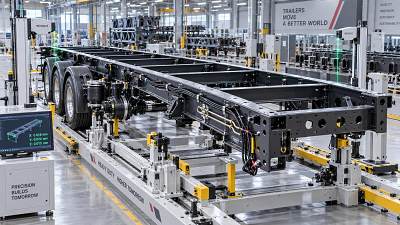
More often, they result from repeated overload points, poor weld penetration, weak cross-member layout, or unsuitable material thickness.
For bulk haulage on rough access roads, this risk deserves more weight than cosmetic finish.
For container or pallet transport on maintained highways, corrosion protection and component standardization may matter more over time.
Truck trailer sourcing should therefore ask for steel grades, weld inspection records, and critical stress-point photos, not just payload claims.
5. Parts compatibility shapes downtime more than purchase price
A lower initial quote can become expensive when brake chambers, suspension bushes, landing legs, or electrical connectors are difficult to replace locally.
This is especially relevant in remote logistics corridors and mixed fleets.
If the tractor units already use certain coupling heights, air systems, or wheel-end standards, the trailer should align with them.
Truck trailer sourcing is stronger when spare parts lists, brand options, and interchangeability notes are confirmed before production starts.
Delivery risk is not only about shipping date
6. Lead time slips when engineering changes are left open
Many delays come from late design corrections rather than factory backlog alone.
Hydraulic brand changes, tire substitutions, drawing updates, or revised axle loads can move delivery by weeks.
In actual sourcing work, projects with unusual body dimensions or destination-specific compliance checks need longer decision windows.
A realistic schedule includes drawing approval, component procurement, inspection, inland transport, and export handling.
7. Total cost is misread when only invoice value is compared
Truck trailer sourcing should compare operating life, not only order price.
A cheaper trailer may consume more tires, require more welding repair, or reduce legal payload because of poor weight distribution.
For fleets handling repetitive long-distance transport, small fuel or maintenance penalties multiply quickly.
For infrastructure projects, downtime can be even more costly than component replacement.
That is why lifecycle cost, service intervals, and residual usability deserve a place in every sourcing comparison.
A practical way to compare truck trailer sourcing options
Once the seven risks are clear, comparison becomes more disciplined.
The useful method is to score each option against the operating scene rather than against a generic ideal trailer.
- Match the trailer layout to cargo type, route quality, loading frequency, and legal limits.
- Confirm supplier depth through drawings, inspection records, and component traceability.
- Check destination compliance for the exact configuration, not a similar model.
- Review service parts availability across the regions where the unit will actually work.
- Calculate total ownership impact, including downtime exposure and maintenance burden.
This is also where digital sourcing platforms bring practical value.
A marketplace focused on the heavy truck ecosystem can shorten early research by combining supplier access, product categories, buying guides, and industry insight in one place.
That improves visibility, but it does not replace technical due diligence.
Misjudgments that appear often in trailer orders
Several mistakes repeat across truck trailer sourcing projects because similar transport jobs are treated as identical.
- Selecting by rated payload without checking axle load distribution under real loading methods.
- Approving a familiar suspension or brake package without considering local spare parts channels.
- Assuming harsh-road use only requires thicker steel, while ignoring geometry and reinforcement design.
- Treating certification as a paperwork issue instead of a configuration issue.
- Comparing quotations from different suppliers without aligning technical scope line by line.
These errors are avoidable when sourcing starts from the use case, then moves to technical fit, and only then to commercial comparison.
Before ordering, turn risk checks into a sourcing standard
The most reliable truck trailer sourcing process is not the fastest one on the first day.
It is the one that prevents redesign, compliance issues, and field failure later.
Start by defining the real operating scene, then list the non-negotiable limits for load, roads, regulations, and service support.
From there, compare suppliers using the same technical checklist and ask for evidence that matches the final configuration.
When the next order is prepared, refine those checks with market insight, supplier data, and category comparisons from a specialized heavy truck platform.
That approach keeps truck trailer sourcing grounded in application reality and leads to stronger long-term value on the road.
Trending News
- How axle load limits affect low bed trailer exports to Southeast Asia
- How to locate a truck exhaust system leak before replacing parts
- When does heavy equipment transport require a lowboy trailer?
- When does a light commercial vehicle for urban delivery save fleet costs?
- How to choose an off road truck for steep and unstable job sites
Tag
Recommended News
 Buying GuideWhen does heavy equipment transport require a lowboy trailer?Does your heavy equipment need a lowboy trailer? Discover how loaded height, weight distribution, loading access, and route limits determine the right choice for safe transport.
 Buying GuideHow to choose an off road truck for steep and unstable job sitesChoose the right off road truck for steep, unstable job sites. Compare traction, braking, stability, clearance, payload, and route-test essentials.
 Buying GuideHow to match crane truck lifting capacity to your jobsite loadsCrane truck capacity planning made clear: calculate gross load, radius, rigging, outriggers, and ground conditions to select safer, job-ready lifting equipment.
 Buying GuideHow to match lowbed trailer deck height to your hauling equipmentLowbed trailer deck height guide: match equipment clearance, ramp geometry, axle loads, tractor fit, and route limits for safer, more efficient hauling.
 Buying GuideWhat to verify before choosing a delivery truck supplier for school transportationDelivery truck supplier for school transportation: verify route fit, payload, safety, compliance, service support, and total cost before choosing a reliable partner.
 Buying GuideWhat an excavator manufacturer catalog should show before you compare modelsExcavator manufacturer catalog guide: verify supplier identity, configurations, hydraulics, compliance, parts support, and delivery readiness before comparing models.
 Buying GuideWhat to check before appointing a bulldozer distributorBulldozer distributor selection guide: evaluate service, parts availability, warranty, pricing, compliance, and lifecycle value to reduce downtime and protect fleet investment.
 Buying GuideWhat to verify before choosing a truck cement mixer supplierTruck cement mixer supplier checklist: verify chassis fit, drum quality, hydraulics, compliance, spare parts, and after-sales support before you buy.
 Buying GuideHow to verify a truck spare parts supplier before placing a bulk orderTruck spare parts supplier verification made practical: learn how to check part specifications, factory control, test records, samples, pricing, and delivery capability before placing a bulk order.
 Buying GuideWhat size truck container is right for a typical freight load?Truck container sizing made simple: compare payload, volume, pallet layouts, route access, and loading needs to choose the most efficient freight solution.
 Buying GuideWhat drives semi trailer price differences between similar models?Semi trailer price differences come down to frame materials, axles, suspension, coating, and configuration. Compare specifications line by line to choose lasting value.
 Buying GuideHow to compare excavator manufacturer price lists before requesting quotesCompare an excavator manufacturer price list with confidence. Learn to normalize configurations, calculate landed costs, assess options and service, and create stronger RFQs.
 Buying GuideHow to choose a mixer truck drum capacity for your concrete pourMixer truck capacity guide: match drum size to pour rate, legal payload, site access, and delivery cycles for efficient, reliable concrete placement.
 Buying GuideHow to size a bulldozer for construction site grading workBulldozer for construction sizing guide: match weight, blade, traction, grade control, and transport needs to improve grading productivity and costs.
 Buying GuideHow to assess a truck cement manufacturer’s build quality before orderingTruck cement manufacturer build quality: assess tank steel, welding, chassis integration, pneumatic systems, factory QC, and inspection evidence before ordering.
 Buying GuideWhen does a truck trailer OEM make sense for private-label fleets?Truck trailer OEM programs help private-label fleets cut lifecycle costs, standardize operations, and improve uptime. Learn when customization delivers real commercial value.
 Buying GuideWhat to verify before choosing a water truck OEM for your fleetWater truck OEM selection guide: verify chassis compatibility, tank quality, pump performance, compliance, and service support to build a safer, more reliable fleet.
 Buying GuideHow to size a cab chassis truck for a fire department apparatusCab chassis truck for fire department sizing guide: balance GVWR, axle loads, wheelbase, water tank placement, and mission needs for safer apparatus design.
 Buying GuideWhat to verify before choosing a truck chassis supplierChoose the right truck chassis supplier with a practical checklist for application fit, axle ratings, body integration, quality control, delivery reliability, and after-sales support.
 Buying GuideHow to choose a logging truck for steep and rough forest roadsLogging truck selection for steep, rough forest roads: compare traction, braking, gearing, chassis strength, tires, and supplier support for safer, more reliable hauling.
 Buying GuideHow to choose a flatbed trailer deck length for oversized loadsFlatbed trailer deck length guide for oversized loads: balance cargo support, axle weight, securement space, overhang, and route access for safer transport.
 Buying GuideHow to assess a truck chassis supplier for trailer manufacturingTruck chassis supplier for trailer manufacturing: learn how to assess technical fit, quality control, engineering support, and delivery reliability for smarter sourcing.
 Buying GuideIs the SHACMAN H3000 6×4 Cement Mixer suitable for large projects?SHACMAN H3000 6×4 Cement Mixer: assess payload, cycle time, traction, and service support to see if it can keep large concrete projects moving efficiently.
 Buying GuideHow to evaluate heavy duty trucks for sale in Russia before buyingHeavy duty trucks for sale in Russia: learn how to compare specifications, winter readiness, service support, supplier reliability, and total ownership costs before buying.
 Buying GuideWhat to verify before choosing a logging truck producerChoose a logging truck producer with confidence: verify chassis strength, load security, compliance, service support, and delivery control for demanding forestry routes.