How to Evaluate a Truck Trailer Manufacturer Before Ordering
How to Evaluate a Truck Trailer Manufacturer Before Ordering
Choosing the right truck trailer manufacturer is a critical step for cost control, compliance, and long-term supply stability.
Before placing an order, buyers should assess production capacity, quality standards, certifications, delivery performance, and after-sales support.
A structured review reduces procurement risk and helps identify a reliable truck trailer manufacturer for sustainable international business growth.
In practice, the strongest supplier is not always the cheapest one. The best fit is the manufacturer that can deliver consistent quality, clear documentation, and stable cooperation.
Start with Business Fit, Not Just Product Photos
Many sourcing decisions begin with catalog images and headline prices. That is useful, but it is not enough for serious evaluation.
A capable truck trailer manufacturer should match your operating environment, legal market requirements, and volume expectations.
For example, a trailer for mining haulage has different demands than a unit used for cross-border logistics or municipal construction work.
This also means the supplier must understand axle load, road conditions, local regulations, and maintenance realities in your target market.
At an early stage, ask a simple question: does this truck trailer manufacturer build for your exact use case, or only offer generic configurations?
- Confirm the trailer type and payload requirement.
- Check destination-country compliance needs.
- Review typical operating routes and terrain.
- Define expected service life and maintenance cycle.
Check Manufacturing Capability in Detail
Production capability is one of the clearest signals when evaluating a truck trailer manufacturer.
A factory may look impressive online, but actual capability depends on equipment, process control, labor skill, and scheduling discipline.
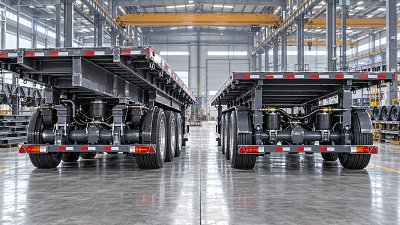
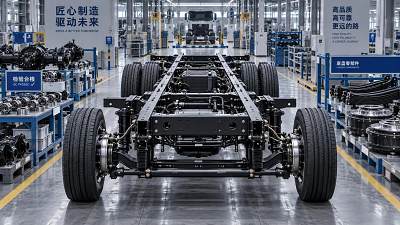
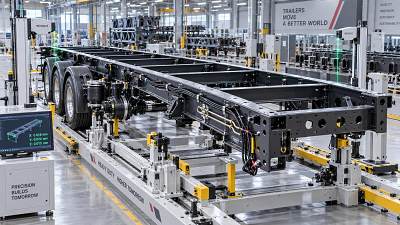
Ask for information about welding lines, frame fabrication, painting systems, assembly flow, and final inspection procedures.
A reliable truck trailer manufacturer should explain its process clearly, without vague claims or missing technical detail.
More importantly, the supplier should show whether the production line can handle your order quantity without affecting lead time or quality.
If possible, request recent production records, line videos, or a live factory audit.
In actual business, consistency matters more than peak output. Stable monthly capacity is often more valuable than an overstated annual number.
What to Verify on the Factory Side
- Number of active production lines.
- Monthly output by trailer model.
- Core fabrication equipment and maintenance status.
- In-house versus outsourced processes.
- Ability to handle customization without delay.
Review Quality Systems, Materials, and Traceability
Quality evaluation should go beyond a polished brochure. A dependable truck trailer manufacturer needs a real system behind the finished unit.
Start with raw materials. Ask what steel grades are used, where key components come from, and how incoming materials are inspected.
Then move to process quality. Welding standards, dimensional checks, load testing, and coating inspection should all be documented.
A serious truck trailer manufacturer should also offer traceability for critical parts such as axles, suspension, landing gear, and braking systems.
This becomes especially important when products are shipped internationally and later face claims, inspections, or warranty disputes.
From a risk perspective, poor traceability usually leads to slow root-cause analysis and higher after-sales cost.
Quality Questions Worth Asking
- Are material certificates available for the main structure?
- What inspection points exist during fabrication and assembly?
- Which defects are most common, and how are they corrected?
- Can the supplier provide pre-shipment inspection records?
Verify Certifications and Regulatory Readiness
Compliance is often where weak suppliers get exposed. A truck trailer manufacturer may build acceptable products, yet still fail market entry requirements.
Check whether the manufacturer holds relevant certifications for quality management and product conformity in the destination region.
Depending on the market, this may include ISO systems, welding qualifications, brake compliance, lighting requirements, or type approval documents.
The more useful signal is not the certificate itself, but the supplier’s ability to explain how compliance is maintained during production changes.
That matters because a certified sample is meaningless if later batches deviate from the approved configuration.
Assess Delivery Reliability and Supply Chain Strength
Lead time is not just a sales promise. It reflects planning quality, supplier coordination, and export execution.
A trustworthy truck trailer manufacturer should provide a realistic production schedule, not an optimistic estimate designed to win the order.
Ask how key components are sourced. If the supplier depends on unstable third-party parts, delivery risk increases quickly.
This is even more relevant during periods of shipping disruption, steel price volatility, or regional policy changes.
One practical method is to compare the promised lead time against recent export cases for similar trailer models.
A truck trailer manufacturer with stable delivery records is usually easier to scale with over time.
Delivery Signals That Matter
- Average lead time by model and order size.
- On-time shipment performance.
- Backup suppliers for critical components.
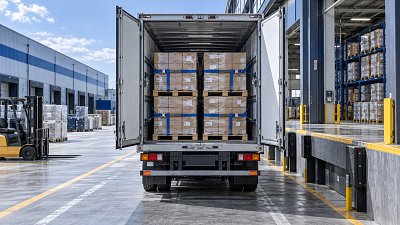
- Export packaging and loading experience.
Examine Service Support After the Order
A truck trailer manufacturer should not disappear after shipment. Long-term value depends heavily on service response and parts support.
Review the warranty scope, claim handling timeline, spare parts policy, and technical support process.
The key point is responsiveness. Delayed answers can turn a minor defect into a serious operational loss.
In actual operations, a strong truck trailer manufacturer usually has standard service documents, issue tracking, and clear escalation contacts.
That also suggests the supplier has handled international business before and understands the cost of downtime.
Use a Structured Evaluation Scorecard
To avoid subjective decisions, build a simple scorecard before final comparison.
This helps separate marketing language from measurable supplier performance.
A practical scorecard for a truck trailer manufacturer can include five weighted areas.
- Product and technical fit.
- Manufacturing and quality capability.
- Certification and compliance readiness.
- Delivery reliability and supply stability.
- After-sales support and communication.
Price should be included, but it should not dominate the final result.
A lower quote from an unproven truck trailer manufacturer often creates higher total cost later.
Make the Final Decision with Evidence
Before ordering, gather the evidence into one clear decision file.
Include technical specifications, certifications, audit notes, lead time records, payment terms, and service commitments.
At that point, the strongest truck trailer manufacturer should stand out through consistency, not sales pressure.
For global sourcing teams, platforms that connect verified suppliers, product data, and industry insights can shorten this process significantly.
The Global Heavy Truck Industry Platform supports this by helping buyers compare manufacturers, review product categories, and identify suitable partners across the heavy transport supply chain.
That kind of visibility is useful when screening more than one truck trailer manufacturer across different markets.
The final step is simple: verify the facts, score the risks, and place the order only when the supplier proves long-term reliability.
A careful evaluation today usually leads to better asset performance, fewer disputes, and a stronger sourcing foundation tomorrow.
Trending News
- How to verify a truck trailer OEM's claimed payload capacity
- How does operating weight affect the price of a new excavator?
- How to compare concrete mixer truck suppliers by total landed cost
- How axle load limits affect low bed trailer exports to Southeast Asia
- How to locate a truck exhaust system leak before replacing parts
Tag
Recommended News
 Buying GuideHow to verify a truck trailer OEM's claimed payload capacityVerify a truck trailer OEM's payload claim with tare records, load calculations, and structural evidence. Learn key checks to avoid costly mistakes and buy with confidence.
 Buying GuideHow does operating weight affect the price of a new excavator?See how operating weight affects excavator price, transport costs, and productivity. Compare configurations and uncover the best value for your next equipment purchase.
 Buying GuideHow to compare concrete mixer truck suppliers by total landed costCompare truck cement mixer supplier quotes by total landed cost, including freight, duties, and delivery. Uncover hidden charges and choose the best-value truck for your fleet.
 Buying GuideWhen does heavy equipment transport require a lowboy trailer?Does your heavy equipment need a lowboy trailer? Discover how loaded height, weight distribution, loading access, and route limits determine the right choice for safe transport.
 Buying GuideHow to choose an off road truck for steep and unstable job sitesChoose the right off road truck for steep, unstable job sites. Compare traction, braking, stability, clearance, payload, and route-test essentials.
 Buying GuideHow to match crane truck lifting capacity to your jobsite loadsCrane truck capacity planning made clear: calculate gross load, radius, rigging, outriggers, and ground conditions to select safer, job-ready lifting equipment.
 Buying GuideHow to match lowbed trailer deck height to your hauling equipmentLowbed trailer deck height guide: match equipment clearance, ramp geometry, axle loads, tractor fit, and route limits for safer, more efficient hauling.
 Buying GuideWhat to verify before choosing a delivery truck supplier for school transportationDelivery truck supplier for school transportation: verify route fit, payload, safety, compliance, service support, and total cost before choosing a reliable partner.
 Buying GuideWhat an excavator manufacturer catalog should show before you compare modelsExcavator manufacturer catalog guide: verify supplier identity, configurations, hydraulics, compliance, parts support, and delivery readiness before comparing models.
 Buying GuideWhat to check before appointing a bulldozer distributorBulldozer distributor selection guide: evaluate service, parts availability, warranty, pricing, compliance, and lifecycle value to reduce downtime and protect fleet investment.
 Buying GuideWhat to verify before choosing a truck cement mixer supplierTruck cement mixer supplier checklist: verify chassis fit, drum quality, hydraulics, compliance, spare parts, and after-sales support before you buy.
 Buying GuideHow to verify a truck spare parts supplier before placing a bulk orderTruck spare parts supplier verification made practical: learn how to check part specifications, factory control, test records, samples, pricing, and delivery capability before placing a bulk order.
 Buying GuideWhat size truck container is right for a typical freight load?Truck container sizing made simple: compare payload, volume, pallet layouts, route access, and loading needs to choose the most efficient freight solution.
 Buying GuideWhat drives semi trailer price differences between similar models?Semi trailer price differences come down to frame materials, axles, suspension, coating, and configuration. Compare specifications line by line to choose lasting value.
 Buying GuideHow to compare excavator manufacturer price lists before requesting quotesCompare an excavator manufacturer price list with confidence. Learn to normalize configurations, calculate landed costs, assess options and service, and create stronger RFQs.
 Buying GuideHow to choose a mixer truck drum capacity for your concrete pourMixer truck capacity guide: match drum size to pour rate, legal payload, site access, and delivery cycles for efficient, reliable concrete placement.
 Buying GuideHow to size a bulldozer for construction site grading workBulldozer for construction sizing guide: match weight, blade, traction, grade control, and transport needs to improve grading productivity and costs.
 Buying GuideHow to assess a truck cement manufacturer’s build quality before orderingTruck cement manufacturer build quality: assess tank steel, welding, chassis integration, pneumatic systems, factory QC, and inspection evidence before ordering.
 Buying GuideWhen does a truck trailer OEM make sense for private-label fleets?Truck trailer OEM programs help private-label fleets cut lifecycle costs, standardize operations, and improve uptime. Learn when customization delivers real commercial value.
 Buying GuideWhat to verify before choosing a water truck OEM for your fleetWater truck OEM selection guide: verify chassis compatibility, tank quality, pump performance, compliance, and service support to build a safer, more reliable fleet.
 Buying GuideHow to size a cab chassis truck for a fire department apparatusCab chassis truck for fire department sizing guide: balance GVWR, axle loads, wheelbase, water tank placement, and mission needs for safer apparatus design.
 Buying GuideWhat to verify before choosing a truck chassis supplierChoose the right truck chassis supplier with a practical checklist for application fit, axle ratings, body integration, quality control, delivery reliability, and after-sales support.
 Buying GuideHow to choose a logging truck for steep and rough forest roadsLogging truck selection for steep, rough forest roads: compare traction, braking, gearing, chassis strength, tires, and supplier support for safer, more reliable hauling.
 Buying GuideHow to choose a flatbed trailer deck length for oversized loadsFlatbed trailer deck length guide for oversized loads: balance cargo support, axle weight, securement space, overhang, and route access for safer transport.
 Buying GuideHow to assess a truck chassis supplier for trailer manufacturingTruck chassis supplier for trailer manufacturing: learn how to assess technical fit, quality control, engineering support, and delivery reliability for smarter sourcing.