Tianjin–Shanghai Express Multimodal Train Launches
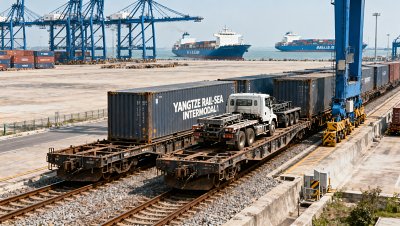
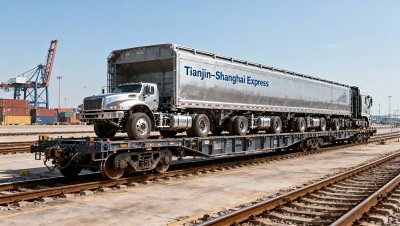
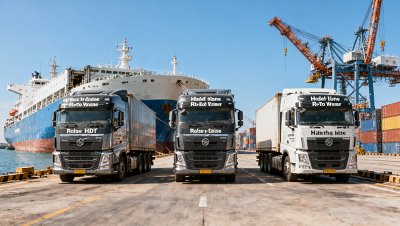
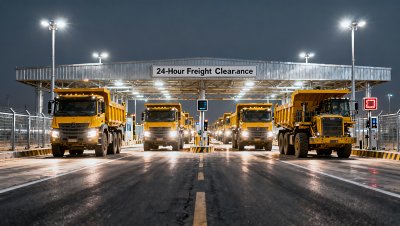
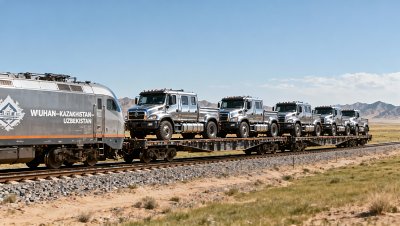
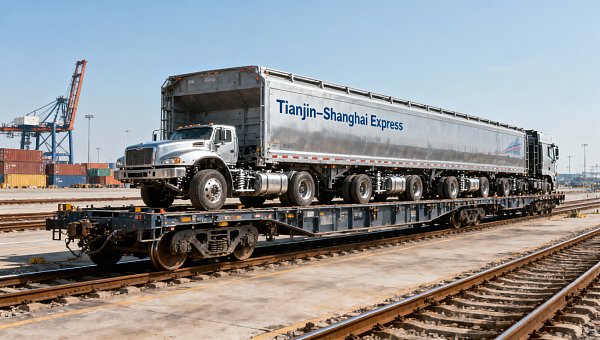
On April 24, 2026, the first dedicated heavy-duty truck chassis multimodal train service between Tianjin Port and Yangshan Port in Shanghai commenced operations — marking a structural shift in China’s export logistics infrastructure. By integrating road-to-rail transfer and intelligent yard management, the service compresses the ‘factory-to-port’ transit time for chassis to just 36 hours, significantly accelerating vessel loading readiness. This development directly impacts automotive export supply chains, particularly for OEMs and Tier-1 suppliers reliant on time-bound ocean freight schedules.
Event Overview
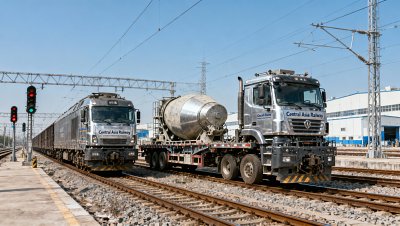
According to a report published on April 24, 2026 by China Service Trade Guide Network, the inaugural multimodal train service linking Tianjin Port and Shanghai Yangshan Port officially launched. The service employs a ‘road-to-rail + intelligent yard’ operational model, enabling direct delivery of finished heavy-duty truck chassis from manufacturing plants to port terminals for immediate vessel loading. Participating enterprises include FAW Jiefang and Shaanxi Automobile Group — two leading Chinese commercial vehicle manufacturers. Export orders now move from chassis roll-off the production line to vessel stowage an average of 2.3 days faster than prior methods.
Industries Impacted
Direct Exporting Enterprises
For OEMs and export-focused vehicle assemblers, this service reduces end-to-end lead time variability. Shorter factory-to-port windows improve adherence to shipping line cutoffs and reduce demurrage exposure. However, benefit realization depends on synchronized internal planning — including order release timing, chassis build sequencing, and documentation readiness — which remain outside the rail operator’s control.
Raw Material Procurement Enterprises
Suppliers of chassis components (e.g., axles, cabs, powertrain modules) face tighter upstream coordination requirements. With downstream assembly and dispatch cycles compressed, procurement lead times must be recalibrated to avoid bottlenecking final chassis completion. Inventory buffers may need rebalancing toward just-in-sequence rather than just-in-time delivery patterns.
Contract Manufacturing & Assembly Enterprises
Third-party chassis integrators or CKD/SKD packagers serving export markets experience heightened pressure on yard throughput capacity and staging accuracy. The 36-hour window demands near-zero tolerance for misrouted units, labeling errors, or customs pre-clearance delays — increasing reliance on digital twin yard systems and automated gate processes.
Logistics & Supply Chain Service Providers
Freight forwarders, inland haulage operators, and port logistics integrators must adapt to new handover protocols at both origin and destination yards. The shift from fragmented road-only transport to coordinated rail-yard-vessel handoffs implies revised SLA frameworks, real-time tracking integration, and updated liability allocation across modal interfaces.
Key Considerations and Recommended Actions
Align Production Scheduling with Rail Departure Windows
Manufacturers should map chassis roll-off timelines against fixed train departure slots — not just daily port cut-offs — to avoid last-minute consolidation delays or missed departures.
Pre-validate Documentation for Automated Customs Clearance
Given the compressed timeline, manual document corrections are no longer feasible. Exporters must ensure electronic submission of CIQ, customs declarations, and bill-of-lading data is fully synchronized with chassis ID and train manifest before yard entry.
Evaluate Yard Interface Capabilities at Origin Facilities
Not all host plants possess rail-served yards or automated chassis marshalling zones. Companies should assess whether their current loading infrastructure supports seamless transfer into designated rail wagons — or whether temporary staging investments are required.
Editorial Perspective / Industry Observation
Analysis shows this initiative is less about incremental speed gain and more about systemic synchronization: it tests whether China’s industrial logistics can shift from mode-optimized to process-optimized execution. Observably, success hinges not on rail capacity alone but on interoperability between ERP, TMS, and port community systems. From an industry perspective, the 2.3-day reduction reflects improved handoff discipline — not necessarily faster physical movement. Current more critical questions involve scalability beyond heavy-truck chassis, replicability at other port pairs (e.g., Qingdao–Ningbo), and tariff transparency across the multimodal chain.
Conclusion
This launch signals a maturing phase in China’s multimodal policy implementation — where infrastructure investment meets operational discipline. It does not replace maritime or air freight but redefines the viable scope of ‘just-in-time export logistics’ for capital-intensive, schedule-sensitive goods. A rational interpretation is that such services will gradually become table stakes for Tier-1 exporters competing in global tenders requiring guaranteed port arrival windows.
Source Attribution
Primary source: China Service Trade Guide Network, April 24, 2026 report titled ‘First Dedicated Heavy-Duty Chassis Multimodal Train Launched Between Tianjin Port and Shanghai Yangshan Port’. Note: Operational KPIs (e.g., on-time performance, wagon utilization rates, and cross-enterprise data-sharing protocols) remain unreported and warrant continued observation.
Trending News
- Yangtze River Delta Rail-Sea Freight Exceeds 1M TEUs
- Zhengzhou-Moscow Postal Test Train Launches New 'Mail-Level' Clearance for Heavy-Duty CKD Exports
- Shatian Customs Releases May Transport Inspection Data
- Tianjin–Shanghai Express Multimodal Train Launches
- Tongjiang Waterway Port Resumes Summer Passenger-Cargo Transport to Russia
Tag
Recommended News
 Logistics & FreightYangtze River Delta Rail-Sea Freight Exceeds 1M TEUsYangtze River Delta rail-sea freight exceeds 1M TEUs — unlocking cost-efficient, reliable intermodal logistics for heavy-duty truck exporters and ASEAN supply chains.
 Logistics & FreightTianjin–Shanghai Express Multimodal Train LaunchesTianjin–Shanghai Express Multimodal Train slashes chassis transit to 36 hours — boosting OEM export speed, reducing demurrage, and redefining just-in-time logistics for陆路运输设备.
 Logistics & FreightTongjiang Waterway Port Resumes Summer Passenger-Cargo Transport to RussiaTongjiang Waterway Port resumes summer passenger-cargo transport to Russia — a cost-effective, weather-resilient Ro-Ro solution for heavy-duty truck exporters and cross-border logistics providers.
 Logistics & FreightAsia's First Dedicated Cargo Airport Launches Two Intercontinental Freight RoutesAsia's first dedicated cargo airport launches intercontinental freight routes—boosting speed & reliability for land-transport equipment components like ADAS controllers and steer-by-wire ECUs.
 Logistics & FreightChina Captures 90% of Global VLCC Newbuilding OrdersVLCC newbuilding orders surge: China secures 90% globally—impacting HDT exports, KD kit shipments, and Ro-Ro capacity from Ningbo, Shanghai, Qingdao. Act now.
 Logistics & FreightTurkey Launches AI HS Classifier for Heavy-Duty Vehicle PartsTurkey's new AI HS Classifier boosts accuracy to 99.2% for heavy-duty vehicle parts — air suspension, disc brakes & hydraulic retarders. Streamline Turkish customs clearance now.
 Logistics & FreightTurkey Launches AI System for Heavy-Duty Vehicle Parts ClassificationAI system for heavy-duty vehicle parts classification launched in Turkey — boost HS code accuracy to 99.2% and cut customs clearance to 1.3 days for brake discs, air suspension & more.
 Logistics & FreightNXP S32G3 Chip Output Up 35% for Heavy-Duty TrucksNXP S32G3 chip output up 35% for heavy-duty trucks—boosting V2X-ready T-Box production, EU/MENA export readiness, and L2+/L3 automation deployment.
 Logistics & FreightAsia's First Dedicated Cargo Airport Launches Two Intercontinental Freight RoutesLand transport equipment exporters: Ezhou’s new cargo airport launches Chicago & Frankfurt air routes—7-day delivery for heavy-duty truck components, modular air freight, green channel access.
 Logistics & FreightPakistan Opens 6 Iran-Bound Land Corridors, Cutting China Heavy-Truck Transit to 6 HoursPakistan opens 6 Iran-bound land corridors—cutting China heavy-truck transit to just 6 hours. Boost BS VI truck exports, slash logistics costs & accelerate CPEC freight.
 Hits 103 Trains in One Month") Logistics & FreightCentral Asia Railway (Wuhan) Hits 103 Trains in One MonthCentral Asia Railway (Wuhan) hits 103 trains in April 2026 — traction vehicles, concrete mixer chassis & low-bed semi-trailers drive 37% of exports. Fast, reliable overland transport for Central Asia & Caspian markets.
Logistics & FreightCentral Asia Railway (Wuhan) Hits 103 Trains in One MonthCentral Asia Railway (Wuhan) hits 103 trains in April 2026 — traction vehicles, concrete mixer chassis & low-bed semi-trailers drive 37% of exports. Fast, reliable overland transport for Central Asia & Caspian markets. Logistics & FreightErenhot Highway Port Launches 24-Hour Freight ClearanceErenhot Highway Port now offers 24-hour freight clearance—boosting speed & reliability for heavy-duty truck exporters, cross-border logistics, and Mongolian distributors.
 Logistics & FreightErlianhot Highway Port Launches 24-Hour Freight ClearanceErlianhot Highway Port now offers 24-hour freight clearance — China’s first round-the-clock land port for Mongolia-bound heavy-duty vehicles and construction equipment. Faster, more predictable cross-border logistics await.
 Hits 103 Trains in One Month") Logistics & FreightCentral Asia Railway (Wuhan) Hits 103 Trains in One MonthCentral Asia Railway (Wuhan) hits 103 trains in April 2026 — a record boost for land transport equipment exporters, freight forwarders & EU/Central Asian buyers.
Logistics & FreightCentral Asia Railway (Wuhan) Hits 103 Trains in One MonthCentral Asia Railway (Wuhan) hits 103 trains in April 2026 — a record boost for land transport equipment exporters, freight forwarders & EU/Central Asian buyers. Logistics & FreightBest Flatbed Trailer Supplier Options for Logistics TransportationFind the best flatbed trailer supplier for logistics transportation with expert tips on load capacity, durability, compliance, and supplier support to improve fleet efficiency.
 Logistics & FreightErenhot Highway Port Launches 24-Hour Freight Clearance for MongoliaErenhot Highway Port launches 24-hour freight clearance for Mongolia — boosting speed, reliability & TIR-compliant exports of heavy vehicles and machinery.
 Logistics & FreightChina–Central Asia Customs Sign E-Release Mutual Recognition MOUChina–Central Asia e-release MOU streamlines road transport equipment clearance—tractors, semi-trailers & special vehicles now benefit from mutual recognition, faster borders & lower logistics costs.
 Logistics & FreightPakistan Opens 6 Land Routes to Iran, Cutting China Heavy-Truck Transit to 6 HoursPakistan opens 6 new land routes to Iran—cutting China heavy-truck transit to just 6 hours. Transform logistics, slash clearance time & boost supply chain resilience.
 Logistics & FreightChina-Central Asia Customs Sign E-Release Mutual Recognition MOUChina-Central Asia e-release MOU streamlines land transport equipment clearance—cutting costs 11% and enabling single-declaration, five-country mutual recognition for tractors, trailers & chassis.
 Logistics & FreightPakistan Activates 6 Land Freight Corridors to IranPakistan’s 6 new land freight corridors to Iran — including Gwadar–Gabd — enable sub-6-hour cross-border heavy freight. Boost efficiency, bypass Hormuz, and future-proof your陆路运输设备 logistics.
 Logistics & FreightBest Semi Trailer Manufacturer for Logistics in 2026Find the best semi trailer manufacturer for logistics in 2026. Compare durable, compliant, cost-efficient trailer solutions for regional, long-haul, port, and heavy-duty transport.
 Logistics & FreightLow Bed Trailer Export for Mining: Load Limits and Route PlanningLow bed trailer export for mining: learn load limits, axle distribution, and route planning tips to reduce delays, improve compliance, and choose the right trailer for safer project delivery.
 Logistics & Freight24-Hour Full-Truckload Delivery Now Standard for Global Buyers24-hour full-truckload delivery is now standard for global buyers — enabling JIT reliability, API-driven visibility, and up to 40% safety stock reduction across陆路运输设备 supply chains.
 Logistics & FreightChina-Mongolia-Russia Trucking Pact Upgraded with e-CMR & Cold Chain Data SharingChina-Mongolia-Russia trucking pact upgrades cold chain logistics with e-CMR adoption and real-time temperature data sharing—boost compliance, cut delays, and future-proof cross-border road transport.
 Logistics & FreightChina Launches 24-Hour Full-Load Freight for 'Next-Day Delivery'China's 24-hour full-load freight enables guaranteed T+1 next-day delivery for exporters — boosting reliability, cutting air freight costs, and transforming cross-border supply chain planning.