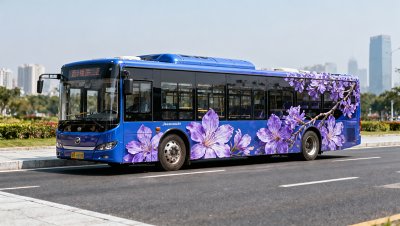
Kunming Launches Jacaranda-Themed EV Bus; Inspires Latin American Design Feedback
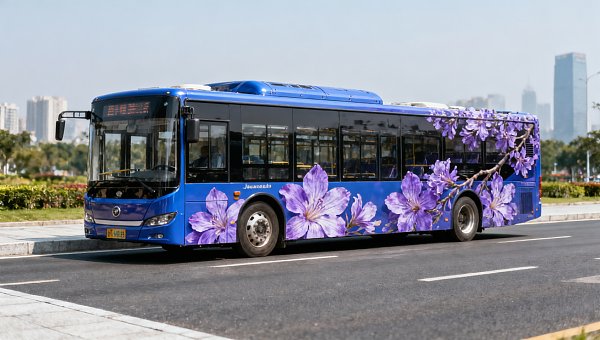
On May 6, 2026, Kunming Public Transport Group launched a 12-meter pure-electric low-floor bus featuring a jacaranda-themed livery and localized human-machine interface — marking a notable shift in how Chinese new-energy vehicle exporters engage with cultural specificity in overseas markets. This initiative has drawn direct attention from importers and design research teams in Chile and Colombia, signaling growing demand for context-aware product adaptation across Latin America’s urban mobility sector.
Event Overview
On May 6, 2026, Kunming Public Transport Group introduced a fleet of 12-meter pure-electric low-floor buses with custom exterior livery inspired by Kunming’s iconic blue jacaranda blossoms and an onboard human-machine interface tailored for local passenger behavior. A joint调研 team from Chilean and Colombian importers conducted on-site sampling of both the visual design and UI elements during the launch.
Industries Affected
Direct Trade Enterprises
Export-oriented bus manufacturers and trading companies serving Latin American markets are directly affected because this case demonstrates rising buyer expectations beyond technical compliance — specifically, demand for culturally resonant aesthetics and service-layer customization. Impact manifests in longer pre-sale consultation cycles, increased need for co-design frameworks, and pressure to restructure export quotation models to include design R&D services.
Raw Material Procurement Enterprises
Suppliers of exterior coating materials, interior trim components, and display-grade electronics face recalibration needs: jacaranda-themed color palettes require pigment formulations aligned with regional UV exposure standards and durability benchmarks in tropical climates; meanwhile, UI-integrated displays must meet new thermal and dust-resistance certifications for Andean and coastal urban environments — prompting earlier engagement with downstream OEMs during material qualification.
Manufacturing Enterprises
Bus assemblers and Tier-1 component integrators are impacted by evolving platform requirements: low-floor chassis adaptations now need concurrent validation for both structural safety and aesthetic integration (e.g., panel curvature accommodating floral motifs without compromising crash integrity); additionally, software-defined vehicle platforms must support multi-language UI localization — not just translation, but layout, iconography, and gesture logic adapted to local usage norms.
Supply Chain Service Providers
Logistics operators, certification consultants, and after-sales network developers must adjust service scopes: transport packaging now requires anti-scratch protection for custom-painted surfaces; homologation support must extend beyond UN ECE or INMETRO compliance to include municipal-level branding guidelines (e.g., Santiago’s public transport visual identity manual); and spare-parts warehousing strategies must anticipate higher SKU diversity due to region-specific trim and UI module variants.
Key Considerations and Recommended Actions
Adopt ‘Co-Creation’ Engagement Models Early in Export Cycles
Rather than treating design feedback as post-delivery input, exporters should institutionalize joint workshops with importer-led user groups — especially during prototype review stages — to capture cultural nuance before mass production. The Kunming case shows that physical co-location (e.g., on-site sampling) yields higher-fidelity insights than remote surveys alone.
Integrate Local Visual Identity Standards into Design Validation Protocols
Manufacturers should formalize partnerships with regional design institutes or municipal transit authorities to benchmark color gamut, typography hierarchy, and icon semantics against local public signage standards — avoiding costly late-stage redesigns when entering cities like Medellín or Valparaíso.
Expand After-Sales Capability Beyond Hardware to Include UI Localization Maintenance
Given that UI interfaces are now part of the value proposition, service contracts must cover over-the-air update management, multilingual content versioning, and accessibility compliance updates — requiring cross-functional coordination between software engineers, linguists, and field technicians.
Editorial Perspective / Industry Observation
Observably, this is not merely about surface-level ‘localization’ — it reflects a deeper strategic pivot: Chinese NEV exporters are transitioning from volume-driven hardware supply to context-sensitive mobility system participation. Analysis shows that successful replication of the Kunming model hinges less on aesthetic replication and more on institutionalizing feedback loops that convert cultural observation into modular, certifiable design assets. From an industry perspective, what was once treated as marketing embellishment is now becoming a core engineering requirement — particularly where public procurement rules increasingly weigh ‘user experience alignment’ alongside energy efficiency metrics.
Conclusion
This case signals a maturation point: cultural resonance is no longer optional differentiation but an operational prerequisite for sustainable market access in emerging urban transit ecosystems. A rational interpretation is that policy-aligned green mobility initiatives — such as China’s ‘Green Export Facilitation Guidelines’ and Latin America’s ‘Sustainable Urban Mobility Plans’ — are converging to elevate design intelligence as infrastructure-grade capability.
Source Attribution
Sources: Kunming Public Transport Group official press release (May 6, 2026); Chilean National Transport Authority (MTT) field observation report #CL-MTT-2026-047; Colombian Ministry of Transport ‘Importer Design Feedback Initiative’ summary (Q2 2026). Note: Ongoing monitoring required for regulatory updates in Peru and Argentina regarding municipal-level branding clauses in bus procurement tenders.
Trending News
- Construction Machinery Cost Control: 7 Hidden Expenses in Project Planning
- Logging Truck Price Guide: Spec Choices That Change Total Ownership Cost
- Crane Truck Cost Breakdown: Chassis, Crane Unit, and Compliance Fees
- How to Vet a Logging Truck Distributor Before Entering a New Market
- Logging Truck Supplier Selection: Load Capacity, Terrain Fit, and Downtime
Tag
Recommended News
 New Truck ReleasesKunming Launches Jacaranda-Themed EV Bus; Inspires Latin American Design FeedbackKunming's jacaranda-themed EV bus sets new standard for cultural adaptation in Latin American陆路运输设备 exports — blending aesthetics, UI localization & sustainable mobility.
 New Truck ReleasesStake trailer wood decking warps faster in coastal regions — alternatives gaining traction in 2026Stake trailer, van trailer & flatbed trailer operators in coastal areas are switching to corrosion-resistant decking—explore 2026’s top alternatives: gooseneck trailer, curtain side trailer, bulk trailer & more.
 New Truck ReleasesNot just another export model: What’s changed in the SHACMAN H3000 6×4 Cement Mixer since 2023SHACMAN H3000 6×4 Cement Mixer: Key 2023–2026 upgrades in durability, hydraulics, HMI & telematics—backed by real-world data across 17 countries.