Chongqing-Zhanjiang 'One-Order' Export Clearance Live
On April 16, 2026, the first cross-regional sea-rail multimodal export under a unified customs declaration — linking Chongqing, Zhanjiang Port, and Yangpu Port (Hainan) — successfully cleared for export to Yangon, Myanmar. This milestone directly impacts manufacturers and exporters of automotive components, specialized vehicle parts, and rail-transported industrial equipment targeting RCEP and ASEAN markets — marking a structural shift in inland China’s export logistics efficiency.
Event Overview
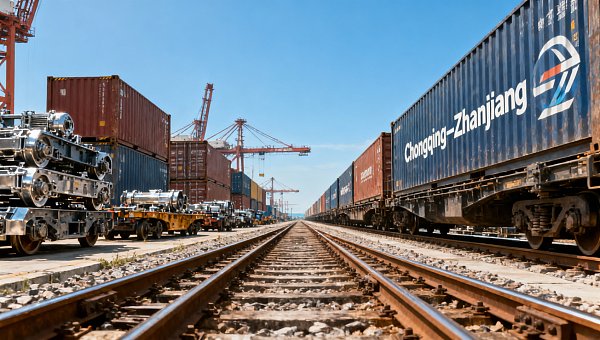
On April 16, 2026, motorcycle spare parts produced in Chongqing were transported by rail to Zhanjiang Port, then seamlessly transferred onto a vessel bound for Yangpu Port (Hainan), and onward to Yangon, Myanmar. The entire process operated under a ‘one declaration, one bill of lading’ framework, with synchronized customs supervision across Chongqing, Zhanjiang, and Yangpu. This marked the first implementation of zero-transit customs clearance for sea-rail multimodal exports along the Western Land-Sea New Passage.
Industries Affected by Segment
Direct Exporters (e.g., OEMs, Tier-1 Suppliers)
These enterprises are directly exposed to customs clearance time and documentation complexity. The new model eliminates repeated declarations and physical inspections at transit points, reducing total export lead time and lowering compliance-related administrative costs.
Manufacturers of Rail-Transported Industrial Equipment (e.g., chassis, special-purpose vehicle kits)
As highlighted in the event summary, this mode specifically enhances delivery certainty for whole vehicles, chassis, and aftermarket modification components shipped via rail. Delivery windows become more predictable, supporting just-in-time inventory planning and contractual service-level commitments.
Logistics & Multimodal Service Providers
Firms offering integrated sea-rail solutions gain operational validation for end-to-end bill-of-lading models. However, they must now align internal systems — especially EDI interfaces and cargo tracking — with three-region customs data sharing protocols.
Distribution & Regional Trading Companies Serving ASEAN Markets
Those managing consolidated shipments from Southwest China face lower coordination overhead per consignment. But they must verify whether their existing freight forwarders or port agents are certified participants in the tri-regional ‘one-order’ pilot before committing to it operationally.
What Enterprises Should Monitor and Act On Now
Track official expansion timelines and eligibility criteria
Current implementation is confirmed only for Chongqing–Zhanjiang–Yangpu–Myanmar routes. Enterprises should monitor announcements from GACC (General Administration of Customs of China) and provincial customs offices for formal inclusion of additional origin cities, ports, or destination countries — particularly within RCEP member states.
Validate product eligibility against initial scope
The event highlights motorcycles and related parts, plus rail-suitable industrial equipment. Firms exporting other categories (e.g., electronics, textiles) should not assume automatic coverage; verification with local customs or designated pilot operators is required before adoption.
Distinguish between policy rollout and operational readiness
While the regulatory framework is live, full system integration (e.g., synchronized cargo manifest submission, real-time customs status feeds across three jurisdictions) may still be undergoing refinement. Early adopters should treat initial runs as process validation, not production-scale deployment, until at least two consecutive successful clearances are documented.
Prepare documentation and carrier coordination in advance
‘One-order’ requires consistent commodity descriptions, HS codes, and valuation across all legs. Exporters should audit current shipping instructions and align with rail carriers and ocean lines on standardized data fields — especially for weight, packaging type, and origin certification — ahead of pilot participation.
Editorial Perspective / Industry Observation
Observably, this is a regulatory and procedural milestone — not yet a fully scaled infrastructure upgrade. It demonstrates inter-customs coordination capability, but does not inherently resolve physical bottlenecks (e.g., rail yard capacity at Zhanjiang, vessel frequency on the Yangpu–Myanmar leg). Analysis shows that its primary value lies in signaling institutional commitment to simplifying multimodal trade for inland exporters. From an industry perspective, it functions less as an immediate productivity tool and more as a foundational enabler: once replicated across other corridors and product categories, it could reshape how inland manufacturing hubs price and schedule exports to ASEAN. Continued monitoring is warranted — not for what has been achieved, but for how quickly the model expands beyond its current narrow scope.
In summary, the Chongqing–Zhanjiang ‘one-order’ clearance is a targeted procedural innovation with tangible benefits for specific exporters and logistics providers — but its broader industry significance depends entirely on replication, scalability, and integration depth. It is best understood today not as a new standard, but as a validated prototype awaiting expansion.
Source: Official announcement dated April 16, 2026, referencing implementation of the Western Land-Sea New Passage sea-rail multimodal export pilot. Note: Expansion to additional origins, destinations, or product categories remains unconfirmed and is subject to ongoing observation.
Trending News
- Cab Chassis Truck for Fire Department: Key Specs Before Ordering
- When to Use an Excavator With Long Reach Boom on Site
- Choosing a Water Truck Factory for Municipal and Mining Projects
- Truck Parts Wholesale: How to Balance Price, Quality, and Lead Time
- Crane Truck Price in 2026: What Drives Total Ownership Cost
Tag
Recommended News
 Hits 103 Trains in One Month") Logistics & FreightCentral Asia Railway (Wuhan) Hits 103 Trains in One MonthCentral Asia Railway (Wuhan) hits 103 trains in April 2026 — traction vehicles, concrete mixer chassis & low-bed semi-trailers drive 37% of exports. Fast, reliable overland transport for Central Asia & Caspian markets.
Logistics & FreightCentral Asia Railway (Wuhan) Hits 103 Trains in One MonthCentral Asia Railway (Wuhan) hits 103 trains in April 2026 — traction vehicles, concrete mixer chassis & low-bed semi-trailers drive 37% of exports. Fast, reliable overland transport for Central Asia & Caspian markets. Logistics & FreightErenhot Highway Port Launches 24-Hour Freight ClearanceErenhot Highway Port now offers 24-hour freight clearance—boosting speed & reliability for heavy-duty truck exporters, cross-border logistics, and Mongolian distributors.
 Logistics & FreightErlianhot Highway Port Launches 24-Hour Freight ClearanceErlianhot Highway Port now offers 24-hour freight clearance — China’s first round-the-clock land port for Mongolia-bound heavy-duty vehicles and construction equipment. Faster, more predictable cross-border logistics await.
 Hits 103 Trains in One Month") Logistics & FreightCentral Asia Railway (Wuhan) Hits 103 Trains in One MonthCentral Asia Railway (Wuhan) hits 103 trains in April 2026 — a record boost for land transport equipment exporters, freight forwarders & EU/Central Asian buyers.
Logistics & FreightCentral Asia Railway (Wuhan) Hits 103 Trains in One MonthCentral Asia Railway (Wuhan) hits 103 trains in April 2026 — a record boost for land transport equipment exporters, freight forwarders & EU/Central Asian buyers. Logistics & FreightBest Flatbed Trailer Supplier Options for Logistics TransportationFind the best flatbed trailer supplier for logistics transportation with expert tips on load capacity, durability, compliance, and supplier support to improve fleet efficiency.
 Logistics & FreightErenhot Highway Port Launches 24-Hour Freight Clearance for MongoliaErenhot Highway Port launches 24-hour freight clearance for Mongolia — boosting speed, reliability & TIR-compliant exports of heavy vehicles and machinery.
 Logistics & FreightChina–Central Asia Customs Sign E-Release Mutual Recognition MOUChina–Central Asia e-release MOU streamlines road transport equipment clearance—tractors, semi-trailers & special vehicles now benefit from mutual recognition, faster borders & lower logistics costs.
 Logistics & FreightPakistan Opens 6 Land Routes to Iran, Cutting China Heavy-Truck Transit to 6 HoursPakistan opens 6 new land routes to Iran—cutting China heavy-truck transit to just 6 hours. Transform logistics, slash clearance time & boost supply chain resilience.
 Logistics & FreightChina-Central Asia Customs Sign E-Release Mutual Recognition MOUChina-Central Asia e-release MOU streamlines land transport equipment clearance—cutting costs 11% and enabling single-declaration, five-country mutual recognition for tractors, trailers & chassis.
 Logistics & FreightPakistan Activates 6 Land Freight Corridors to IranPakistan’s 6 new land freight corridors to Iran — including Gwadar–Gabd — enable sub-6-hour cross-border heavy freight. Boost efficiency, bypass Hormuz, and future-proof your陆路运输设备 logistics.
 Logistics & FreightBest Semi Trailer Manufacturer for Logistics in 2026Find the best semi trailer manufacturer for logistics in 2026. Compare durable, compliant, cost-efficient trailer solutions for regional, long-haul, port, and heavy-duty transport.
 Logistics & FreightLow Bed Trailer Export for Mining: Load Limits and Route PlanningLow bed trailer export for mining: learn load limits, axle distribution, and route planning tips to reduce delays, improve compliance, and choose the right trailer for safer project delivery.
 Logistics & Freight24-Hour Full-Truckload Delivery Now Standard for Global Buyers24-hour full-truckload delivery is now standard for global buyers — enabling JIT reliability, API-driven visibility, and up to 40% safety stock reduction across陆路运输设备 supply chains.
 Logistics & FreightChina-Mongolia-Russia Trucking Pact Upgraded with e-CMR & Cold Chain Data SharingChina-Mongolia-Russia trucking pact upgrades cold chain logistics with e-CMR adoption and real-time temperature data sharing—boost compliance, cut delays, and future-proof cross-border road transport.
 Logistics & FreightChina Launches 24-Hour Full-Load Freight for 'Next-Day Delivery'China's 24-hour full-load freight enables guaranteed T+1 next-day delivery for exporters — boosting reliability, cutting air freight costs, and transforming cross-border supply chain planning.
 Logistics & FreightAll 27 Bridges Across Pinglu Canal CompletedAll 27 bridges across Pinglu Canal completed — unlocking a game-changing inland waterway route for heavy-duty road transport equipment from Southwest China to global markets.
 Logistics & FreightChoosing Commercial Vehicle Parts for Cold Storage ReliabilityCommercial vehicle parts for cold storage are key to reefer reliability. Learn how to choose durable, compatible parts that reduce downtime, protect cargo, and improve fleet performance.
 Logistics & Freight27 Bridges Over Pinglu Canal Completed, Accelerating Southwest Equipment ExportsPinglu Canal's 27 bridges completed—boosting陆路运输设备 exports to ASEAN, Middle East & Africa. Discover logistics advantages for heavy machinery, mining vehicles & concrete mixers.
 Logistics & FreightChina Launches 24-Hour Full-Truckload Delivery for Overseas BuyersFull-truckload delivery from China now guarantees 24-hour land transport for overseas buyers — transforming procurement, inventory, and supply chain resilience for陆路运输设备 exporters and importers.
 Logistics & FreightSix New Iran-Pakistan Land Crossings Opened, Land Clearance Cut to 6 HoursSix new Iran-Pakistan land crossings slash cargo clearance to just 6 hours—boosting efficiency for heavy-duty trucks, semi-trailers & CKD/SKD kits export.
 Logistics & FreightNanjing Launches First Wind Power Equipment Shipping Route to PakistanWind power equipment shipping route from Nanjing to Pakistan launched—key logistics upgrade for CPEC renewable projects, heavy transport & EPC contractors.
 Logistics & FreightIran-Pakistan Launch 6 Cross-Border Roads, 3 New Land PortsIran-Pakistan launch 6 cross-border roads & 3 new land ports—boosting overland logistics, heavy-duty truck demand, and Central Asia–Gulf corridor efficiency.
 Logistics & FreightTruck Spare Parts Supplier in Europe: How to Avoid Cross-Border DelaysTruck spare parts supplier in Europe guide: learn how to reduce cross-border delays, improve parts sourcing, and keep fleet repairs fast with smarter supplier selection.
 Logistics & FreightFlatbed Trailer Supplier for Logistics Transportation: Key Load FactorsFlatbed trailer supplier for logistics transportation: learn key load factors like weight distribution, cargo size, and road conditions to choose safer, cost-efficient trailers.
 Logistics & FreightHuanggang Port Freight Operations Cease, Shenzhen-Hong Kong Cross-Border Logistics Shifts to 'East-In-East-Out, West-In-West-Out'Huanggang Port freight operations cease May 2026—Shenzhen-Hong Kong logistics shifts to 'East-In-East-Out, West-In-West-Out'. Key for陆路运输设备 stakeholders: update vehicle specs, optimize routes, ensure compliance now.