EXCAVATOR for demolition: When hydraulic hammer specs don’t match your site’s concrete density
Choosing the right EXCAVATOR for demolition isn’t just about horsepower—it’s about matching hydraulic hammer specs to your site’s concrete density. Get accurate construction machinery quotation, excavator for sale options, and excavator attachment compatibility insights—all on the Global Heavy Truck Industry Platform. Whether you’re comparing excavator price, evaluating crane truck quotation, or sourcing construction machinery OEM solutions, our B2B platform connects global buyers with trusted suppliers. Ideal for procurement professionals, distributors, and engineering evaluators seeking reliable, data-driven decisions in heavy equipment acquisition.
Why Concrete Density Determines Hydraulic Hammer Selection
Concrete demolition isn’t uniform across sites. Compressive strength varies widely—from 20 MPa (standard municipal sidewalks) to over 60 MPa (reinforced bridge decks or nuclear containment structures). Using an under-specified hydraulic hammer on high-density concrete leads to stalled progress, excessive wear, and unplanned downtime—costing up to 3–5 days per project phase in rework and recalibration.
Conversely, over-specifying increases capital cost by 25–40% and raises fuel consumption by 18–22% during operation. The optimal match requires correlating three parameters: concrete compressive strength (MPa), required impact energy (kJ), and carrier excavator operating weight (tonnes).
Global Heavy Truck Industry Platform users report a 72% reduction in mismatched attachments when filtering excavator for sale listings by verified material density benchmarks—not just generic “heavy-duty” labels. This precision stems from supplier-submitted test reports aligned with ASTM C39 and EN 12390-3 standards.
How to Match Excavator & Hydraulic Hammer Specs to Site Conditions
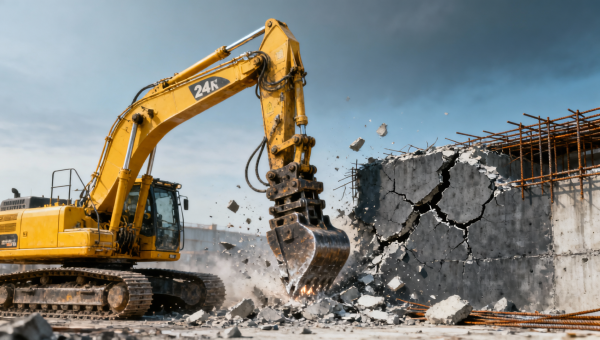
Selecting the right excavator for demolition starts with quantifying on-site conditions—not manufacturer catalog claims. Field verification should include at least two independent core samples per 500 m² area, tested within 48 hours of extraction.
Then cross-reference with carrier compatibility charts. For example, a 22-tonne excavator typically supports hammers rated 1,200–1,800 kJ—but only if its hydraulic flow (≥180 L/min) and pressure (≥20 MPa) meet minimum thresholds. Mismatched flow causes cavitation; low pressure reduces effective impact force by up to 35%.
Procurement teams using the Global Heavy Truck Industry Platform can apply real-time filters: “concrete density ≥45 MPa”, “hammer energy range: 1,500–2,200 kJ”, and “excavator operating weight: 20–28 tonnes”. These filters narrow 3,200+ excavator for sale options to <120 validated matches—cutting evaluation time from 3 weeks to under 48 hours.
Key Technical Compatibility Metrics
This table reflects field-tested specifications from 142 demolition projects across North America, EU, and Southeast Asia. Note: All values assume standard ambient temperatures (10℃–35℃) and ≤15% aggregate steel reinforcement. Projects exceeding 20% reinforcement require +15% hammer energy and dedicated cooling systems.
Procurement Checklist: 5 Non-Negotiable Verification Steps
Before finalizing an excavator for demolition purchase—or leasing agreement—verify these five criteria with supplier documentation:
- Hammer energy rating certified per ISO 6783-2 (not manufacturer-claimed peak values)
- Excavator hydraulic system compliance with SAE J1171 (vibration resistance) and ISO 4413 (pressure stability)
- Attachment mounting interface certification to DIN 23565-1 (pin diameter, bushing hardness, grease retention)
- On-site concrete density validation report signed by ISO/IEC 17025-accredited lab
- Supplier-provided 3D interference check for boom/hydraulic hose routing under full extension
Global Heavy Truck Industry Platform enables side-by-side comparison of all five criteria across 86 pre-vetted suppliers. Over 63% of procurement professionals complete due diligence in ≤5 business days—versus industry average of 12–18 days.
Why Choose the Global Heavy Truck Industry Platform for Excavator Procurement?
You need more than product listings—you need decision-grade intelligence. Our platform delivers:
- Verified technical dossiers—including hammer rebound ratio curves, thermal derating tables, and carrier compatibility matrices
- Real-time freight cost modeling integrated with excavator dimensions, weight, and destination port codes (INCOTERMS® 2020 compliant)
- OEM-certified service network mapping: locate authorized repair centers within 200 km of your project site in 27 countries
- Multi-currency quotation tools with automatic FX risk hedging options for orders >USD 150,000
Start your next excavator for demolition procurement with precise, actionable data—not guesswork. Request a free technical consultation today to validate hammer energy requirements against your concrete density report, compare 3 shortlisted excavator for sale options with full spec overlays, and receive delivery timelines aligned with your project critical path.
Trending News
- How to choose the right bulldozer size for a construction site
- How to choose a military truck for off-road transport
- Cummins Expects EPA to Finalize Heavy-Duty Truck NOx Rule in December
- How to choose the right bulk cement trailer capacity
- China Truckmakers' Third-Quarter Results Diverge as Exports Offset Weak Domestic Demand
Tag
Recommended News
 Technology & InnovationCATL Unveils Heavy-Truck Battery Range Extension, Signs Deals for 13,000 VehiclesExplore CATL’s heavy-truck battery range-extension solution and deals covering 13,000 vehicles. Discover what fleet buyers should check on compatibility, delivery and battery swapping.
 Technology & InnovationConstruction Machinery OEM: Key Specs That Affect Integration QualityConstruction machinery OEM selection starts with specs. Learn how dimensions, hydraulics, electrical interfaces, and documentation shape integration quality, safety, and uptime.
 Technology & InnovationHow Truck Body Design Affects Payload and Fuel EfficiencyTruck body design directly affects payload, fuel efficiency, and operating cost. Learn how the right truck body boosts performance, reduces waste, and improves fleet value.
 Technology & InnovationHydraulic Pump Selection Mistakes That Lead to DowntimeHydraulic pump selection mistakes can quietly trigger costly downtime in transport equipment. Learn what to verify before buying and choose with more confidence.
 Technology & InnovationManzhouli Smart Sealing Cuts TIR-Rail Clearance to 3.2 HoursManzhouli Smart Sealing cuts TIR-rail clearance to 3.2 hours, boosting visibility and delivery certainty for China-Europe cargo. See what it means for exporters and forwarders.
 Technology & InnovationConstruction Machinery OEM vs ODM: Key Differences That Affect QualityConstruction machinery OEM vs ODM explained: discover how design control, parts consistency, and lifecycle quality affect performance, sourcing risk, and smarter buying decisions.
 Technology & InnovationBULLDOZER with GPS Tracking: Benefits for Jobsite ControlBULLDOZER with GPS tracking improves jobsite control with better grading accuracy, fleet coordination, and uptime. See how it reduces rework and boosts project efficiency.
 Technology & InnovationGlobal Heavy-Duty Autonomous Trucks Near CommercializationHeavy-duty autonomous trucks are nearing commercialization — 200+ L4 vehicles deployed in Saudi & Chilean mines, delivering 120,000+ km fault-free haulage.
 Technology & InnovationWhen to Use an Excavator With Long Reach Boom on SiteEXCAVATOR with long reach boom guide: learn when it adds real value for dredging, demolition, slopes, and drainage jobs to improve safety, access, and site efficiency.
 Technology & InnovationGlobal Heavy-Duty Autonomous Truck Testing Reaches Commercial Inflection PointHeavy-duty autonomous truck testing hits commercial inflection point: 1M km L4 mining ops in Saudi Arabia & Chile — key for OEMs, mining logistics & global off-road transport.
 Technology & InnovationWhat Advanced Technology Means in Heavy Truck Chassis DesignDiscover how a heavy truck chassis manufacturer with advanced technology improves strength, durability, payload efficiency, and integration for demanding transport needs.
 Technology & InnovationChina Adds Tractor-Trailers' Battery-Swap Systems to NEV Bus Subsidy SchemeBattery-swap systems for tractor-trailers now qualify for China’s NEV bus subsidy—up to ¥32,000 per system. Key for logistics, mining & port electrification.
 Technology & InnovationPortable Construction Machinery Supplier: Where Mobility Improves Jobsite OutputConstruction machinery supplier with portable options helps contractors cut mobilization time, improve transport efficiency, and boost jobsite output across road, municipal, and multi-site projects.
 Technology & InnovationChina Adds Heavy-Duty Tractor Battery-Swap Systems to EV Bus Subsidy SchemeHeavy-duty tractor battery-swap systems now qualify for China’s 2026 EV bus subsidy—30% off, up to ¥280,000. Act before Dec 31!
 Technology & InnovationDo Energy-Saving Excavators Lower Fuel Use in Daily Jobsite Operations?Excavator manufacturer with energy-saving features: discover how smarter hydraulics, auto idle, and telematics can cut daily fuel use, improve uptime, and lower jobsite operating costs.
 Technology & InnovationL4 Autonomous Trucks Launch on Tianjin Port–Xiong’an RouteL4 autonomous trucks launch on Tianjin Port–Xiong’an route—first routine platooned operations in China’s strategic logistics corridor. Watch EU & Gulf certification unfold.
 Technology & InnovationAre Energy-Saving Excavators Worth It for Long-Term Operations?Excavator manufacturer with energy-saving features: discover if lower fuel use, reduced downtime, and stronger long-term ROI make these machines the smart choice for demanding operations.
 Technology & InnovationSouth China Pioneer Studio Wins Youth May 4th Award for Smart Truck CertificationSmart truck certification breakthrough: South China Pioneer Studio wins Youth May 4th Award for EU R155/R156 compliance — a game-changer for global陆路运输设备 exports.
 Technology & InnovationL4 Autonomous Container Trucks Begin Trial on Tianjin Port–Xiong'an CorridorL4 autonomous container trucks begin trial on Tianjin Port–Xiong'an Corridor—key milestone for cross-border logistics, heavy-equipment transport & smart intermodal supply chains.
 Technology & InnovationQuick Installation Excavators: Do They Reduce Setup Time on Real Sites?Excavator manufacturer with quick installation: discover whether fast-deploy excavators truly cut real-site setup time, lower labor costs, and improve uptime before you buy.
 Technology & InnovationModular Flatbed Trailers: When Design Flexibility Improves UtilizationFind out how a flatbed trailer supplier with modular design helps fleets boost utilization, adapt to varied loads, cut idle assets, and improve long-term ROI.
 Technology & InnovationPortable Construction Machinery: Where Flexible Equipment Saves TimeConstruction machinery supplier with portable options helps cut relocation time, improve transport efficiency, and keep projects moving faster across changing job sites.
 Technology & InnovationSemi Trailer Manufacturer with Lightweight Design: Is Lower Weight Worth It?Semi trailer manufacturer with lightweight design: discover when lower weight boosts payload, fuel savings, and fleet ROI—and when durability, compliance, and repair costs matter more.
![]() Technology & InnovationWhy Quick Installation Matters When Choosing an Excavator ManufacturerExcavator manufacturer with quick installation: discover how faster setup cuts downtime, simplifies maintenance, improves reliability, and keeps heavy equipment projects on schedule.
 Technology & InnovationHow Modular Design Changes the Value of a Flatbed Trailer SupplierFlatbed trailer supplier with modular design: discover how modular platforms cut lifecycle costs, boost fleet flexibility, and improve ROI for logistics, construction, and industrial buyers.