Small Yacht Operators (Under 12 Pax) Must Comply with Maritime Authority Rules
On April 20, 2026, China’s Ministry of Transport clarified jurisdictional responsibility for unlicensed commercial operations by small yachts (under 12 passenger seats), specifying that maritime administration authorities—not waterway transport regulators—hold enforcement authority. This ruling directly affects export service providers, port engineering contractors, and cross-modal logistics operators engaged in roll-on/roll-off (Ro-Ro) vessel support, inland terminal personnel transfers, and other water-land intermodal scenarios.
Event Overview
On April 20, 2026, the Ministry of Transport issued an official clarification stating that for yachts carrying fewer than 12 passengers conducting unauthorized commercial transportation—including Ro-Ro vessel crew/passenger shuttle services and aquatic transfer of port construction vehicles—the competent enforcement authority is the maritime management institution. The notice establishes a clear regulatory boundary for land-based transport equipment operating within water-land intermodal contexts.
Industries Affected
Export Service Providers
These firms often coordinate vessel-side personnel transfers, customs clearance shuttles, or pre-departure crew rotations using small craft. The ruling means their current operational models—especially those relying on unlicensed yachts or converted workboats—now fall under maritime safety and licensing oversight, not just transport service registration.
Port Engineering & Construction Contractors
Contractors deploying engineering vehicles (e.g., cranes, loaders) via temporary water transfer between shore and offshore worksites must now ensure any accompanying passenger vessels used for staff movement hold valid maritime operation permits. Previously ambiguous responsibilities are now explicitly assigned to maritime authorities.
Road-Ro-Ro Intermodal Logistics Operators
Operators managing truck-to-vessel handovers at coastal or inland Ro-Ro terminals frequently use small boats for driver or escort personnel transfer. Under the new guidance, such auxiliary transport activities—though ancillary to road freight—are subject to maritime licensing and inspection if conducted commercially without authorization.
Key Considerations and Recommended Actions
Monitor official implementation notices from local maritime bureaus
The Ministry’s notice sets national jurisdictional principle, but local maritime administrations may issue supplementary requirements (e.g., application procedures, vessel classification criteria, or transitional timelines). Firms should track announcements from provincial-level maritime safety administrations, particularly in key port clusters (e.g., Yangtze River Delta, Pearl River Delta, Bohai Rim).
Distinguish between incidental and commercial use in operational documentation
Activities previously treated as ‘logistical support’—such as moving site supervisors or inspectors—may now be deemed commercial transport if performed regularly, for fee, or under contractual obligation. Firms should review internal service agreements and vessel usage logs to assess exposure.
Review vessel eligibility and permit pathways before renewing or expanding fleet operations
Maritime licensing for sub-12-pax vessels typically involves vessel survey, crew certification, and operational plan approval—not merely waterway transport business registration. Companies planning to acquire or charter small craft for staff transfer should initiate maritime compliance assessment early.
Coordinate with port authorities and Ro-Ro terminal operators on shared compliance expectations
Since many affected services occur within terminal-controlled waters, aligning with port management on permitted vessel types, designated berthing zones, and reporting protocols can help avoid operational disruptions during enforcement ramp-up.
Editorial Perspective / Industry Observation
From industry perspective, this notice is best understood as a jurisdictional calibration—not a new policy launch. It formalizes existing enforcement practice where maritime authorities have historically managed safety-critical vessel operations, even when linked to land-based logistics. Analysis来看, it signals a tightening of accountability at the water-land interface, especially where transport functions blur across administrative silos. Observation来看, the timing suggests growing attention to risk governance in integrated logistics chains, rather than targeting specific sectors. Current more appropriate interpretation is that this is a clarifying signal—not yet a fully implemented enforcement regime—but one requiring proactive alignment given its direct impact on daily port and terminal support workflows.
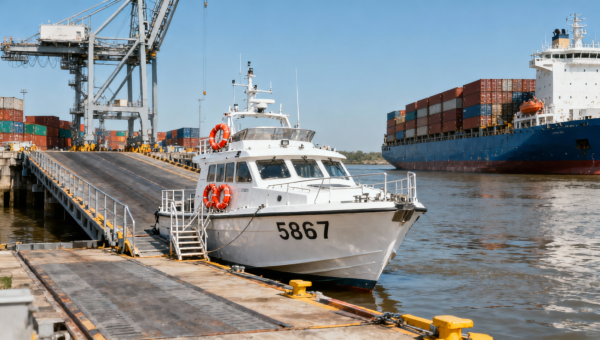
In summary, this notice redefines regulatory ownership for a narrow but operationally common activity: small-vessel personnel movement tied to commercial maritime infrastructure. Its significance lies less in introducing novel obligations and more in eliminating ambiguity—making compliance non-negotiable for any entity using watercraft to support Ro-Ro, port engineering, or export logistics. It is currently most appropriately understood as a procedural milestone confirming where responsibility resides, not as an immediate trigger for broad regulatory overhaul.
Source: Ministry of Transport of the People’s Republic of China, official notice issued April 20, 2026.
Note: Implementation guidelines, local interpretations, and enforcement thresholds remain subject to ongoing observation.
Trending News
- How to choose a military truck for off-road transport
- Cummins Expects EPA to Finalize Heavy-Duty Truck NOx Rule in December
- How to choose the right bulk cement trailer capacity
- China Truckmakers' Third-Quarter Results Diverge as Exports Offset Weak Domestic Demand
- How to check if truck spare parts are compatible with your vehicle
Tag
Recommended News
 Policy & RegulationsCummins Expects EPA to Finalize Heavy-Duty Truck NOx Rule in DecemberCummins expects the EPA heavy-duty truck NOx rule in December 2026. Discover what the tight timeline could mean for truck demand and engine sales.
 Policy & RegulationsBeijing-Tianjin-Hebei Region Explores Heavy-Duty New Energy Truck DemonstrationHeavy-duty new energy trucks could reshape transport in the Beijing-Tianjin-Hebei region. Explore the opportunities and challenges behind wider adoption.
 Policy & RegulationsFMCSA Announces Up to $7 Million for Heavy-Truck Safety ResearchFMCSA offers up to $7 million for heavy-truck safety research. Discover who can apply, the deadline, and what the findings could mean for operators.
 Policy & RegulationsUS Imposes 25% Tariff on Imported Medium- and Heavy-Duty Trucks and BusesUS truck and bus tariffs add 25% to eligible imports. Explore USMCA exemptions and potential impacts on commercial vehicle costs and sourcing.
 Policy & RegulationsGhana Transport Operators Threaten November 1 Strike Over Traffic EnforcementGhana transport operators threaten a November 1 strike over TraffiTech-GH enforcement. Discover what the dispute could mean for passengers and freight.
 Policy & RegulationsBeijing Plan Targets Large-Scale Hydrogen Heavy-Truck DeploymentBeijing's hydrogen heavy-duty truck plan signals opportunities for fleets and suppliers. Explore potential impacts on freight, procurement and fueling infrastructure.
 Policy & RegulationsHow axle load limits affect low bed trailer exports to Southeast AsiaPlanning low bed trailer export to Southeast Asia? Learn how axle load limits affect legal payload, axle layouts, and route compliance to avoid costly mistakes before ordering.
 Policy & RegulationsGermany Ends EV Subsidy ExtensionGermany ends EV subsidy extension, reshaping EV and commercial vehicle plans in Europe. See how importers, distributors, and Chinese NEV suppliers should respond.
 Policy & RegulationsEU Rule Sets LCA Certification for Truck ImportsEU Rule Sets LCA Certification for Truck Imports: learn how the new EU LCA and EPD compliance rule will affect truck approvals, export timelines, costs, and delivery planning.
 Policy & RegulationsEU Requires LCA Reports for Imported HDVs from Oct 2026EU LCA reports for imported HDVs become mandatory from Oct 2026. Learn how the new EU heavy-duty vehicle carbon compliance rule affects exporters, suppliers, costs, and delivery readiness.
 Policy & RegulationsChina Tightens Export Filing for New Energy Heavy TrucksChina Tightens Export Filing for New Energy Heavy Trucks: learn how new HS code rules and CNAS carbon-footprint reports may impact customs clearance, compliance, and delivery timelines.
 Policy & RegulationsEU Updates CO2 Rules for Heavy-Duty Vehicle ApprovalEU Updates CO2 Rules for Heavy-Duty Vehicle Approval: learn how new lifecycle carbon and battery due diligence requirements affect EU market access, approval timing, and compliance costs.
 Policy & RegulationsChina Customs Adds New Export Fields for Road Transport EquipmentChina Customs adds new export fields for road transport equipment from Aug 15, 2026. Learn how drive type and certification data may affect compliance, clearance speed, and export planning.
 Policy & RegulationsEU Tightens Truck WVTA Brake and Lighting TestsEU Tightens Truck WVTA Brake and Lighting Tests: learn how Regulation (EU) 2026/1387 reshapes brake response, headlamp compliance, certification timing, and EU market access.
 Policy & RegulationsEU Sets CO2 Rules for New Heavy Trucks from 2027EU Sets CO2 Rules for New Heavy Trucks from 2027: learn how new EU CO2 limits, OBD, and remote data upload requirements could reshape type approval, costs, and delivery planning.
 Policy & RegulationsEU Brings Forward Cybersecurity Approval for Heavy TrucksEU heavy truck cybersecurity approval moves to August 1, 2026. Learn how WVTA, UNECE R155, OTA and telematics rules will impact EU exports, type approval and delivery plans.
 Policy & RegulationsEU Moves Truck Cybersecurity WVTA Forward to Aug 1, 2026EU truck cybersecurity WVTA moves to Aug 1, 2026. Learn how UN R155 and EU 2022/1426 affect heavy truck type approval, exports, suppliers, and compliance planning.
 Policy & RegulationsEU Brings Forward WVTA Cybersecurity Approval for TrucksEU Brings Forward WVTA Cybersecurity Approval for Trucks: learn how the 2026 deadline impacts heavy truck exports, retrofit projects, supplier compliance, costs, and EU market-entry planning.
 Policy & RegulationsEU Brings Forward WVTA Cybersecurity Approval for Heavy TrucksEU heavy truck WVTA cybersecurity approval now starts on August 1, 2026. Learn how EU type approval, CSMS audits, ADAS, OTA, and registration risks affect exporters and manufacturers.
 Policy & RegulationsEU Cybersecurity Approval Rule Takes Effect for Heavy TrucksEU Cybersecurity Approval Rule now reshapes heavy trucks market access. Learn how CSMS, UNECE R155, and WVTA deadlines could impact certification, delivery, and EU export readiness.
 Policy & RegulationsEU Requires EN 15038 Declarations for Truck ImportsEU Requires EN 15038 Declarations for Truck Imports: learn how the new EU rule affects heavy truck customs clearance, compliance timing, and export readiness.
 Policy & RegulationsEU Rule Brings SCIP Filing to Imported Truck Battery PartsSCIP filing for imported truck battery parts becomes critical in the EU from Oct 1, 2026. Learn how the rule impacts heavy-duty truck exports, aftermarket parts, and customs compliance.
 Policy & RegulationsEU REACH Expands to Truck Battery PartsEU REACH expands to truck battery parts, covering lithium-ion battery modules, BMS units, and thermal systems. Learn how SCIP filing, SVHC disclosure, and EU export compliance may affect truck suppliers.
 Policy & RegulationsEU Sets Battery Footprint Rule for Heavy TrucksEU Sets Battery Footprint Rule for Heavy Trucks: learn how the 2027 EU battery carbon footprint requirement could impact type approval, customs clearance, and truck exports.
 Policy & RegulationsEU Requires Certified V2X Modules in Heavy TrucksEU Requires Certified V2X Modules in Heavy Trucks from July 22, 2026. Learn how UN R155 and ETSI EN 303 648 rules will impact EU type approval, registration, and exports.


