How to choose a logging truck for steep and rough forest roads
Start with the road, not the payload target
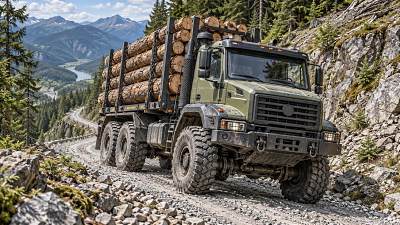
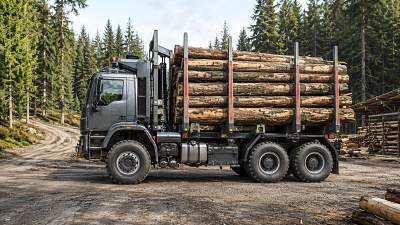
A logging truck that performs well on paved haul routes can become a costly liability on steep, rough forest roads. For procurement buyers, the first decision should be based on the worst regular section of the route: the longest sustained grade, the softest road surface, the tightest switchback, the deepest rut, and the most difficult loaded descent. Those conditions determine the truck configuration more reliably than the nominal timber volume to be moved.
For demanding forest access roads, a lower-payload configuration with adequate traction, braking reserve, clearance, and chassis durability often produces more usable output over a season than a higher-capacity truck that must reduce loads, lose time in poor weather, or suffer repeated driveline and suspension damage. The right logging truck is therefore the one that can make loaded and empty trips safely within the operating limits of the road, not simply the one with the largest advertised payload.
Buyers should begin by separating the route into three parts: the forest road, the landing or loading area, and the public-road transfer section. A truck may need different capabilities in each. The public-road portion may favor speed, fuel efficiency, and legal axle loading. The forest section may demand low-speed torque, axle articulation, durable tires, and reliable engine braking. The loading area may expose the truck to side slopes, unstable ground, sharp debris, and repeated short maneuvers under heavy load.
If the forest-road portion is short but severe, it can still dictate the specification. A few difficult kilometers can govern the safe operating weight, tire choice, drive layout, and required braking performance for the entire vehicle.
Choose the axle and drive configuration for traction and stability
Axle configuration is one of the most consequential decisions in a logging truck purchase. There is no universal best layout because the correct answer depends on road gradient, surface consistency, legal weight limits, turning space, and the truck's expected share of paved-road running.
For routes with persistent mud, loose aggregate, snow, deep ruts, or steep climbs, buyers should give serious weight to multi-axle drive configurations. More driven axles can improve traction and reduce the likelihood that a loaded truck stops on a grade because one axle has lost grip. They can also distribute load more effectively on soft surfaces. The trade-off is increased purchase cost, added weight, more driveline components, potentially higher fuel consumption, and a more demanding maintenance program.
A 6x4 may be suitable where forest roads are regularly maintained, grades are moderate, and the truck spends substantial time on hard-surface roads. It can offer a useful balance of payload, operating cost, and drivability. On steep and rough roads, however, a 6x4 should not be selected simply because it is common in regional fleet operations. Its suitability depends on whether the rear drive axles can maintain contact and traction when the truck is loaded, articulated over uneven ground, or climbing after rain.
Where poor traction is a routine operating condition, a 6x6 or 8x8 configuration may justify its additional cost. Buyers should assess this against actual route exposure rather than assuming that all-wheel drive solves every forest-road problem. More drive axles do not compensate for poor tire selection, insufficient ground clearance, overloaded axles, weak braking discipline, or an unsuitable trailer.
Steering axle count also matters. Long logging combinations operating on narrow roads and switchbacks need a configuration that can turn without excessive tire scrub, road damage, or repeated reversing. A truck that reaches the loading point only after multiple maneuvers will lose productivity and face more exposure to soft shoulders and unstable edges. Suppliers should be asked for turning-circle data for the complete truck-and-trailer combination, not only for the truck chassis.
- Specify the maximum expected grade for both loaded ascent and loaded descent.
- Record whether difficult sections are loose, wet, rutted, frozen, rocky, or cross-sloped.
- Check the tightest curve and the available recovery space if a maneuver must be aborted.
- Evaluate axle loading at realistic payload, including trailer, crane, bunks, chains, and other carried equipment.
- Confirm which axles are driven, liftable, steering, or lockable in the proposed configuration.
Braking capacity matters most on the way down
Steep forest roads create a procurement risk that is often underestimated when buyers focus mainly on climbing traction. A loaded descent places continuous demand on the service brakes, engine brake or retarder, tires, driveline, and driver judgment. The relevant question is not whether the truck has an engine brake listed in its specification. It is whether the complete combination can control speed on the route's longest and steepest descent without relying excessively on friction brakes.
Engine braking performance should be evaluated together with transmission ratios, engine torque characteristics, gross combination weight, and tire diameter. A truck with strong low-speed braking capability and well-matched gear ratios allows the driver to descend under control at a stable speed. If the ratio spread is poorly suited to the route, the driver may be forced to alternate between gears or use service brakes too frequently. That raises brake temperature, shortens component life, and reduces safety margin.
Retarders can provide valuable additional braking support in some operating environments, but buyers should consider their suitability in relation to route conditions, vehicle weight, maintenance support, and local operating practice. They are not a substitute for correctly sized foundation brakes, sound brake adjustment procedures, and a trailer braking system that responds predictably on low-grip surfaces.
The trailer deserves equal scrutiny. On a downhill bend, an unstable or poorly braked trailer can dictate the behavior of the entire combination. Review the trailer axle arrangement, brake compatibility, load-sensing behavior where applicable, coupling specification, and the interaction between truck and trailer under partial loads. Logging work rarely produces perfectly uniform loads; a configuration that remains stable when the load position changes is more valuable than one optimized only for an ideal loading pattern.
Procurement specifications should require suppliers to explain the intended downhill control strategy at the proposed gross combination weight. That conversation will reveal whether the configuration has been selected for the actual route or assembled from standard components with limited consideration of forestry duty.
Buy torque and gearing as a system
High engine output alone does not guarantee good performance on forest roads. A logging truck needs usable torque at low vehicle speeds, gearing that keeps the engine in its effective operating range, and a driveline able to tolerate repeated starts on grades. The most demanding moments are often not steady climbs. They are restart situations after slowing for a rut, a washout, an oncoming vehicle, or a tight corner.
A truck with ample peak horsepower but unsuitable axle ratios may feel strong on open roads while struggling to move a loaded combination smoothly at low speed. Conversely, an engine with moderate rated output can perform effectively when matched to a transmission and final-drive ratio designed for sustained heavy haulage at low speeds.
Automated manual transmissions can reduce driver workload and offer consistent shifting, but they should be assessed for forestry-specific calibration. Shift strategy, clutch protection, creep behavior, hill-hold function, and manual override capability affect performance in rough terrain. A transmission that shifts smoothly on a highway may hesitate, search for gears, or overprotect the clutch during repeated low-speed starts on a steep track.
Ask the supplier to provide the proposed engine, transmission, transfer case if fitted, axle ratio, and tire size as one complete driveline package. It is useful to review predicted road speeds at the route's expected working weights and gradients. A supplier that cannot discuss the relationship between gearing, gradeability, and loaded restart performance may be offering a general heavy-haul specification rather than a forestry-ready truck.
Chassis strength is more than frame thickness
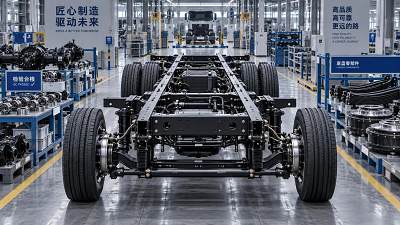
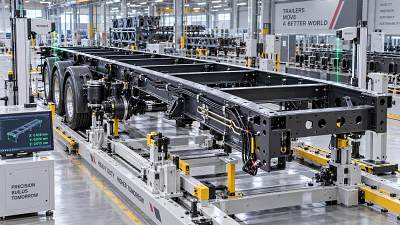
Rough forest roads subject a logging truck to twisting loads that are very different from long-distance road transport. Frame rails, crossmembers, suspension mounts, cab mounts, body supports, bunks, hydraulic lines, electrical connectors, and exhaust components may all experience repeated shock and articulation. A heavy-looking chassis is not automatically durable if its equipment mounting, suspension travel, and load body integration are poorly matched.
Buyers should examine the truck as a working platform, including the timber body or bolsters, headboard, load-securing arrangement, trailer connection, and crane installation where relevant. Equipment installed after the truck leaves the factory can materially change axle loads, center of gravity, torsional behavior, service access, and warranty responsibility. The chassis supplier and body builder should have a clear, documented division of responsibility.
Suspension selection involves a practical compromise. Mechanical suspension can offer durability and predictable behavior in severe conditions, while air suspension may improve ride quality and load handling in certain applications. The correct choice depends on expected terrain, body type, load stability needs, and the operator's ability to maintain the system. Rather than treating one suspension type as categorically superior, procurement teams should evaluate ground clearance, articulation, component protection, replacement-part availability, and performance when the truck is unevenly loaded.
Ground clearance should be checked at vulnerable points rather than quoted as a single headline figure. Consider differential housings, fuel tanks, air reservoirs, step assemblies, exhaust routing, hydraulic tanks, and wiring runs. On rocky roads, exposed components create avoidable downtime even when the axle and frame themselves are robust.
Tires and load restraint are operating decisions, not accessories
Tire selection is closely tied to safety, route availability, and operating cost. A tire designed primarily for paved-road fuel economy may offer limited traction and cut resistance on sharp aggregate, exposed roots, and broken ground. A more aggressive forestry-oriented tire may improve grip and durability but can bring higher rolling resistance, road wear, noise, and reduced performance on long highway transfers.
The practical selection should reflect the percentage of travel on forest roads, the seasonality of the operation, the probability of mud or snow, and the cost of a road closure or recovery event. Tire load rating must match actual axle loads, including dynamic loading on uneven terrain. Sidewall protection, tread pattern, casing suitability for retreading, and access to replacements in the operating region all deserve attention.
Timber restraint should be reviewed with the same care as traction equipment. The load can shift when a truck crosses ruts, leans into a side slope, or brakes on a descent. Bunks, stakes, chains or straps, tensioning equipment, and headboard design should suit the length, diameter variation, and surface condition of the logs carried. A procurement specification that assumes consistent log dimensions may overlook the load-security challenges created by mixed harvests.
Compare suppliers on support for the complete operating cycle
The lowest acquisition price can be misleading in remote forestry work. Downtime may involve more than a repair invoice: a disabled truck can block a narrow road, interrupt loading operations, delay contracted deliveries, and require specialized recovery. For that reason, supplier evaluation should focus on the ability to support the truck where it works, not only on the completeness of the quotation.
Ask prospective suppliers which high-wear and high-risk parts are normally available through their service network: brake components, driveline parts, suspension bushes, wheel-end components, filters, sensors, hoses, lights, and body-related hardware. Confirm whether diagnostic equipment, trained technicians, and roadside support are accessible within the operating region. For cross-border or remote-area procurement, clarify lead times, warranty handling, parts identification, technical documentation, and whether the body builder can support its own equipment independently of the chassis supplier.
It is also sensible to compare maintenance access. A truck designed for harsh duty should allow technicians to inspect driveline joints, brake hardware, filters, reservoirs, electrical connections, and lubrication points without excessive dismantling. Small differences in accessibility become significant when inspections are frequent and work is conducted away from a full workshop.
A practical way to make the final decision
Before requesting final quotations, prepare a route-based operating sheet rather than a generic truck specification. Include expected gross weights, annual operating period, paved-road distance, maximum grades, typical road surface, turning constraints, weather exposure, loading method, trailer type, and available maintenance resources. Give each supplier the same operating sheet and require a complete proposed configuration.
Then compare offers against the difficult conditions first: loaded restart on a grade, controlled descent, clearance over ruts, turning at the tightest switchback, stability on side slopes, and parts support after a breakdown. Payload and purchase price remain important, but they should be assessed after the truck has demonstrated that it is structurally and mechanically suited to the road.
A well-chosen logging truck does not eliminate the need for road maintenance, load control, and disciplined operation. It does, however, give the fleet a larger safety and reliability margin when those conditions become less predictable. On steep and rough forest roads, that margin is often the difference between a productive haul cycle and an operation governed by recoveries, repairs, and avoidable delays.
Trending News
- When does a light commercial vehicle for urban delivery save fleet costs?
- How to choose an off road truck for steep and unstable job sites
- How to match crane truck lifting capacity to your jobsite loads
- What drives logging truck cost beyond the base purchase price?
- How to match lowbed trailer deck height to your hauling equipment
Tag
Recommended News
 Buying GuideHow to choose an off road truck for steep and unstable job sitesChoose the right off road truck for steep, unstable job sites. Compare traction, braking, stability, clearance, payload, and route-test essentials.
 Buying GuideHow to match crane truck lifting capacity to your jobsite loadsCrane truck capacity planning made clear: calculate gross load, radius, rigging, outriggers, and ground conditions to select safer, job-ready lifting equipment.
 Buying GuideHow to match lowbed trailer deck height to your hauling equipmentLowbed trailer deck height guide: match equipment clearance, ramp geometry, axle loads, tractor fit, and route limits for safer, more efficient hauling.
 Buying GuideWhat to verify before choosing a delivery truck supplier for school transportationDelivery truck supplier for school transportation: verify route fit, payload, safety, compliance, service support, and total cost before choosing a reliable partner.
 Buying GuideWhat an excavator manufacturer catalog should show before you compare modelsExcavator manufacturer catalog guide: verify supplier identity, configurations, hydraulics, compliance, parts support, and delivery readiness before comparing models.
 Buying GuideWhat to check before appointing a bulldozer distributorBulldozer distributor selection guide: evaluate service, parts availability, warranty, pricing, compliance, and lifecycle value to reduce downtime and protect fleet investment.
 Buying GuideWhat to verify before choosing a truck cement mixer supplierTruck cement mixer supplier checklist: verify chassis fit, drum quality, hydraulics, compliance, spare parts, and after-sales support before you buy.
 Buying GuideHow to verify a truck spare parts supplier before placing a bulk orderTruck spare parts supplier verification made practical: learn how to check part specifications, factory control, test records, samples, pricing, and delivery capability before placing a bulk order.
 Buying GuideWhat size truck container is right for a typical freight load?Truck container sizing made simple: compare payload, volume, pallet layouts, route access, and loading needs to choose the most efficient freight solution.
 Buying GuideWhat drives semi trailer price differences between similar models?Semi trailer price differences come down to frame materials, axles, suspension, coating, and configuration. Compare specifications line by line to choose lasting value.
 Buying GuideHow to compare excavator manufacturer price lists before requesting quotesCompare an excavator manufacturer price list with confidence. Learn to normalize configurations, calculate landed costs, assess options and service, and create stronger RFQs.
 Buying GuideHow to choose a mixer truck drum capacity for your concrete pourMixer truck capacity guide: match drum size to pour rate, legal payload, site access, and delivery cycles for efficient, reliable concrete placement.
 Buying GuideHow to size a bulldozer for construction site grading workBulldozer for construction sizing guide: match weight, blade, traction, grade control, and transport needs to improve grading productivity and costs.
 Buying GuideHow to assess a truck cement manufacturer’s build quality before orderingTruck cement manufacturer build quality: assess tank steel, welding, chassis integration, pneumatic systems, factory QC, and inspection evidence before ordering.
 Buying GuideWhen does a truck trailer OEM make sense for private-label fleets?Truck trailer OEM programs help private-label fleets cut lifecycle costs, standardize operations, and improve uptime. Learn when customization delivers real commercial value.
 Buying GuideWhat to verify before choosing a water truck OEM for your fleetWater truck OEM selection guide: verify chassis compatibility, tank quality, pump performance, compliance, and service support to build a safer, more reliable fleet.
 Buying GuideHow to size a cab chassis truck for a fire department apparatusCab chassis truck for fire department sizing guide: balance GVWR, axle loads, wheelbase, water tank placement, and mission needs for safer apparatus design.
 Buying GuideWhat to verify before choosing a truck chassis supplierChoose the right truck chassis supplier with a practical checklist for application fit, axle ratings, body integration, quality control, delivery reliability, and after-sales support.
 Buying GuideHow to choose a logging truck for steep and rough forest roadsLogging truck selection for steep, rough forest roads: compare traction, braking, gearing, chassis strength, tires, and supplier support for safer, more reliable hauling.
 Buying GuideHow to choose a flatbed trailer deck length for oversized loadsFlatbed trailer deck length guide for oversized loads: balance cargo support, axle weight, securement space, overhang, and route access for safer transport.
 Buying GuideHow to assess a truck chassis supplier for trailer manufacturingTruck chassis supplier for trailer manufacturing: learn how to assess technical fit, quality control, engineering support, and delivery reliability for smarter sourcing.
 Buying GuideIs the SHACMAN H3000 6×4 Cement Mixer suitable for large projects?SHACMAN H3000 6×4 Cement Mixer: assess payload, cycle time, traction, and service support to see if it can keep large concrete projects moving efficiently.
 Buying GuideHow to evaluate heavy duty trucks for sale in Russia before buyingHeavy duty trucks for sale in Russia: learn how to compare specifications, winter readiness, service support, supplier reliability, and total ownership costs before buying.
 Buying GuideWhat to verify before choosing a logging truck producerChoose a logging truck producer with confidence: verify chassis strength, load security, compliance, service support, and delivery control for demanding forestry routes.
 Buying GuideHow to choose a truck excavator for confined construction sitesTruck excavator selection for confined sites: explore access, reach, stability, attachments, and safety factors to choose a productive, space-efficient solution.